Highlights
- Implementation of 2016 Australian infant feeding guidelines recommending earlier allergenic food introduction has led to measurable population-level reductions in childhood food allergy, particularly peanut and cashew allergies.
- Egg allergy prevalence has decreased following similar guideline updates promoting earlier egg introduction, especially in infants with early eczema.
- Despite widespread early allergen introduction, food allergy prevalence remains high, implicating phenotypic and genetic subgroups less amenable to prevention by feeding strategies alone.
- Early exposure to cow’s milk protein within the first 3 months is also associated with decreased milk allergy, supporting early dietary exposure’s role in immune tolerance development.
Background
Food allergy represents a significant, growing public health concern worldwide, with an estimated 3-6% prevalence in children globally and substantial impacts on quality of life and healthcare costs. Historically, infant feeding guidelines advised delaying introduction of allergenic foods to prevent allergy development. However, emerging evidence from landmark randomized controlled trials since the early 2010s, notably the LEAP trial for peanut allergy, challenged this paradigm, demonstrating that early introduction of allergenic foods reduces the risk of food allergy development. Consequently, many national and international guidelines, including Australia’s in 2016, have shifted recommendations to encourage introduction of common allergens such as peanut and egg within the first year of life. Evaluating the real-world impact of these guideline changes is vital to inform clinical practice and policy.Key Content
Chronology and Impact of Australian Infant Feeding Guideline Changes
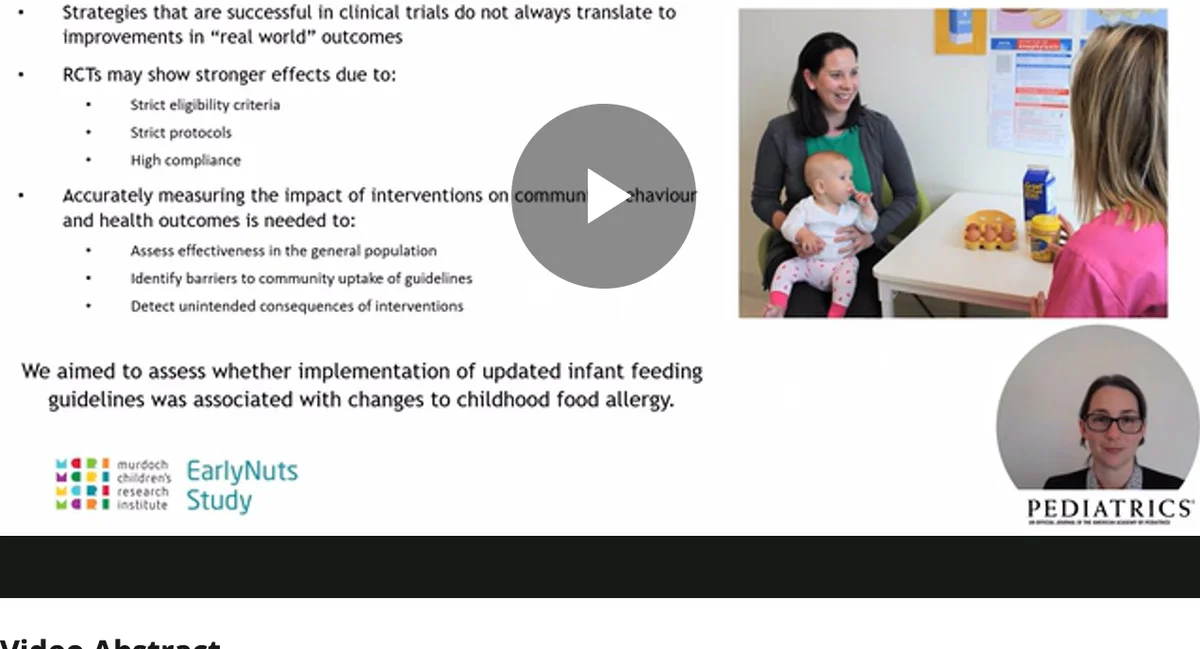
The Australian guidelines updated in 2016 recommended the introduction of allergenic foods within the first year, with particular emphasis on peanut and egg, to prevent allergy development. Two major population-based cohort studies in Melbourne, Australia, provide compelling epidemiological evidence evaluating this shift. The HealthNuts study (2007–2011 cohort, n=5276 infants) was followed by a replicate EarlyNuts cohort (2018–2019, n=1933 infants), both with longitudinal follow-up including questionnaires, skin prick testing (SPT), and oral food challenges at age 6 years and 12 months respectively.Changes in Food Allergy Prevalence at Age 6 Years
Peters et al. (2026) analyzed data from children at 6 years of age, before and after guideline implementation. After adjusting for demographic and allergy risk factors and accounting for missing data via multiple imputation (n=7209), food allergy prevalence decreased by an absolute 2.0% (95% CI, -3.4% to -0.6%, P=.005) and a relative 31% reduction (95% CI, -50% to -11%, P=.002). Complete-case analysis corroborated these findings with a relative reduction of 37%. Notably, reductions were predominantly driven by peanut and cashew allergies, while milk and egg allergy prevalence remained relatively stable in this age group.Egg Allergy and Early Introduction
In line with the 2016 guideline emphasis on early egg introduction, a separate cross-sectional study (Birch et al., 2026) compared egg allergy prevalence in infants aged 11-15 months before and after guideline changes. The median age of egg introduction decreased from 8 to 6 months, with egg allergy prevalence decreasing from 9.2% to 7.6% (adjusted absolute difference, -1.6%). The decline was more pronounced among infants with early eczema (34.6% to 21.9%), confirming that earlier egg introduction translates to reduced egg allergy risk, especially in those at higher risk.Peanut Allergy Trends and Ethnic Considerations
Research by Koplin et al. (2022) and subsequent follow-ups confirmed that early peanut introduction increased substantially post-guideline (from 28% to over 88% by 12 months). Despite this, population-level peanut allergy prevalence did not demonstrate a significant decline overall—2.6% vs. 3.1%. Importantly, the protective effect of early peanut introduction was significant in infants of Australian ancestry but attenuated in those of East Asian ancestry, highlighting gene-environment interactions and the need for targeted prevention strategies.Cashew Allergy: Emerging Insights
Cashew allergy, a major tree nut allergen in Australia, was studied in the EarlyNuts cohort by Koplin et al. (2023). The prevalence of cashew allergy at 12 months was approximately 1.5%. Despite early introduction, no association was found between timing of cashew introduction and allergy development, though eczema and coexisting peanut allergy increased cashew allergy risk. Notably, less than 30% of infants had cashew introduced before 12 months, suggesting that earlier introduction of all allergens is yet incomplete in practice.Early Cow’s Milk Protein Exposure
Contrasting prior delayed introduction strategies, early exposure to cow’s milk protein (within the first 3 months) is associated with reduced cow’s milk sensitization and allergy at 12 months (Perkins et al., 2019). This effect persists despite concomitant breastfeeding and appears specific to milk allergy without altering risk for other food allergies. This observational evidence supports immunologic tolerance mechanisms through early oral antigen exposure.Breastfeeding, Formula Use, and Food Allergy Risk
Data from a large Australian cohort (Koplin et al., 2016) demonstrated no association between exclusive breastfeeding duration or use of partially hydrolyzed formula and the risk of food allergy at 12 months. These findings challenge previous assumptions and support focusing prevention efforts on allergen introduction timing rather than infant feeding modality.Other Epidemiological Considerations
A UK birth cohort (Fisher et al., 2016) demonstrated that food hypersensitivity phenotypes (IgE-mediated and non-IgE-mediated) may have distinct predictors, including eczema, maternal atopy, and age of solid food introduction. These differing phenotypes reflect complex immunological and environmental interactions influencing allergy development.Expert Commentary
The cumulative evidence robustly supports a paradigm shift—from allergen avoidance to proactive early allergen introduction during infancy—as an effective public health strategy to reduce food allergy prevalence, particularly for peanut and egg. The significant reduction in peanut and cashew allergies after guideline implementation corroborates findings from controlled trials and mechanistically aligns with the development of oral tolerance through early antigen exposure during a critical immunologic window. However, complexities remain. The persistent high prevalence of food allergy despite early introduction signifies subpopulations with genetic predispositions, such as infants of East Asian ancestry or those with severe early eczema, who may require adjunct or alternative preventive interventions beyond feeding guidelines alone. Moreover, delayed or incomplete introduction of some allergens, like cashew, reflects barriers in translating guidelines into practice. Mechanistically, early oral antigen exposure likely promotes regulatory T cell induction and immune tolerance pathways. Contrastingly, sensitization may occur through alternate routes such as disrupted skin barrier in eczema, emphasizing the importance of eczema management in prevention strategies. Limitations across studies include observational designs vulnerable to confounding, potential participation bias, and varying follow-up durations. Nonetheless, population-based studies with rigorous food challenge confirmation strengthen causal inference. Future research directions include interventions targeting high-risk phenotypes, elucidation of gene-environment interactions, and assessment of long-term outcomes.Conclusion
The transition in infant feeding guidelines towards earlier allergenic food introduction since 2016 in Australia has translated to meaningful reductions in childhood food allergy at the population level—most notably for peanut and cashew allergies—with emerging evidence supporting similar benefits for egg and cow’s milk allergies. Despite these advances, food allergy prevalence remains considerable, underscoring the need for continued research into mechanisms underlying refractory phenotypes and implementation science to enhance guideline adherence. Clinicians should actively encourage timely introduction of allergenic foods as part of comprehensive allergy prevention strategies, particularly in infants without contraindications. Tailored approaches may be necessary for high-risk groups identified by ancestry, eczema status, or other factors.References
- Peters RL et al. Changes in Childhood Food Allergy Following Implementation of Infant Feeding Guidelines. Pediatrics. 2026; e2026077960. PMID: 43039025.
- Birch J et al. Egg Allergy Prevalence Before and After Guidelines for Earlier Egg Introduction. JAMA Pediatr. 2026;180(9):1015-1023. PMID: 42258202.
- Koplin JJ et al. Earlier ingestion of peanut after changes to infant feeding guidelines: The EarlyNuts study. J Allergy Clin Immunol. 2019;144(5):1327-1335.e5. PMID: 31401287.
- Koplin JJ et al. Association Between Earlier Introduction of Peanut and Prevalence of Peanut Allergy in Infants in Australia. JAMA. 2022;328(1):48-56. PMID: 35788795.
- Koplin JJ et al. Cashew Allergy Prevalence and Sensitization in 1-Year-Old Infants. J Allergy Clin Immunol Pract. 2023;11(11):3478-3484.e5. PMID: 37481112.
- Perkins C et al. Early Exposure to Cow’s Milk Protein Is Associated with a Reduced Risk of Cow’s Milk Allergic Outcomes. J Allergy Clin Immunol Pract. 2019;7(2):462-470.e1. PMID: 30267891.
- Koplin JJ et al. Formula and breast feeding in infant food allergy: A population-based study. J Paediatr Child Health. 2016;52(4):377-384. PMID: 27145499.
- Fisher HR et al. Incidence and risk factors for food hypersensitivity in UK infants: results from a birth cohort study. Clin Transl Allergy. 2016;6(1):1. PMID: 26816616.
- Tey D et al. Increased risk of peanut allergy in infants of Asian-born parents compared to those of Australian-born parents. Allergy. 2014;69(12):1639-1647. PMID: 25041549.
- Du Toit G et al. Randomized Trial of Peanut Consumption in Infants at Risk for Peanut Allergy. N Engl J Med. 2015;372(9):803-813. PMID: 25617769.
Specialty calculators
For clinical reference; use professional judgment.