Highlight
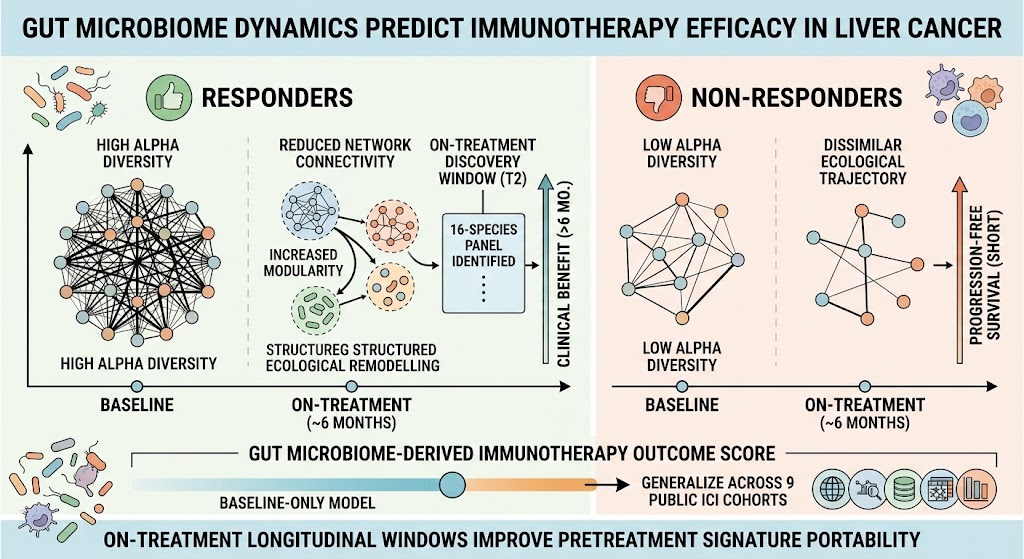
This comprehensive study of 315 patients with advanced primary liver cancer undergoing immune checkpoint inhibitor (ICI) therapy demonstrated that the gut microbiome undergoes significant ecological remodeling during treatment. Key microbial features identified at approximately six months on therapy allowed improved prediction of clinical benefit and overall survival compared with baseline-only assessments. The findings emphasize the potential for longitudinal microbiome monitoring to stratify patients effectively and guide immuno-oncology interventions.
Study Background
Primary liver cancer ranks among the leading causes of cancer-related mortality globally, with hepatocellular carcinoma (HCC) being the predominant histologic subtype. Immunotherapy with ICIs targeting PD-1/PD-L1 pathways has improved outcomes but exhibits variable efficacy, with only a subset of patients experiencing durable clinical benefit. The gut microbiome has been implicated as a critical modulator of host immune responses, potentially influencing ICI effectiveness. However, prior studies have principally focused on baseline microbiome signatures, leaving the temporal microbial dynamics during therapy largely unexplored. Understanding these longitudinal changes could refine biomarker identification and patient stratification strategies.
Study Design
In this large prospective longitudinal study, 315 patients with advanced primary liver cancer receiving ICI-based therapy were enrolled. Stool samples were collected serially—at baseline and approximately every three months during treatment—yielding 777 metagenomic samples profiled with shotgun sequencing. Responders were defined by durable clinical benefit lasting six months or more, with extended follow-up beyond 18 months for this group. The study leveraged an on-treatment window centered around six months (designated T2) for microbial feature discovery, which was then validated across nine publicly available ICI cohorts (totaling 1,204 patients) to assess generalizability.
Key Findings
Baseline Microbiome Characteristics and Response
At baseline, responders exhibited significantly higher alpha diversity — a measure of microbial richness and evenness — and a distinct community composition compared to nonresponders. These features align with previous observations linking microbial diversity to favorable ICI outcomes.
Longitudinal Microbial Dynamics During Therapy
Serial profiling revealed marked ecological remodeling in the gut microbiome during ICI treatment across both responders and nonresponders. Notably, there was a reduction in microbial network connectivity and an increase in modularity, indicating a shift toward more compartmentalized microbial communities. Species contributing to discrimination between clinical outcomes showed strong time-point specificity, suggesting dynamic microbial succession influenced by therapy and host immune status.
Microbial Signature Discovery and Validation
Using the on-treatment microbiome snapshot at approximately six months (T2), researchers identified a panel of 16 bacterial species associated with clinical benefit. When this panel was applied to baseline samples, a predictive model was constructed that outperformed models trained on baseline-only data discovered without longitudinal context. Importantly, this model generalized well across nine independent ICI cohorts spanning various cancer types and geographies.
Clinical Utility of the Immunotherapy Outcome Score
The model-derived “gut microbiome-derived immunotherapy outcome score” effectively stratified patients by overall survival (hazard ratio [HR] ~0.49) and progression-free survival (HR ~0.44) not only in the discovery cohort but also in external validation datasets. Remarkably, this score also discriminated patients categorized with stable disease, a group traditionally challenging to stratify for prognosis.
Expert Commentary
This study significantly advances our understanding of the gut microbiome’s role in modulating ICI responses in liver cancer and potentially other malignancies. By emphasizing longitudinal microbial dynamics rather than static baseline snapshots, the authors highlight important temporal complexity that may reflect treatment-driven immune-microbiome interactions. The use of shotgun metagenomics provides high-resolution taxonomic identification, strengthening the biological plausibility of the identified microbial signatures.
However, several limitations warrant consideration. The cohort was restricted to advanced liver cancer patients predominantly treated with ICIs; its applicability to earlier-stage disease or combination regimens remains to be explored. Additionally, while predictive modeling was robust across cohorts, further mechanistic studies are needed to delineate causality and functionality of these microbial taxa. Integration with host immune profiling and metabolomics could enhance understanding of underlying pathways.
These findings underscore microbiome-guided stratification as an emerging precision medicine approach in immuno-oncology. They also prompt clinical trials testing whether microbiome modulation—for instance, via probiotics, prebiotics, or fecal microbiota transplantation—can improve ICI efficacy.
Conclusion
This landmark prospective longitudinal study reveals that the gut microbiome undergoes structured and time-dependent ecological remodeling during immunotherapy in advanced primary liver cancer. Incorporating on-treatment microbial data markedly enhances prediction models for durable clinical benefit and survival outcomes beyond baseline features. These insights highlight the dynamic interplay between microbes and host immunity under treatment pressure and support the integration of longitudinal microbiome monitoring into immuno-oncology practice. Future work should focus on mechanistic validation and interventional strategies exploiting the microbiome to optimize cancer immunotherapy responses.
Funding
The study was supported by institutional grants and research funding detailed in the original publication. No clinical trial registration was noted.
References
Qian Z, Han J, Lyu B, et al. Longitudinal gut microbiome dynamics during immunotherapy identify microbial features of clinical benefit in advanced primary liver cancer. Gut. 2026 Sep 16. PMID: 42749361.
Gopalakrishnan V, Spencer CN, Nezi L, et al. Gut microbiome modulates response to anti–PD-1 immunotherapy in melanoma patients. Science. 2018 Jan 5;359(6371):97-103.
Matson V, Fessler J, Bao R, et al. The commensal microbiome is associated with anti-PD-1 efficacy in metastatic melanoma patients. Science. 2018 Jan 5;359(6371):104-108.
Routy B, Le Chatelier E, Derosa L, et al. Gut microbiome influences efficacy of PD-1–based immunotherapy against epithelial tumors. Science. 2018 Jan 5;359(6371):91-97.