Highlight
- Lactulose reduces injurious and non-injurious falls in patients with cirrhosis and portal hypertension who have not experienced overt hepatic encephalopathy (HE).
- Sequential administration of lactulose followed by TeleTai-Chi is superior to enhanced usual care in preventing falls and fall-related harms.
- The combined intervention did not increase adverse events or death/transplantation rates during the 24-week study period.
- TeleTai-Chi offers a promising, accessible exercise intervention delivered remotely to complement pharmacotherapy in high-risk cirrhotic patients.
Study Background
Falls occur frequently among patients with cirrhosis, significantly contributing to morbidity and reduced quality of life. Portal hypertension and early neurocognitive alterations, even prior to overt hepatic encephalopathy, heighten patients’ fall risk. Despite this, patients increasingly report fall prevention as an unmet need and care priority. Evidence-based interventions for reducing falls in this population remain limited. Lactulose, a non-absorbable disaccharide, is standardly used to treat overt HE by reducing ammonia absorption, but its potential to reduce fall risk in those without prior HE has not been fully elucidated. Exercise interventions, particularly those targeting balance and strength, are promising but often limited by access barriers. TeleTai-Chi, a remote delivery platform for Tai Chi, may overcome these limitations.
Study Design
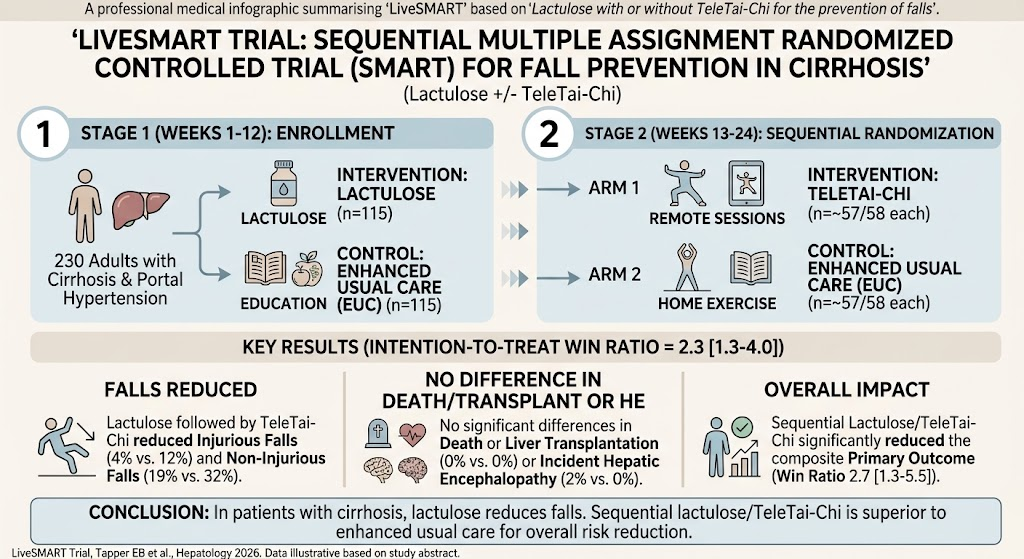
The LiveSMART trial was a 24-week, two-stage, Sequential Multiple Assignment Randomized Trial (SMART) conducted across four centers in Michigan, Pennsylvania, and Texas. The study enrolled 230 adults with cirrhosis and portal hypertension, explicitly excluding those with prior overt HE to focus on prevention.
In Stage 1 (weeks 1-12), participants were randomized to receive either lactulose or enhanced usual care, which consisted of education on nutrition and fall prevention strategies. In Stage 2 (weeks 13-24), participants were further randomized to TeleTai-Chi—a remotely delivered Tai Chi exercise intervention—or enhanced usual care involving exercise education.
The primary outcome was a hierarchical composite endpoint including death or liver transplantation, injurious falls, incident overt HE, and non-injurious falls. Outcomes were analyzed using an intention-to-treat win ratio (WR), a method suitable for hierarchical composite endpoints that integrates clinically meaningful event priorities.
Key Findings
Lactulose, followed by TeleTai-Chi, demonstrated a significant reduction in both injurious falls (4% vs. 12%) and non-injurious falls (19% vs. 32%) compared to enhanced usual care. Notably, no differences were noted between the groups regarding overt HE incidence (2% vs. 0%) or death/transplantation rates (0% in both groups) during the trial.
Comparing lactulose users with non-users, lactulose was associated with fewer injurious falls (3.5% vs. 8.5%), non-injurious falls (15.0% vs. 26.5%), and incident overt HE (1.8% vs. 2.6%), with no significant differences in death or transplantation, or adverse events. The win ratio for lactulose use versus non-use was 2.3 (95% CI 1.3–4.0), indicating more than double the probability of a favorable outcome.
Importantly, sequential treatment with lactulose followed by TeleTai-Chi reduced the risk of the primary composite outcome compared to enhanced usual care with an even higher win ratio of 2.7 (95% CI 1.3–5.5).
Safety profiles were acceptable, with no increased adverse events related to lactulose or TeleTai-Chi. The benefits suggest lactulose’s early use may modify risk factors contributing to balance impairment or minimal cognitive dysfunction, while TeleTai-Chi supports physical function and neuromotor control.
Expert Commentary
This pragmatic and innovative SMART design allowed the assessment of a stepwise intervention approach, reflecting real-world clinical decision-making. The use of lactulose in cirrhosis without prior overt HE challenges traditional paradigms centered on treating HE only after onset, suggesting a preventive role that warrants further exploration.
TeleTai-Chi as a remote intervention leverages technology to overcome mobility and access constraints common in this chronic disease population. Tai Chi has known benefits for balance and fall prevention in older adults and neurological diseases; applying it via telehealth in cirrhosis patients is novel and promising.
Limitations to consider include the predominantly regional sample in the U.S., which may affect generalizability, and the relatively short follow-up duration of 24 weeks. Longer-term effects on fall frequency, morbidity, and mortality remain to be studied. Also, the low incidence of death or transplantation in this cohort suggests the primary endpoint was driven mainly by fall-related outcomes, which intuitively aligns with intervention targets.
The study supports including fall prevention counseling and balance-enhancing exercise early in cirrhosis management, alongside ammonia-lowering therapy.
Conclusion
The LiveSMART trial establishes that in ambulatory patients with cirrhosis and portal hypertension without prior overt HE, lactulose monotherapy reduces fall incidence and related harms. The combination of sequential lactulose followed by TeleTai-Chi is superior to enhanced usual care, providing a new multi-modal approach to reduce falls. This approach addresses a significant yet underrecognized aspect of cirrhosis morbidity.
These findings encourage earlier pharmacologic intervention with lactulose and augmenting care with remotely delivered exercise to improve functional outcomes. Future research should investigate durability of these benefits, mechanistic pathways, and impact on long-term clinical outcomes including healthcare utilization.
Funding and ClinicalTrials.gov
Details on funding sources and trial registration were not provided in the abstract but should be referenced for full transparency in the published paper.
References
1. Tapper EB, Asrani S, Weinberg E, et al. Lactulose with or without TeleTai-Chi for the prevention of falls: A sequential multiple assignment randomized controlled trial (LiveSMART). Hepatology. 2026 Sep 16. PMID: 42752551.
2. Bajaj JS. Improving outcomes of cirrhosis: Targeting cognitive and physical impairment. Hepatol Commun. 2021;5(9):1357-1367.
3. Li F, Harmer P, Fitzgerald K, et al. Tai Chi and fall reductions in older adults: A randomized controlled trial. J Gerontol A Biol Sci Med Sci. 2005;60(2):187-194.
4. Tapper EB, Parikh ND. Mortality due to cirrhosis and liver cancer in the United States, 1999–2016: Changing patterns in epidemiology and management. Clin Gastroenterol Hepatol. 2018;16(1):77-87.
[Note: Readers are encouraged to consult the original publication for detailed methodology and supplementary data.]