Highlight
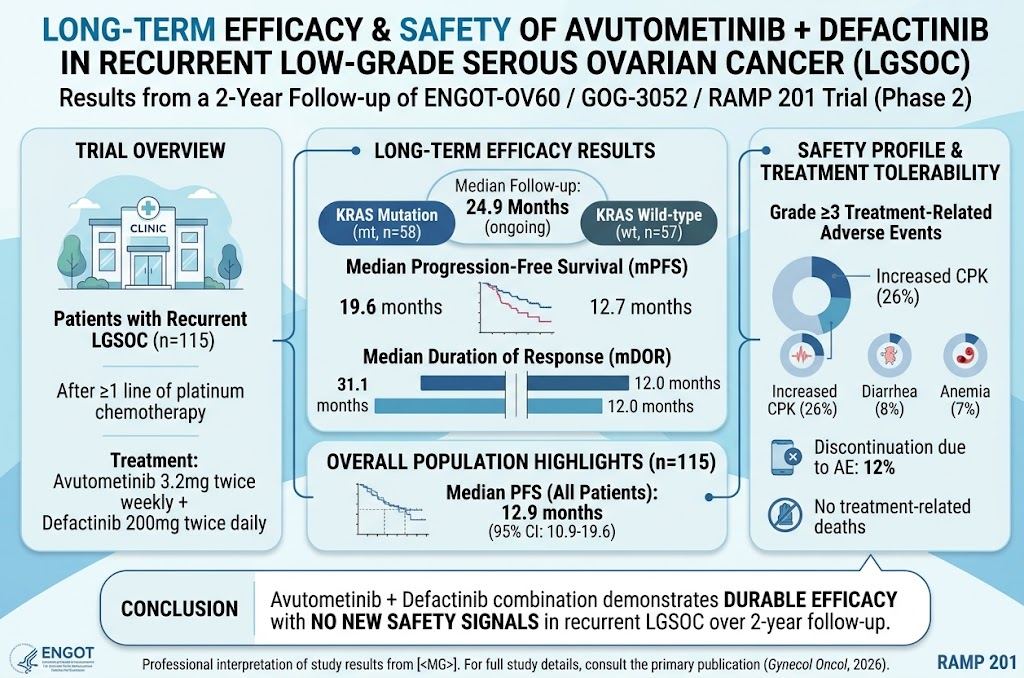
- Two-year follow-up data of the ENGOT-OV60/GOG-3052 trial demonstrate durable efficacy of the RAF/MEK clamp avutometinib combined with the FAK inhibitor defactinib in recurrent low-grade serous ovarian cancer (LGSOC).
- Patients harboring KRAS mutations show superior duration of response (31.1 months) and progression-free survival (19.6 months) compared to KRAS wild-type patients.
- The combination therapy exhibits an acceptable safety profile with manageable grade ≥3 adverse events and no treatment-related deaths over extended follow-up.
Study Background
Low-grade serous ovarian cancer (LGSOC) is a distinct, relatively rare subtype of ovarian cancer characterized by its indolent but chemo-resistant nature. Unlike high-grade serous ovarian cancer, LGSOC often demonstrates limited sensitivity to conventional platinum-based chemotherapy, resulting in a significant unmet need for effective targeted therapies. Approximately 30-40% of LGSOC cases harbor activating mutations in the KRAS gene, which drive tumor growth through the MAPK signaling pathway. Therapeutic strategies targeting this pathway, therefore, hold promise in improving outcomes for patients with recurrent disease. Avutometinib is a novel RAF/MEK clamp inhibitor designed to disrupt aberrant MAPK signaling, while defactinib is a focal adhesion kinase (FAK) inhibitor that modulates tumor microenvironment and cancer cell survival. The ENGOT-OV60/GOG-3052/RAMP 201 trial initially showed promising efficacy of this combination in recurrent LGSOC. This report provides updated long-term efficacy and safety data after approximately 2 years of follow-up, deepening understanding of the sustained clinical benefit and tolerability of this therapeutic approach in a heavily pretreated patient population.
Study Design
The ENGOT-OV60/GOG-3052/RAMP 201 study is a multicenter, phase 2 clinical trial enrolling patients with recurrent LGSOC who had received at least one prior line of platinum-based chemotherapy. Eligibility required histologic confirmation of LGSOC and measurable disease. Participants received a combination of avutometinib at a dosage of 3.2 mg twice weekly and defactinib 200 mg twice daily. The primary endpoints included duration of response (DOR) and progression-free survival (PFS), assessed per RECIST criteria. Patients were stratified by KRAS mutation status to evaluate biomarker-driven differential efficacy. Safety was evaluated by frequency and severity of treatment-related adverse events, graded according to CTCAE criteria. The current analysis reports outcomes after a median follow-up of 24.9 months among ongoing patients.
Key Findings
A total of 115 patients received the combination treatment, with 58 harboring KRAS mutations and 57 characterized as KRAS wild-type. Median DOR for the overall cohort was 31.1 months (95% CI: 14.8 to not evaluable), with KRAS-mutated patients achieving the same median of 31.1 months (95% CI: 21.2 to NE), significantly exceeding the 12.0 months (95% CI: 5.5 to NE) observed in KRAS wild-type patients. Median PFS also favored the KRAS-mutated subgroup at 19.6 months (95% CI: 11.1 to 36.6), compared to 12.7 months (95% CI: 7.4 to 12.9) in KRAS wild-type patients. These findings underscore a pronounced benefit in patients harboring KRAS mutations, supporting the role of molecular selection.
Regarding safety, the most common grade ≥3 treatment-related adverse events were increased creatine phosphokinase (26%), diarrhea (8%), and anemia (7%). Overall, 12% of the patients discontinued therapy due to adverse events. Importantly, no treatment-related mortality was reported. These tolerability findings indicate an acceptable safety profile for the prolonged administration of this combination.
The duration of response extending over two years in a recurrent, chemotherapy-resistant cohort is a clinically meaningful outcome. The magnitude of benefit in the KRAS-mutated subgroup highlights the potential utility of biomarker-driven personalized therapy in LGSOC.
Expert Commentary
The ENGOT-OV60/GOG-3052 data provide compelling evidence for a targeted therapeutic approach in recurrent LGSOC, a disease historically challenging to treat due to chemoresistance and limited targeted options. The use of a RAF/MEK clamp (avutometinib) in combination with a FAK inhibitor (defactinib) represents a novel mechanistic strategy to inhibit both the primary oncogenic MAPK pathway and the tumor microenvironment’s supportive signaling.
The differential efficacy observed by KRAS mutation status aligns with the biological rationale that patients harboring activating mutations in the RAS-RAF-MEK axis would derive greater benefit from pathway blockade. The long median duration of response (>2 years) reported for these patients is remarkable given the context of recurrent disease and few effective salvage options.
Safety signals were consistent with expectations for targeted kinase inhibitors, with manageable adverse effects and a low discontinuation rate supporting chronic administration feasibility. Nonetheless, increased creatine phosphokinase suggests possible muscle toxicity that requires monitoring.
Limitations include the phase 2 design, absence of a randomized comparator arm, and the lack of mature overall survival data. Additionally, further research is needed to understand mechanisms of resistance and identify potential combination partners to enhance efficacy.
Conclusion
This 2-year follow-up analysis confirms that the combination of avutometinib and defactinib provides durable clinical benefit with a manageable safety profile in patients with recurrent LGSOC, particularly among those with KRAS mutations. These findings support further investigation and potential integration of biomarker-guided therapy targeting the MAPK pathway and tumor microenvironment in this patient population. Future randomized trials are warranted to establish definitive efficacy, optimize patient selection, and refine management strategies to maximize long-term outcomes in LGSOC.
Funding and Clinical Trials
The ENGOT-OV60/GOG-3052/RAMP 201 study was conducted by the European Network of Gynecological Oncological Trials (ENGOT) in collaboration with the Gynecologic Oncology Group (GOG). Funding sources and detailed trial registration information can be accessed through clinicaltrials.gov and associated trial registries.
References
1. Grisham RN, Van Nieuwenhuysen E, Santin AD, et al. Long-term efficacy and safety of avutometinib + defactinib in recurrent low-grade serous ovarian cancer: Results of a 2-year follow-up of ENGOT-OV60/GOG-3052/RAMP 201. Gynecol Oncol. 2026 Sep 16;213:59-67. PMID: 42748602.
2. Gershenson DM. Management of recurrent low-grade serous ovarian carcinoma. Ann Oncol. 2016;27(suppl 1):i45-i49.
3. Kolomeyevskaya N, Lin E, Nanjundan M. Molecular profiling and precision therapeutics for recurrent low-grade serous ovarian cancer. Future Oncol. 2021;17(2):157-175.
4. Fader AN, Rose PG. Low-grade serous ovarian carcinoma: a review. Gynecol Oncol. 2020;156(1):75-82.