Highlight
– Children with severe atopic dermatitis (AD) frequently exhibit impaired growth, shown by overrepresentation in lower height percentiles at baseline.
– Dupilumab treatment leads to significant increases in linear growth, especially among children below the 40th height percentile.
– Dupilumab also elevates bone alkaline phosphatase (BALP), a biomarker of bone mineralization, over 52 weeks.
– Transitioning from placebo to dupilumab yields similar growth and bone biomarker improvements by one year.
Study Background
Atopic dermatitis is a chronic inflammatory skin condition commonly affecting children. Beyond skin manifestations, moderate to severe AD has been implicated in systemic effects, including impaired linear growth and decreased bone mineral density (BMD) in pediatric patients. Chronic inflammation and the associated cutaneous barrier dysfunction may alter nutritional status, physical activity, and systemic cytokine profiles, all impacting growth plate activity and bone remodeling processes. Existing therapies mainly target skin symptoms, but their influence on growth outcomes remains underexplored. As dupilumab, a monoclonal antibody inhibiting interleukin-4 and interleukin-13 signaling, has shown efficacy and safety in childhood AD, evaluating its potential impact on growth and bone metabolism is clinically relevant.
Study Design
This post hoc analysis focuses on children aged 6 to 11 years with severe atopic dermatitis enrolled in a phase 3 randomized, placebo-controlled clinical trial followed by an open-label extension up to 52 weeks. The initial 16-week double-blind period compared dupilumab versus placebo, succeeded by an open-label phase in which all participants received dupilumab. Key endpoints included baseline height percentile distribution, proportions of patients achieving ≥5-percentile increase in height at weeks 16 and 52, and serial measurements of bone alkaline phosphatase (BALP), a biomarker reflective of bone formation and mineralization status. The analysis particularly highlighted growth changes in children below the 40th height percentile at baseline, a subgroup more susceptible to growth impairment.
Key Findings
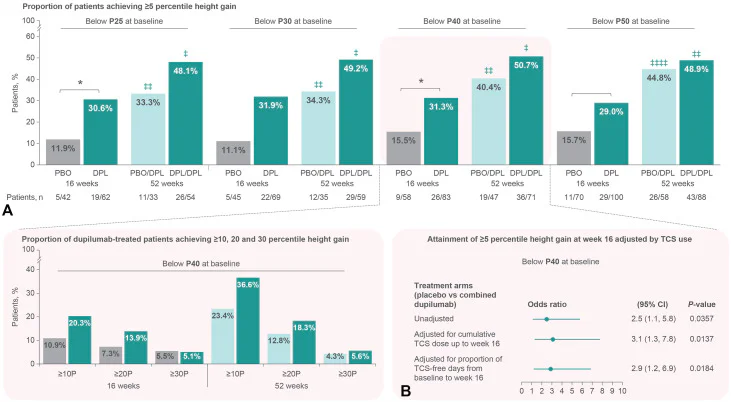
Baseline evaluation demonstrated a disproportionate number of children with severe AD in lower height percentiles, confirming growth impairment association. Among children below the 40th height percentile at baseline, 31.3% of those treated with dupilumab achieved a ≥5-percentile increase in height at 16 weeks compared to 15.5% in the placebo group (P < .05), indicating a statistically significant improvement during the controlled phase. This growth benefit was amplified at week 52, with 50.7% of these children on continuous dupilumab showing such a gain.
BALP levels, although maintained within the normal physiological range, were significantly higher at week 16 in the dupilumab group compared to placebo, consistent with enhanced bone formation activity. BALP levels continued to rise through week 52, further implying sustained bone anabolic effects of dupilumab therapy.
Participants initially assigned to placebo who transitioned to dupilumab after 16 weeks demonstrated comparable height gains and BALP increases by week 52 relative to those receiving uninterrupted dupilumab, emphasizing the treatment’s role in reversing growth impairments associated with severe AD.
No new safety signals were reported, consistent with dupilumab’s established pediatric safety profile. The study’s limitation includes the relatively short follow-up duration (1 year), leaving longer-term growth trajectories and final adult height effects uncharacterized.
Expert Commentary
These findings provide clinically meaningful insights into the systemic benefits of dupilumab beyond skin symptom control. Growth impairment in pediatric AD is multifactorial, involving chronic inflammation, nutritional deficiencies, sleep disturbances, and possible glucocorticoid exposure. By effectively mitigating type 2 inflammation through IL-4/IL-13 blockade, dupilumab may restore the physiological milieu conducive to normal bone remodeling and linear growth.
Previous observational data highlighted growth delays in children with moderate-to-severe AD; however, this post hoc trial analysis uniquely quantifies the positive impact of targeted biologic therapy on both stature and a surrogate bone health biomarker (BALP). The biological plausibility is supported by experimental studies linking type 2 cytokines to impaired osteoblast differentiation and increased osteoclast activity.
Notwithstanding the encouraging data, clinicians should interpret these findings in context. Growth outcomes are influenced by multifactorial aspects including genetics, nutrition, and comorbidities. Larger, dedicated long-term studies with direct bone density assessments and evaluation of pubertal development stages would be valuable to comprehensively understand dupilumab’s impact on skeletal maturation. Additionally, exploring whether early intervention with dupilumab can prevent or reverse bone deficits associated with severe AD warrants further research.
Conclusion
This post hoc analysis from a robust phase 3 clinical trial and its extension demonstrates that dupilumab treatment in children aged 6 to 11 years with severe atopic dermatitis is associated with significant improvements in linear growth and bone alkaline phosphatase levels over 52 weeks. These findings suggest dupilumab’s therapeutic benefits extend beyond skin clearance to potentially enhancing bone health and overall growth trajectories in pediatric patients with severe AD. Further longitudinal studies are needed to confirm long-term benefits and to integrate growth outcomes into personalized treatment strategies for this vulnerable population.
Funding and ClinicalTrials.gov
The original clinical trial was funded by Sanofi and Regeneron Pharmaceuticals, the manufacturers of dupilumab. The trial is registered at ClinicalTrials.gov under identifier NCT03345914.
References
1. Irvine AD, et al. Dupilumab treatment improves linear growth and bone biomarkers in children with atopic dermatitis: Post hoc analysis of a phase 3 randomized, placebo-controlled clinical trial and an open-label extension study. J Am Acad Dermatol. 2026 Jul 7;95(5):1324-1334. PMID: 42413781.
2. Silverberg JI, et al. Atopic dermatitis and growth impairment in childhood: a review of epidemiology and mechanisms. Clin Dermatol. 2020;38(6):651-658.
3. Kim BS, et al. IL-4 and IL-13 signaling in bone metabolism: implications for inflammatory bone diseases. Immunol Lett. 2019;214:22-30.
4. Paller AS, et al. Dupilumab in children aged 6 to 11 years with severe atopic dermatitis: Phase 3 clinical trial results. N Engl J Med. 2021;384(1):20-31.
Specialty calculators
For clinical reference; use professional judgment.