Highlight
- Allergic fungal rhinosinusitis (AFRS) and eosinophilic chronic rhinosinusitis with nasal polyps (eCRSwNP) present with overlapping clinical features but exhibit distinct profiles in structured histopathology and laboratory parameters.
- AFRS occurs at a younger median age and is characterized by markedly elevated total serum IgE and predominant unilateral sinus involvement on CT imaging compared to eCRSwNP.
- Histopathologically, AFRS shows less neutrophilic infiltration, reduced subepithelial edema, and fewer epithelial changes such as hyperplasia and squamous metaplasia than eCRSwNP, supporting AFRS as a distinct CRSwNP phenotype.
- Recurrence rates post-functional endoscopic sinus surgery are similar between the two conditions, underscoring challenges in long-term disease control.
Study Background
Chronic rhinosinusitis with nasal polyps (CRSwNP) is a heterogeneous inflammatory disease commonly subdivided by histopathologic and immunologic profiles. Allergic fungal rhinosinusitis (AFRS), a noninvasive form of fungal hypersensitivity-driven sinus inflammation, and eosinophilic chronic rhinosinusitis with nasal polyps (eCRSwNP), distinguished by tissue eosinophilia, both constitute significant clinical phenotypes within the CRSwNP spectrum. However, diagnostic criteria and management strategies often overlap, obscuring whether these conditions represent distinct pathological entities or variants on a continuum of sinonasal inflammation. This diagnostic ambiguity is particularly understudied in the Middle East, where fungal exposure and genetic predisposition may differ from Western populations. A comprehensive understanding of the clinical, radiographic, laboratory, and histopathologic characteristics distinguishing AFRS from eCRSwNP can inform tailored therapeutic approaches and prognostication.
Study Design
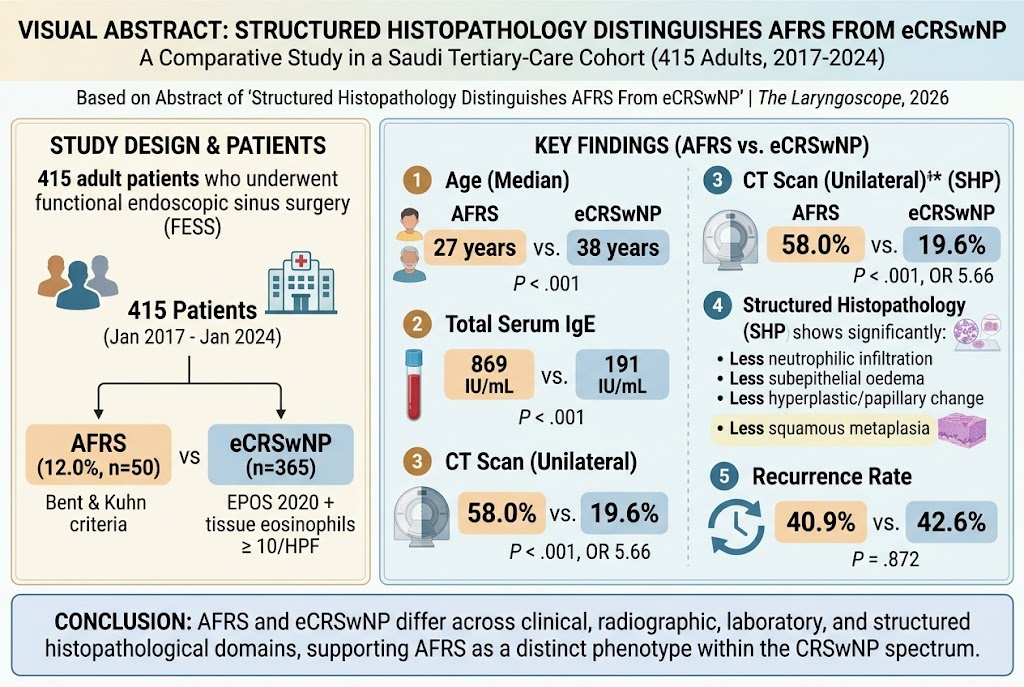
This retrospective cohort study reviewed 415 adult patients undergoing functional endoscopic sinus surgery at a tertiary referral center in Saudi Arabia between January 2017 and January 2024. Diagnostic classification employed established consensus criteria: AFRS diagnosis was based on Bent and Kuhn criteria, incorporating clinical, radiologic, and immunologic features indicative of fungal hypersensitivity; eCRSwNP classification followed European Position Paper on Rhinosinusitis and Nasal Polyps (EPOS) 2020 guidelines, requiring ≥10 tissue eosinophils per high-power field to confirm eosinophilic predominance. A structured histopathologic (SHP) evaluation was performed across 13 variables encompassing inflammatory cellular infiltrates and epithelial morphology. Comparative analyses of clinical characteristics, serum parameters including total IgE, CT imaging distribution patterns, and postoperative recurrence rates were conducted between the two cohorts.
Key Findings
Out of 415 patients, 50 (12.0%) met AFRS criteria. AFRS patients were significantly younger, with a median age of 27 years compared to 38 years in the eCRSwNP group (p < 0.001). Total serum IgE levels were substantially elevated in AFRS (median 869 IU/mL) versus eCRSwNP (191 IU/mL), indicating a robust systemic allergic response (p < 0.001). Radiological assessment demonstrated predominance of unilateral sinus disease in AFRS patients (58.0%) versus mainly bilateral involvement in eCRSwNP (19.6%), yielding an odds ratio of 5.66 (95% CI 3.05–10.51) for unilateral disease in AFRS.
Structured histopathologic analysis revealed key differentiators: AFRS specimens had significantly lower neutrophilic infiltration relative to eCRSwNP, suggesting distinct inflammatory milieu predominated by eosinophils rather than mixed neutrophilic involvement. Moreover, AFRS showed reduced subepithelial edema—a feature often associated with chronic inflammatory remodeling—and lesser epithelial alterations including hyperplastic or papillary changes and squamous metaplasia. These histopathologic distinctions emphasize divergent pathophysiological pathways despite clinical overlap.
Notably, postoperative recurrence rates did not differ significantly between both groups (AFRS 40.9% vs. eCRSwNP 42.6%, p = 0.872), indicating sustained challenges in disease management across phenotypes.
Expert Commentary
The study’s use of a 13-variable structured histopathology model provides a nuanced approach to differentiating AFRS from eCRSwNP, lending granular insight into the cellular and morphological milieu beyond classical diagnostic criteria. The younger age at presentation and elevated IgE corroborate AFRS as a distinct allergic phenotype, consistent with prior studies showing fungal hypersensitivity as an etiologic factor. The predominance of unilateral sinus involvement on CT underscores the localized nature of AFRS pathology compared to the typically diffuse bilateral disease in eCRSwNP.
While recurrence rates were comparable, the study’s retrospective design and single-center setting may limit generalizability. Future prospective multicenter studies incorporating molecular markers could further refine phenotypic distinctions. Additionally, therapeutic implications warrant exploration, as AFRS patients may benefit from targeted antifungal and immunomodulatory treatments distinct from those effective in eCRSwNP.
Conclusion
This comprehensive comparative analysis in a Middle Eastern tertiary-care cohort supports allergic fungal rhinosinusitis as a distinct clinical and histopathological phenotype within the chronic rhinosinusitis with nasal polyps spectrum. Integration of structured histopathology with clinical and radiologic parameters enhances diagnostic accuracy, informs personalized management, and may ultimately improve patient outcomes. Ongoing research should aim to clarify pathophysiological mechanisms and optimize therapeutic algorithms tailored to these differentiated endotypes.
Funding and ClinicalTrials.gov
The article does not specify funding sources or clinical trial registration numbers.
References
Alrashidi AG, Magboul N, Alsudays AM, Asiry AJ, Badghaish AK, Alsalem RF, Alroqi A, Alromaih S, Alrasheed AS, Alammar Y, Alsaleh S. Structured Histopathology Distinguishes AFRS From eCRSwNP. Laryngoscope. 2026 Oct 1. doi: 10.1002/lary.70961. Epub ahead of print. PMID: 42823651.