Introduction and Context
Appendiceal abscess—an encapsulated collection of infected fluid adjacent to an inflamed or perforated appendix—remains among the most debated problems in emergency surgery. Presentations span contained phlegmons and small, well-circumscribed collections to large, multiloculated abscesses and poorly contained mesenteric infections. This anatomic heterogeneity, together with variations in patient physiologic reserve and local resources (interventional radiology access), has driven wide practice variation worldwide.
In response to these inconsistencies, the Italian Society of Research in Surgery and the Italian Society of Emergency and Trauma Surgery convened a consensus conference in 2025 to produce a management-focused guidance document for appendiceal abscess. Using a modified Delphi process (three rounds of remote voting and a final in-person meeting), the panel adopted standardized pathologic definitions and an imaging-based grading classification developed within the initiative, and predefined agreement thresholds for consensus (≥80%) and strong consensus (≥95%). The results were published in Surgery (2026) and provide a reproducible, physiology-driven framework to support decision-making across a range of clinical settings (Cirocchi et al., Surgery. 2026).
Why this consensus now? The panel identified several unmet needs: lack of standardized imaging-driven grading; variable use of percutaneous drainage (often as definitive therapy without clear escalation criteria); inconsistent indications for early vs delayed appendectomy; and limited, often retrospective evidence to guide decision-making in special populations (elderly, immunocompromised, pregnancy). The goal was pragmatic: create clear, reproducible pathways that integrate anatomy (abscess morphology), physiology (clinical stability), and resources (IR availability) to reduce unwarranted variability.
New Guideline Highlights
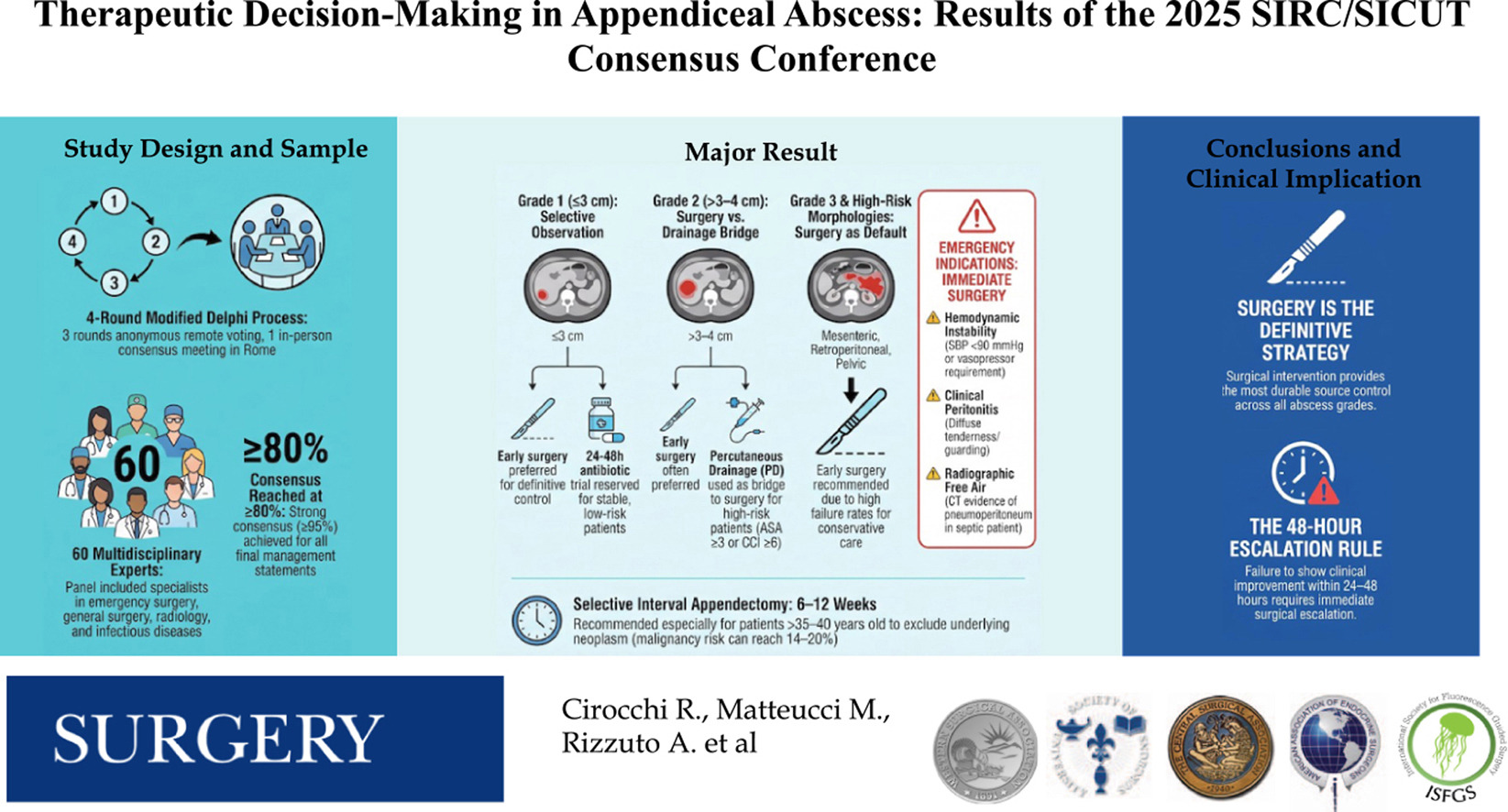
– Imaging-based grading and explicit escalation criteria: The consensus adopted a radiologic grading framework (phlegmon/small abscess versus larger or complex abscesses, mesenteric location, multiloculation) as the anchor for treatment decisions.
– Early appendectomy favored for limited disease: Grade 1 phlegmons and small, well-contained abscesses were considered best treated by early appendectomy as the most definitive therapy, although a brief, closely monitored nonoperative trial is acceptable in low-risk, stable patients.
– Percutaneous drainage redefined as a temporizing, not automatically definitive, option: For abscesses larger than ≈3–4 cm, image-guided percutaneous drainage is recommended selectively as a bridge for patients at high operative risk, rather than as routine definitive treatment.
– Mesenteric abscesses: Identified as high-risk for rapid progression and limited containment; the panel reached consensus that early surgical source control is the most reliable strategy.
– Absolute surgical indications: Clinical instability or generalized peritonitis remain non-negotiable indications for immediate operative source control, regardless of abscess morphology.
– Interval appendectomy: Not recommended routinely. The panel supported a risk-stratified approach—selective interval appendectomy for patients with recurrent symptoms, unresolved inflammatory mass, or when pathology or patient factors suggest high recurrence risk.
Key takeaways for clinicians:
– Anchor decisions in anatomy (radiology) and physiology (clinical stability), not habit or local tradition alone.
– Reserve percutaneous drainage primarily for high-risk surgical candidates as a bridge; do not assume drainage alone will be curative in all cases.
– Tailor interval appendectomy to individual recurrence risk rather than perform it routinely.
Updated Recommendations and Key Changes
The 2025 Italian consensus clarifies and formalizes several areas where prior guidance was inconsistent:
– Imaging-based grading: The consensus formalized a graded classification (grade 1 = phlegmon or small abscess; higher grades = larger or complex abscesses, mesenteric location). This formal grading was not standardized in many prior statements and provides a reproducible anchor for care.
– Role of percutaneous drainage: Older practice patterns frequently used image-guided drainage as definitive therapy for many abscesses. The new consensus restricts routine drainage for large collections only when patients are poor surgical candidates and frames it as a bridge to surgery or further management if needed.
– Interval appendectomy: Earlier decades saw routine interval appendectomy after nonoperative management. The panel moved the field toward selective interval surgery based on symptoms, residual disease on imaging, or patient preference—aligning practice with more contemporary, conservative approaches.
Evidence driving updates: The panel reviewed contemporary observational studies, randomized trials for uncomplicated appendicitis (e.g., antibiotic-first strategies), and data on outcomes after percutaneous drainage. While direct high-quality randomized evidence comparing early appendectomy to drainage for complex abscesses is limited, the consensus relied on pooled observational data, expert judgment, and physiologic principles (anatomic containment, risk of ongoing sepsis) to reach recommendations.
Topic-by-Topic Recommendations
The following synthesizes the panel’s practical, graded recommendations organized by clinical topic. Agreement thresholds noted reflect the Delphi process (consensus ≥80%, strong consensus ≥95%).
1) Diagnostic criteria and imaging grading
– Obtain contrast-enhanced CT (preferred in adults) or ultrasound (in children/pregnancy when CT is restricted) to define abscess size, location, multiloculation, and relation to surrounding structures. (Consensus)
– Apply the adopted imaging-based grading: grade 1 = phlegmon or small (4 cm, multiloculated, or poorly contained; mesenteric abscess flagged as a separate high-risk category. (Strong consensus)
2) Initial physiologic assessment and escalation criteria
– Immediate operative management if generalized peritonitis, sepsis/clinical instability, or failure to respond to resuscitation and antibiotics. (Strong consensus)
– If hemodynamically stable, decisions guided by imaging grade, comorbidity, and resource availability (e.g., IR). (Consensus)
3) Early appendectomy versus conservative therapy
– Grade 1 (phlegmon/small abscess): early appendectomy is the most definitive treatment and preferred for most patients. A short trial (24–72 hours) of nonoperative management with IV antibiotics and close observation may be reasonable in clinically stable, low-risk patients; failure prompts surgery. (Consensus)
4) Role of percutaneous drainage
– Abscesses >3–4 cm: percutaneous, image-guided drainage recommended selectively as a temporizing bridge in high-risk surgical candidates or when immediate safe surgery is not feasible. Drainage is not universally recommended as definitive therapy in the otherwise fit patient. (Consensus)
– When drainage is performed, clinicians should plan for clinical re-evaluation and a strategy for definitive source control if drainage does not promptly resolve infection. (Consensus)
5) Mesenteric abscesses
– Treated as high risk due to limited anatomic containment and potential for rapid spread; early surgical source control is generally favored over percutaneous drainage. (Strong consensus)
6) Salvage surgery and timing of delayed operations
– Salvage (urgent) surgery indicated for clinical deterioration or persistent sepsis despite appropriate drainage/antibiotics. (Strong consensus)
– Interval appendectomy: not routine. Individualize based on residual radiologic disease, recurrent symptoms, young age with high lifetime recurrence risk, or patient preference. Typical windows for elective delayed surgery when chosen are generally 6–12 weeks after initial resolution, but timing should be individualized. (Consensus)
7) Antibiotic therapy and follow-up
– Initiate broad-spectrum IV antibiotics covering gram-negatives and anaerobes upon diagnosis; tailor to cultures when available. Duration depends on source control: after adequate source control (surgery or effective drainage), many patients require a limited course (typically 4–7 days IV/PO transition) guided by clinical improvement; longer courses reserved for ongoing infection or inadequate source control. (Consensus)
8) Special populations
– Elderly, immunocompromised, and pregnant patients: lower threshold for early operative source control and individualized use of drainage; decisions should engage multidisciplinary teams (surgery, obstetrics, anesthesia, IR, infectious disease). (Consensus)
Expert Commentary and Insights
The consensus panel—composed of surgeons, emergency physicians, radiologists, and interventionalists—emphasized a few recurring themes in their deliberations:
– Physiology before technique: The panel repeatedly prioritized whether the patient is physiologically able to tolerate surgery and whether the abscess anatomy allows safe drainage. When anatomy and physiology point in opposite directions, individualized judgment and multidisciplinary discussion are essential.
– Percutaneous drainage is powerful but not omnipotent: While drainage can rapidly control a source, it does not remove an inflamed appendix and may leave the patient at risk of recurrence or ongoing low-grade inflammation. Thus, drainage should be part of a broader plan.
– Avoiding routine, dogmatic pathways: The shift away from routine interval appendectomy and routine drainage reflects an emphasis on avoiding unnecessary procedures in patients who do well clinically with conservative care.
Areas of controversy and research needs
– Optimal abscess-size thresholds: The 3–4 cm threshold for considering drainage is pragmatic, but data are limited; randomized data comparing early appendectomy versus drainage in larger abscesses are needed.
– Best timing for delayed appendectomy: Evidence is sparse; comparative studies of timing (early vs late elective surgery after initial nonoperative management) would be informative.
– Pediatric and pregnant populations: More prospective data are needed to define safe, standardized pathways tailored to these groups.
Practical Implications
For clinicians and systems, the 2025 Italian consensus translates into several actionable changes:
– Standardize imaging reporting and adopt an imaging-grade-driven pathway to reduce variability.
– Prioritize access to interventional radiology for drainage, but use drainage selectively as a bridge rather than routine definitive therapy.
– Incorporate early multidisciplinary case review (surgery + IR + ID) for complex or high-risk patients to tailor individualized plans.
– Educate patients about a risk-stratified plan for interval appendectomy and the rationale for selective rather than routine delayed surgery.
A short vignette illustrating application
John, a 48-year-old with well-controlled diabetes, presents with right lower quadrant pain and fever. CT shows a 4.5-cm well-circumscribed periappendiceal abscess. He is hemodynamically stable and fit for surgery. Under the consensus framework, this case falls at the borderline where early appendectomy and percutaneous drainage are both options. Given John’s low operative risk and the panel’s preference to favor early definitive source control in fit patients rather than defaulting to drainage, a laparoscopic appendectomy with operative drainage would be a reasonable choice after informed discussion. If John had significant cardiopulmonary comorbidity making anesthesia high risk, image-guided percutaneous drainage as a temporizing bridge with planned reassessment would be preferred.
References
– Cirocchi R, Matteucci M, Rizzuto A, et al. Therapeutic decision-making in appendiceal abscess: Results of the 2025 Italian Society of Research in Surgery/Italian Society of Emergency and Trauma Surgery consensus conference. Surgery. 2026 Jul 20;198:110470. PMID: 42617507. https://pubmed.ncbi.nlm.nih.gov/42617507/
– Di Saverio S, Podda M, De Simone B, et al. Diagnosis and treatment of acute appendicitis: 2020 update of the WSES Jerusalem guidelines. World J Emerg Surg. 2020;15:27. doi:10.1186/s13017-020-00318-3
– Salminen P, Tuominen R, Paajanen H, et al. (APPAC) Randomized trial comparing antibiotic therapy and appendectomy for uncomplicated acute appendicitis: mid-term results. (See APPAC trial literature for context on nonoperative management strategies.)
Note: The Italian consensus places this guidance within the broader context of contemporary literature on appendicitis management (including antibiotic-first strategies for uncomplicated disease) while focusing specifically on abscess morphology, physiologic status, and pragmatic escalation criteria.
Final thought
The 2025 Italian consensus reframes appendiceal abscess care around three pillars: precise imaging-based categorization, patient physiology, and tailored escalation plans. By defining when to operate immediately, when drainage can be a useful bridge, and when to reserve interval appendectomy, this work aims to reduce unwarranted variation and improve consistency and transparency in decision-making. Clinicians should combine these recommendations with local resources, multidisciplinary input, and patient-centered discussion to arrive at optimal, individualized care plans.