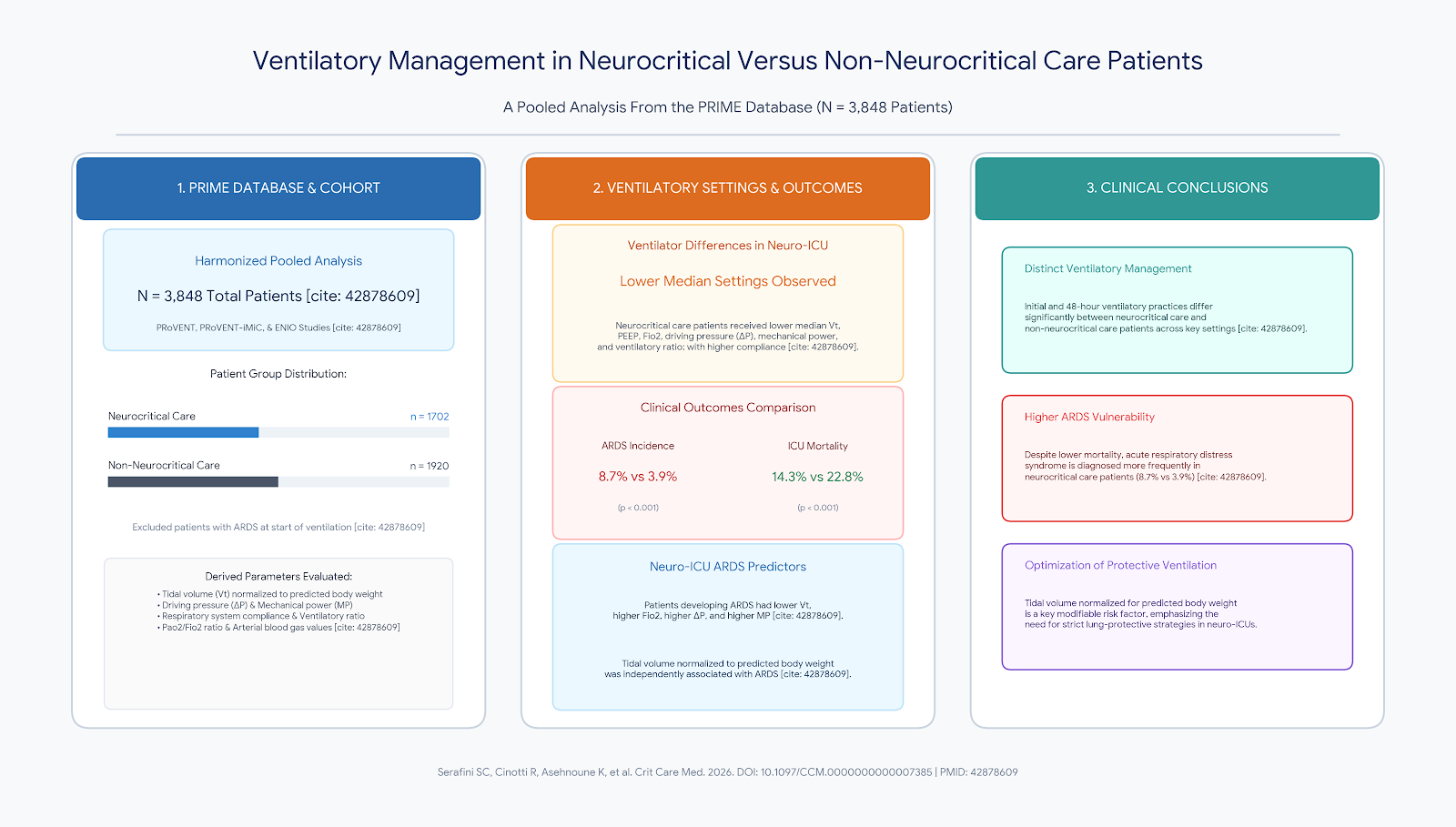
Neurocritical care patients received lower tidal volumes, positive end-expiratory pressure (PEEP), and Fio2 compared to non-neurocritical care patients.
Acute respiratory distress syndrome (ARDS) was more frequently diagnosed in neurocritical care patients despite lower mortality rates compared to non-neurocritical care patients.
In neurocritical patients, higher driving pressures and mechanical power were associated with ARDS development.
Tidal volume normalized to predicted body weight independently predicted ARDS occurrence in neurocritical care patients.
Study Background
Effective ventilatory management is critical in the intensive care unit (ICU), particularly for patients with neurological injuries. Neurocritical care patients often exhibit unique pathophysiological challenges, including altered respiratory mechanics and increased susceptibility to secondary brain injury related to oxygenation and carbon dioxide regulation. Optimizing ventilation in this subgroup is vital, yet literature comparing ventilatory strategies and their outcomes relative to non-neurocritical patients remains limited. Additionally, the risk and impact of ventilator-associated complications such as ARDS—a significant contributor to ICU morbidity and mortality—are incompletely characterized in this population. This study addresses the gap by analyzing ventilatory management differences and their association with ARDS development and mortality between neurocritical care and non-neurocritical critically ill patients.
Study Design
This investigation is a post hoc pooled analysis of individual patient data aggregated from three contemporary prospective observational cohorts comprising the PRIME database: PRoVENT, PRoVENT-iMiC, and ENIO studies. Inclusion criteria encompassed critically ill adults initiating invasive ventilation without ARDS at baseline. A total of 3,848 patients were included, split approximately equally into neurocritical care (n=1,702) and non-neurocritical care (n=1,920) groups. Key ventilatory parameters—tidal volume (Vt) normalized to predicted body weight (PBW), positive end-expiratory pressure (PEEP), fraction of inspired oxygen (Fio2), driving pressure (ΔP), mechanical power (MP), and respiratory system compliance—were examined at initiation and 48 hours. Primary endpoint was the subsequent diagnosis of ARDS post ventilation onset; ICU mortality was a secondary endpoint.
Key Findings
Neurocritical care patients were ventilated with lower median Vt (mL/kg PBW), PEEP, and Fio2 compared to their non-neurocritical counterparts. They exhibited lower median driving pressure and mechanical power alongside higher respiratory system compliance at both time points examined. Despite these differences indicating potentially more lung-protective ventilation, neurocritical patients developed ARDS significantly more often (8.7% vs. 3.9%, p <0.001). Surprisingly, ICU mortality was lower in neurocritical patients (14.3% vs. 22.8%, p <0.001).
Among neurocritical care patients who developed ARDS, ventilator settings revealed lower Vt but increased Fio2, higher driving pressure, and higher mechanical power compared to those who did not develop ARDS. Multivariable analyses identified normalized Vt as an independent risk factor for ARDS onset in the neurocritical cohort, underscoring its possible causal contribution despite generally lower Vt values.
Taken together, these findings suggest distinct respiratory management paradigms and pathophysiological responses between neurocritical and non-neurocritical populations. Lower tidal volumes with lower PEEP and Fio2 might reflect clinical caution to avoid elevated intracranial pressure in neurocritical patients, potentially at a cost of elevated ARDS risk.
Expert Commentary
This robust pooled analysis contributes important data on ventilatory practices and outcomes in a challenging patient population. Current neurocritical ventilation strategies must balance brain protection with lung protection, often resulting in compromises to standard lung-protective ventilation protocols established in general critical care. The higher incidence of ARDS despite lower tidal volumes and mechanical power warrants careful interpretation. It may reflect differences in underlying pulmonary susceptibility or delayed ARDS recognition due to overlapping clinical features in neurocritical patients.
Limitations include the observational design, which restricts causality inferences, and possible heterogeneity among contributing cohorts. The study also does not elaborate on sedation practices, neuromuscular blockade, or intracranial pressure monitoring, factors influencing ventilation choices. Future randomized controlled trials dedicated to neurocritical populations are needed to refine ventilatory targets balancing cerebral and pulmonary outcomes.
Conclusion
The PRIME database analysis highlights that neurocritical care patients receive distinct ventilatory management characterized by lower tidal volumes, PEEP, and oxygen settings compared with non-neurocritical patients. Despite this, they experience a higher rate of ARDS but have lower ICU mortality. Among neurocritical patients, tidal volume normalized to predicted body weight independently predicts ARDS development, suggesting that ventilation strategies tailored for brain injury may predispose to lung injury. Clinicians should be mindful of this trade-off and consider individualized ventilatory approaches in neurocritical care to optimize both pulmonary and neurological outcomes.