Highlight
- The PIONIR trial assessed dietary effects on gut inflammation in high-risk first-degree relatives (FDRs) of Crohn’s disease (CD) patients.
- The Tasty&Healthy (T&H) diet significantly reduced fecal calprotectin (FC), a reliable marker of intestinal inflammation, compared to habitual diet.
- High adherence and acceptability to the T&H diet were observed, alongside modest modulations in gut microbiota composition.
- Findings support feasibility and potential of dietary interventions for primary prevention of CD in at-risk populations.
Study Background: Disease Burden and Unmet Need
Crohn’s disease is a chronic, relapsing inflammatory bowel disease characterized by transmural inflammation of the gastrointestinal tract. With rising global prevalence, Crohn’s disease imposes significant morbidity, impairing quality of life and increasing healthcare resource utilization. First-degree relatives of patients with CD face an increased genetic and environmental risk for developing the disease, highlighting an important target group for preventive strategies. Persistent subclinical intestinal inflammation, often reflected by elevated fecal calprotectin (FC), precedes overt disease and represents a potential biomarker for intervention. Despite advances in therapeutics, there remains an unmet need for primary prevention modalities to reduce incidence and delay onset of Crohn’s disease. Dietary factors are implicated in disease pathogenesis, and modifiable lifestyle interventions present a promising avenue. However, data from rigorously designed trials testing dietary interventions in at-risk but asymptomatic individuals are sparse.Study Design
The PIONIR (Preventing IBD ONset in Individuals at Risk) randomized controlled trial employed a robust two-period, two-sequence crossover design to evaluate whether an 8-week Tasty&Healthy (T&H) dietary intervention modulates intestinal inflammation in high-risk FDRs of CD patients. Eligible participants had persistently elevated FC (>70µg/g) and only mild or nonspecific mucosal abnormalities (edema or ≤10 aphthous ulcers) on video-capsule or ileocolonoscopy, without diagnostic Crohn’s disease. Participants (n=29) were randomized to either begin with the T&H diet, characterized by nutritionally balanced, anti-inflammatory food choices, or to continue their habitual diet (HD) for 8 weeks, then crossed over to the alternate diet for another 8 weeks. The primary endpoint was change in FC, assessed through generalized estimating equations conforming to intention-to-treat principles.Key Findings
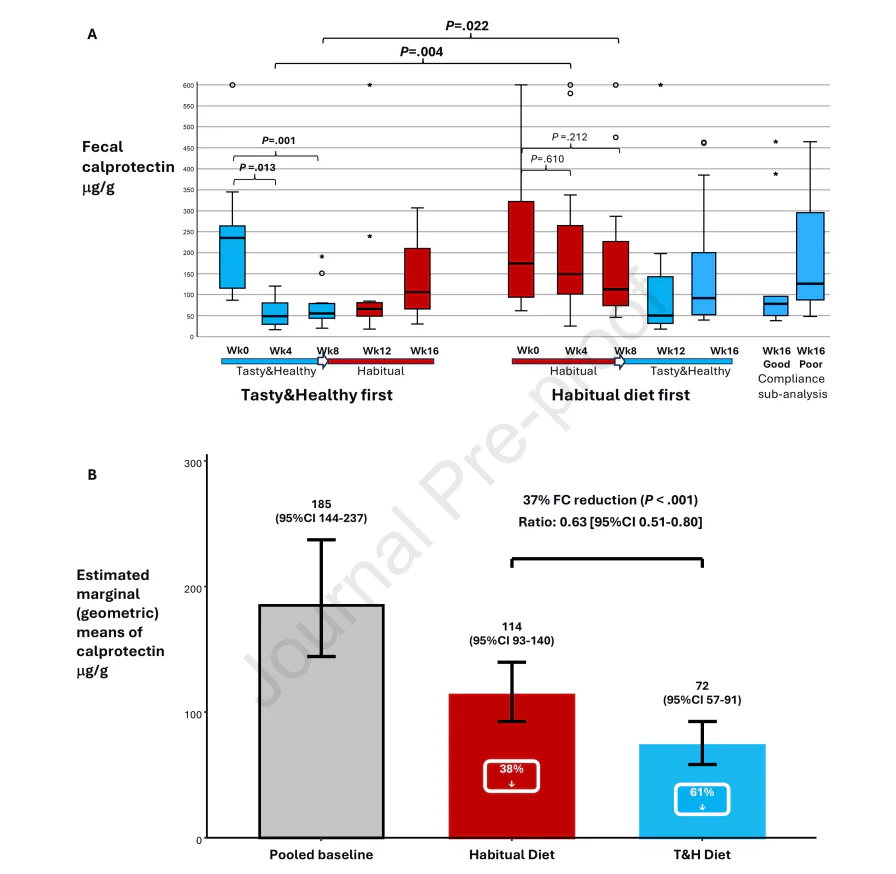
At the 8-week mark, the T&H diet yielded a significant reduction in median FC compared to the habitual diet (64µg/g [IQR 44–127] vs. 112µg/g [74–227]; P=.022). The proportion of participants achieving at least a 50% reduction in FC was considerably higher with T&H (71%) versus HD (27%), corresponding to a risk ratio of 2.68 (95% CI 1.09–6.60; P=.016). Considering the full crossover periods, the estimated marginal mean FC decreased from 185µg/g (95% CI 144–237) by 61% to 72µg/g (95% CI 57–91) with T&H. In contrast, FC decreased 38% to 114µg/g (95% CI 93–140) during the habitual diet phase, representing a significant comparative reduction with T&H (ratio 0.63; 95% CI 0.51–0.80; P<0.001), amounting to an overall 37% decrease. Secondary analyses indicated significant diet-associated shifts in six microbial species, which survived correction for false discovery rate, suggesting dietary modulation of gut microbiota may underlie anti-inflammatory effects. Participant-reported outcomes favored T&H with 79% rating the diet acceptable and 83% demonstrating good to complete adherence, supporting intervention feasibility.Expert Commentary
This study compellingly illustrates the capacity to modulate low-grade intestinal inflammation in asymptomatic high-risk FDR individuals through targeted dietary changes. FC, a sensitive marker for mucosal inflammation, served effectively as an intermediary surrogate endpoint for subclinical disease activity. The crossover design minimizes confounding by inter-individual variability, enhancing result validity. Limitations include relatively modest sample size and short intervention duration, precluding conclusions about long-term clinical endpoints such as frank conversion to Crohn’s disease. The study population was carefully selected with mildly elevated FC and limited mucosal findings, so generalizability to broader at-risk cohorts remains speculative. The observed microbiota changes align with increasing evidence linking diet, microbial ecology, and gut inflammation, although causal pathways require further delineation. Larger, longer-term trials integrating dietary, microbial, and clinical outcomes are warranted to confirm preventive potential.Conclusion and Implications for Practice
The PIONIR trial provides meaningful evidence that diet modification through a palatable, healthful diet can significantly attenuate intestinal inflammation in individuals at elevated risk for Crohn’s disease but without established diagnosis. These findings advance our understanding of modifiable precursor states of inflammatory bowel disease and introduce a practical, non-pharmacologic approach for primary prevention. Pending replication and extension, the T&H dietary pattern could inform clinical guidelines for managing high-risk family members of CD patients, emphasizing early lifestyle intervention to potentially forestall disease onset. This study also encourages incorporation of fecal calprotectin monitoring in preventive strategies, facilitating timely personalized recommendations.Funding and Trial Registration
The PIONIR trial (ClinicalTrials.gov identifier NCT05211518) was supported by relevant institutional and grant funding sources detailed in the primary publication.References
Turner D, Kenigsberg S, Plotkin L, et al. Tasty and Healthy Diet Reduces Fecal Calprotectin in High-Risk First-Degree Relatives of Patients with Crohn’s Disease: PIONIR Randomized Crossover Trial. Gastroenterology. 2026 Oct 26. PMID: 42933673. https://pubmed.ncbi.nlm.nih.gov/42933673/ Additional literature: – Kaplan GG. The global burden of IBD: from 2015 to 2025. Nat Rev Gastroenterol Hepatol. 2015;12(12):720-727. – Paramsothy S, et al. Diet and the intestinal microbiome: Associations with Crohn’s disease risk and therapy. Gastroenterology. 2017;152(2):S9-S17. – Le Berre C, et al. Inflammatory bowel disease: where microbiota and immunity meet. World J Gastroenterol. 2016;22(5):1597-1614.Specialty calculators
For clinical reference; use professional judgment.