Highlight
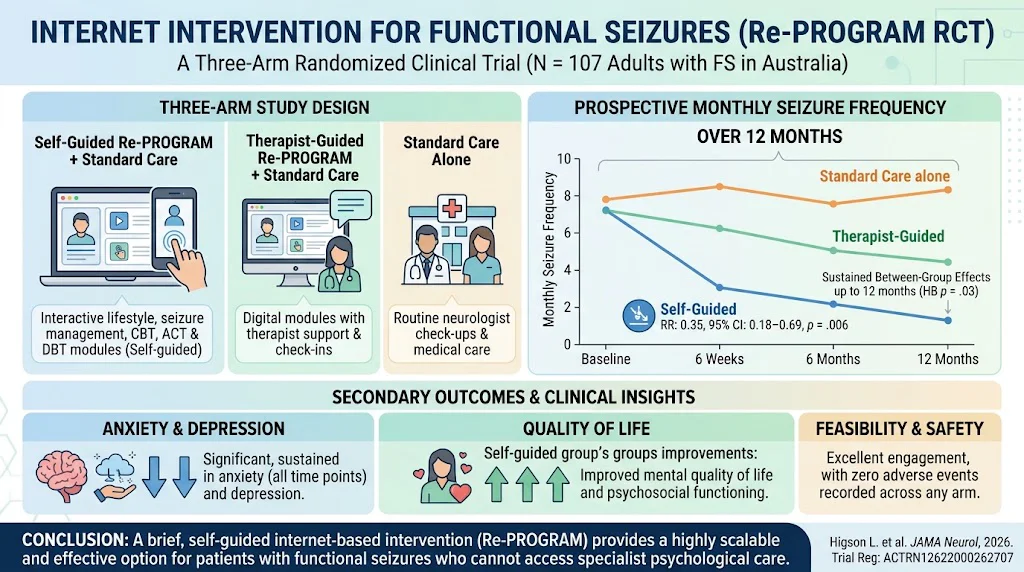
- A self-guided internet-based intervention significantly reduced monthly seizure frequency in adults with functional seizures (FS) compared to standard care alone.
- Improvements in anxiety, depression, and mental quality of life were observed alongside seizure frequency reductions in the self-guided group.
- Therapist-guided internet intervention improved anxiety but did not significantly reduce seizure frequency.
- The study supports scalable and accessible treatment models addressing the unmet need for evidence-based therapies in FS.
Study Background
Functional seizures (FS), also referred to as psychogenic nonepileptic seizures (PNES), represent a prevalent and disabling condition encountered in neurology practice. These episodes resemble epileptic seizures but lack an underlying epileptiform abnormality, instead arising from psychological or functional neurological mechanisms. FS significantly impair quality of life and impose substantial burdens on healthcare systems. Despite this, evidence-based therapeutic options remain difficult to access for many patients worldwide, including Australia, owing to limited specialist availability and geographical barriers. Given the rising prominence of digital health, internet-delivered interventions present a promising avenue to address the treatment gap for FS by enabling scalable, flexible, and cost-effective care delivery outside traditional clinical environments.Study Design
This parallel, three-arm randomized clinical trial enrolled adults aged 18 years or older with video electroencephalogram confirmed FS and a minimum seizure frequency of four episodes monthly. Individuals with comorbid active epilepsy were excluded to isolate FS outcomes. The study was conducted at a specialist outpatient neurology clinic in Melbourne, Australia, from February 2022 through April 2024, with follow-ups extending to 12 months post-randomization. Participants were randomized equally into three groups: (1) a self-guided internet-based intervention alongside standard care, (2) a therapist-guided internet-based intervention with standard care, or (3) standard care alone. The intervention, termed Re-PROGRAM, comprises five structured online sessions targeting lifestyle modifications, seizure self-management techniques, and psychological strategies derived from cognitive behavioral therapy (CBT), acceptance and commitment therapy (ACT), and dialectical behavior therapy (DBT). The primary endpoint was the reduction in monthly seizure frequency measured at 6 weeks, 6 months, and 12 months post-enrollment using prospective daily seizure diaries, supplemented with retrospective reports when diary data were incomplete. Secondary endpoints assessed included changes in depression, anxiety, overall quality of life, psychosocial function, and somatic symptoms. Safety was monitored throughout the study.Key Findings and Results
Of the 220 individuals screened, 107 met eligibility criteria and were randomized (mean age 36.0 years; 83% female). Ninety-six participants completed sufficient follow-up assessments for the primary analysis: 29 in the self-guided group, 34 in the therapist-guided group, and 33 in the standard care group. The self-guided internet intervention demonstrated a statistically and clinically significant reduction in monthly seizure frequency compared to standard care, with an overall rate ratio (RR) of 0.35 (95% CI, 0.18–0.69; Holm-Bonferroni adjusted P = .006). This effect was sustained at all time points: 6 weeks (RR 0.37; 95% CI, 0.18–0.76), 6 months (RR 0.31; 95% CI, 0.12–0.78), and 12 months (RR 0.35; 95% CI, 0.16–0.78), all showing statistical significance. Secondary outcomes showed that the self-guided arm consistently improved anxiety scores relative to standard care across all time points and produced meaningful improvements in depression and mental health-related quality of life at one or more measurements. The therapist-guided group showed significant anxiety reduction at 6 months but did not achieve statistically significant seizure frequency reduction compared to standard care. When directly comparing the two intervention arms, no significant difference was found in seizure reductions (RR, 0.67; 95% CI, 0.33–1.36). No adverse events were associated with any of the interventions, indicating that the internet-based approaches were safe and well-tolerated.Expert Commentary
The marked efficacy of a self-guided internet-based intervention in reducing FS frequency represents a landmark advancement in managing this complex condition, especially given the scarcity of accessible specialist psychological care. The integration of evidence-based psychological frameworks such as CBT, ACT, and DBT within a digitally delivered, structured program may enhance patient empowerment and sustained behavioral change outside conventional clinical settings. The lack of superior seizure reduction in the therapist-guided arm raises intriguing questions regarding the degree of therapist involvement necessary for clinical benefit, potentially reflecting the high motivation and engagement achievable with well-designed self-help programs. However, the therapist presence did improve anxiety at critical intermediate time points, which warrants further exploration. Limitations include a modest sample size and predominance of female participants, which may affect generalizability. Additionally, reliance on self-reported seizure diaries, although prospective, may introduce reporting bias. Future research should explore the cost-effectiveness, applicability in diverse populations, and potential integration into stepped-care models.Conclusion
This randomized clinical trial establishes that a self-guided internet-based intervention can produce significant, sustained reductions in seizure frequency and anxiety among adults with functional seizures when compared with standard care alone. These findings endorse the use of scalable digital therapies to bridge treatment accessibility gaps, promising enhanced clinical outcomes and better quality of life for this underserved population. Wider implementation, accompanied by further validation in broader settings, could revolutionize functional seizure management by harnessing technology to deliver evidence-based psychological care more equitably and efficiently.Funding and Trial Registration
This study was conducted with appropriate ethical approvals and was registered under trial identifier ACTRN12622000262707. Specific funding sources were not disclosed in the abstract.References
1. Goldstein LH, et al. Cognitive behavioral therapy for adults with dissociative seizures (CODES): a pragmatic, multicentre, randomised controlled trial. Lancet Psychiatry. 2020;7(6):491-505. 2. LaFrance WC Jr, et al. Psychogenic nonepileptic seizures: clinical characteristics and bridge-building research initiatives. Neurol Clin. 2019;37(3):493-508. 3. Baslet G. Neurobiology of psychogenic nonepileptic seizures. Epilepsy Behav. 2011;22(3):385-393. 4. Reuber M, et al. Functional neurological disorders: a review. Lancet Neurol. 2016;15(6):630-640. 5. Goldstein LH, Mellers JDC. Recent developments in our understanding of seizure disorders. Curr Opin Neurol. 2017;30(2):205-211.Specialty calculators
For clinical reference; use professional judgment.