Introduction and Context
Hepatocellular carcinoma (HCC) remains a major global cause of cancer mortality. Over the last five years, effective systemic therapies — most notably immune checkpoint inhibitor (ICI)-based combinations and targeted agents — have transformed outcomes for patients with advanced disease. These advances have naturally prompted interest in moving systemic agents earlier in the course of disease: in the perioperative setting (neoadjuvant or adjuvant around curative-intent surgery or ablation) and in combination with locoregional treatments (transarterial chemoembolization [TACE], transarterial radioembolization [TARE], ablation).
But designing clinical trials in these earlier-stage populations is challenging. Early and intermediate-stage HCC are clinically and biologically heterogeneous; liver function, tumor burden, etiology (HBV, HCV, NASH), and transplant candidacy all influence prognosis and treatment decisions. Recognizing these challenges, the HCC-Live Consortium convened a multidisciplinary group of experts to create practical, consensus-driven guidance on how to design trials testing systemic therapies in patients undergoing surgery or locoregional procedures. The consensus report (Yarchoan et al., Gut 2026) defined statements with >70% panel approval and generated focused recommendations for trial inclusion, stratification, treatment arms, endpoints, safety monitoring and translational substudies.
Why this guidance matters now
– Rapidly evolving systemic options (ICI combinations, VEGF inhibitors, multi-kinase inhibitors) create opportunity but also uncertainty about where and how to test these drugs in resectable or locally advanced disease.
– Previous adjuvant/ neoadjuvant trials in HCC have yielded mixed or negative results (for example, sorafenib adjuvant trials), underscoring the need for better patient selection and trial design.
– Heterogeneity of intermediate-stage HCC (BCLC-B) makes single-trial generalizability limited unless populations are tightly defined.
New Guideline Highlights
Major themes from the consensus:
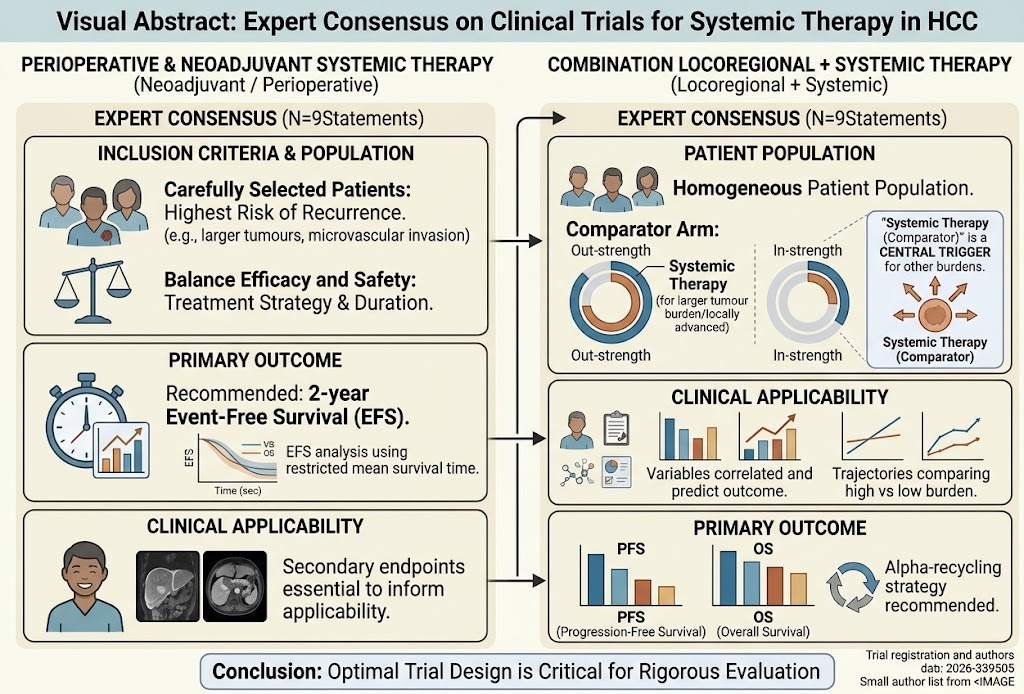
– Enroll well-defined, higher-risk patient cohorts in perioperative (neoadjuvant/adjuvant) trials to maximize event rates and the chance of demonstrating benefit. Typical high-risk features include tumor size >5 cm, multifocal disease, microvascular invasion on imaging suspicion, poor differentiation on biopsy, or other validated molecular risk markers when available.
– Use clinically relevant, time-bound primary endpoints: for perioperative trials the panel recommended 2-year event-free survival (EFS) assessed using restricted mean survival time (RMST) rather than relying only on hazard ratios. For locoregional + systemic combination trials, progression-free survival (PFS) and overall survival (OS) were recommended co-primary endpoints with alpha-recycling strategies to preserve statistical rigor.
– Choose comparator arms that reflect contemporary practice and the target population. For patients with larger tumor burden or locally advanced disease where systemic therapy is a reasonable alternative, systemic therapy alone can be an appropriate comparator to combination locoregional+systemic strategies. For truly resectable patients, the comparator should be standard surgery ± loco-regional therapy.
– Exclude or carefully define transplant candidates unless the trial specifically addresses pre-transplant systemic therapy; immunotherapy before liver transplant carries potential for graft rejection and requires prespecified safety monitoring and washout strategies.
– Mandate robust secondary endpoints and translational studies — pathologic response, radiologic objective response, time to progression, recurrence patterns, liver-specific morbidity, quality of life (QoL), and biomarker substudies (ctDNA, immune gene signatures) to improve generalizability and future patient selection.
Key takeaways for clinicians and investigators
– Trials must prioritize homogeneity of enrolled patients and clear, clinically sensible comparators.
– Statistical design should use RMST for short-to-medium follow-up perioperative trials and alpha-recycling if multiple primary endpoints will be tested.
– Safety and transplant issues deserve explicit, prespecified management rules.
Updated Recommendations and Key Changes from Prior Practice
The consensus refines prior guidance in several ways:
– Shift from long adjuvant durations based on arbitrary intervals to a pragmatic, evidence-informed approach: neoadjuvant windows should be short enough to avoid losing curative opportunity (generally 6–12 weeks), while adjuvant durations mirror those used successfully in earlier-phase studies (for example, many adjuvant immune regimens use 6–12 months), balanced against postoperative recovery and hepatic reserve.
– Greater emphasis on selecting a high-risk perioperative population rather than enrolling all comers after resection — this increases event rates and statistical power.
– Recommendation of RMST (restricted mean survival time) as a primary analytic approach for 2-year EFS in perioperative trials acknowledges that proportional hazards assumptions are often violated in the immunotherapy era and that RMST provides an interpretable measure of average event-free time over a fixed period.
– Explicit recommendations regarding inclusion/exclusion of transplant candidates and required washout durations for anti-VEGF or ICI exposure prior to transplant — many earlier trial designs did not standardize this.
Table: High-level comparison — conventional practice vs. HCC-Live consensus (illustrative)
– Perioperative target population: All resected patients → HCC-Live: high-risk resected patients (e.g., size >5 cm, multifocal, MVI suspicion)
– Primary endpoint: recurrence-free survival (RFS) via HR → HCC-Live: 2-year EFS using RMST
– Neoadjuvant duration: variable → HCC-Live: short window (6–12 weeks) to balance downstaging with timely surgery
– Transplant candidates: variably included → HCC-Live: exclude unless dedicated substudy with safety rules
(here the consensus replaces prior broad approaches with more focused, event-driven designs)
Topic-by-Topic Recommendations
1) Trial populations and inclusion criteria
– Perioperative (neoadjuvant/adjuvant) trials: restrict to patients at highest risk of early recurrence after curative-intent resection or ablation. The panel suggested explicit inclusion criteria such as size >5 cm, multifocal tumors beyond single small lesions, radiologic features suggesting microvascular invasion, or biomarker profiles predictive of recurrence when validated. Enroll predominantly Child-Pugh A patients to preserve liver reserve and limit confounding by underlying cirrhosis.
– Locoregional + systemic trials: enroll homogeneous subgroups within BCLC-B or locally advanced disease. Use objective tumor-burden cutoffs (for example, beyond ‘‘up-to-7’’ criteria) and standardize baseline imaging and staging.
2) Stratification and randomization
– Predefine stratification factors that materially affect prognosis and treatment effect: baseline AFP, presence of clinically significant portal hypertension, tumor burden categories, prior locoregional therapy, and performance status.
– Consider separate randomization strata for viral vs non-viral etiology where biologic rationale or existing data suggest differential immunotherapy response.
3) Comparator arms and treatment strategies
– For curative-intent settings, the control arm should reflect the accepted local standard of care (surgery ± ablation) and not delay curative treatment. Adjuvant therapy should be compared to surveillance when no standard adjuvant therapy exists.
– For patients with borderline resectability or larger tumor burden where systemic therapy is a standard option, comparator arms may include systemic therapy alone (e.g., an ICI-VEGF combo) vs. systemic + locoregional combination.
– Careful consideration of peri-procedural timing of anti-VEGF and ICIs to minimize operative bleeding, wound-healing complications, and hepatic decompensation.
4) Endpoints and statistical approaches
– Perioperative trials: primary endpoint recommended—2-year event-free survival (EFS); analytic approach—restricted mean survival time (RMST) over 2 years. RMST provides a clinically interpretable average event-free duration in a fixed follow-up window and is robust when hazard proportionality is uncertain.
– Combination locoregional + systemic trials: recommended co-primary endpoints—PFS and OS, with alpha-recycling (a pre-specified method to allocate type I error across co-primary endpoints) to preserve statistical integrity while testing more than one key outcome.
– Secondary endpoints: pathologic complete or major response, radiographic objective response rate (RECIST/mRECIST), time to progression, recurrence patterns, liver-specific morbidity and hepatic decompensation, QoL, and transplant-related outcomes (when relevant).
5) Safety, surgery and transplant considerations
– Limit inclusion to Child-Pugh A unless a robust substudy addresses more advanced liver disease.
– Avoid inclusion of patients with immediate transplant intent unless the trial explicitly addresses pre-transplant systemic therapy and has a prespecified transplant protocol. If pre-transplant systemic therapy is allowed, require washout intervals (panel recommended conservative washouts, e.g., 4–6 weeks for VEGF-targeting agents and longer discussion/monitoring for ICIs) and close post-transplant immunologic monitoring. Trials should have predefined stopping rules for graft rejection signals.
– Monitor for immune-related adverse events that could complicate surgery (hepatitis, colitis, endocrinopathies) and for bleeding or wound-healing complications with anti-VEGF therapy.
6) Biomarkers and translational substudies
– Mandatory collection of tissue and plasma for translational endpoints. Priority biomarker strategies include circulating tumor DNA (ctDNA) for minimal residual disease (MRD) detection, immune gene-expression signatures, and longitudinal peripheral immune profiling. These data may support future enrichment and adaptive designs.
7) Special populations
– Patients with Child-Pugh B: generally excluded from pivotal perioperative trials; consider dedicated phase II studies with tailored safety endpoints.
– Viral hepatitis: permit enrollment but require protocol-specified viral management (antiviral therapy for HBV, monitoring for HBV reactivation with immunotherapy).
– Prior locoregional therapy: document and stratify; prior TACE or ablation can affect imaging assessment and interpretation of response.
Expert Commentary and Insights
Consensus panel perspectives
– The expert panel emphasized pragmatism: trials should seek to answer clinically meaningful questions with feasible designs. Recruiting ‘‘all comers’’ dilutes signal and wastes resources; instead, focus on higher-risk subgroups with sufficient event rates to detect clinically meaningful benefits.
– Pathologic response (major pathologic response or pCR) was highlighted as an attractive early readout in neoadjuvant studies, but the panel cautioned that pathologic endpoints must be validated against long-term outcomes in HCC before being considered surrogates for OS.
Key controversies and unresolved areas
– Inclusion of transplant candidates: the risk of post-transplant rejection after checkpoint inhibitor exposure remains a key concern. Some centers have reported successful transplants after ICIs with careful timing and selection, but consensus favors exclusion except in dedicated trials with transplant expertise.
– Choice of comparator in combination trials: with immunotherapy-anti-VEGF combinations increasingly incorporated into first-line practice for advanced HCC, should systemic therapy alone become the default comparator for combination trials in locally advanced disease? The panel recommended yes when systemic therapy is an appropriate alternate standard of care, but acknowledged that rapidly changing standards will necessitate adaptive trial designs.
– Biomarker-driven enrichment: while promising, no validated predictive biomarker (beyond AFP for some contexts) currently exists to guide immunotherapy selection in early-stage HCC; hence, biomarker substudies are urgent priorities.
Future research needs
– Validation of ctDNA and other MRD assays as predictors of recurrence and as enrollment or stratification tools.
– Prospective trials testing shorter vs longer perioperative systemic durations and the optimal timing of surgery after neoadjuvant therapy.
– Studies dedicated to patients with impaired liver function (Child-Pugh B) and those with non-viral etiologies (e.g., NASH), who may respond differently to immunotherapy.
Practical Implications for Clinicians and Trialists
– If planning a perioperative or locoregional+systemic trial, investigators should:
– Define a narrow, high-risk population to preserve event rates;
– Select endpoints and analytic methods (RMST for 2-year EFS, alpha-recycling for multiple primaries) that match the expected event dynamics;
– Predefine transplant rules and safety stopping criteria, particularly when immunotherapy is used;
– Build in mandatory biospecimen collection for MRD and immune correlative studies.
Vignette: Applying the consensus
– Patient: Michael, 62, Child-Pugh A cirrhosis due to hepatitis C, single 6.5-cm HCC in the right lobe on MRI with radiologic features suggesting microvascular invasion. He undergoes surgical resection with clear macroscopic margins but is felt to be at high risk of recurrence.
– How the consensus would guide trial eligibility: Michael would be an appropriate candidate for a perioperative adjuvant trial that enrolls high-risk resected patients. The trial would likely randomize him to adjuvant systemic therapy vs surveillance, use 2-year EFS as the primary endpoint analyzed with RMST, collect serial plasma for ctDNA, and monitor hepatic function and immune-related toxicities closely.
References
– Yarchoan M, Llovet JM, Kelley RK, Finn R, Parikh ND, Tabrizian P, Burgoyne AM, Agopian VG, Sanford NN, Tran Cao HS, Padia SA, Vogel A, Lewandowski RJ, Kirema GR, Lin R, Mehta N, Sapisochin G, Yopp A, Villanueva A, Halazun K, Pinato DJ, Kim E, Heimbach JK, Pillai A, Salem R, El-Khoueiry A, Singal AG. Expert consensus on clinical trials for use of systemic therapy in patients with hepatocellular carcinoma undergoing surgical and locoregional therapies. Gut. 2026 Sep 24. PMID: 42785981.
– Finn RS, Qin S, Ikeda M, Galle PR, Ducreux M, Kim TY, Kudo M, et al. Atezolizumab plus bevacizumab in unresectable hepatocellular carcinoma. N Engl J Med. 2020;382:1894–1905.
– Kudo M, Finn RS, Qin S, Han KH, et al. Lenvatinib versus sorafenib in first-line treatment of patients with unresectable hepatocellular carcinoma: REFLECT trial. Lancet. 2018;391:1163–1173.
– Bruix J, Reig M, Sherman M. Evidence-based diagnosis, staging, and treatment of patients with hepatocellular carcinoma. Gastroenterology. (EASL/AASLD practice guidelines and BCLC strategy papers are relevant background.)
– Reig M, Forner A, Rimola J, et al. BCLC strategy update: Treatment allocation and sequencing in hepatocellular carcinoma. J Hepatol. 2022; (BCLC strategy updates emphasize individualized treatment and sequence planning.)
– Previous adjuvant experience: the STORM trial (sorafenib adjuvant) and other negative adjuvant trials underscore the need for focused perioperative trial design.
Note: The Gut 2026 consensus paper is the primary source of the recommendations summarized here. Where specific trials or guidelines are cited as background, readers should consult the original publications (for example, IMbrave150 NEJM 2020; REFLECT Lancet 2018) for detailed efficacy and safety data.
Concluding remarks
The HCC-Live Consensus offers actionable, pragmatic guidance to improve the rigor and clinical impact of trials that evaluate systemic therapy in patients undergoing resection or locoregional treatment for HCC. Its core message is consistency and focus: recruit the right patients, choose contemporary and meaningful comparators, use endpoints and statistical tools suited to the immunotherapy era, and integrate translational science so that future trials can be better targeted. Implementing these recommendations should accelerate the generation of reliable evidence that can move the most promising systemic strategies safely into curative-intent care pathways for patients with HCC.