Highlight
- Nonarteritic anterior ischemic optic neuropathy (NAION) patients exposed to GLP-1 receptor agonists (GLP-1 RA) have similar optic disc crowding as non-exposed NAION patients.
- A smaller cup-to-disc ratio (CDR) in the unaffected fellow eye is strongly associated with increased odds of developing NAION.
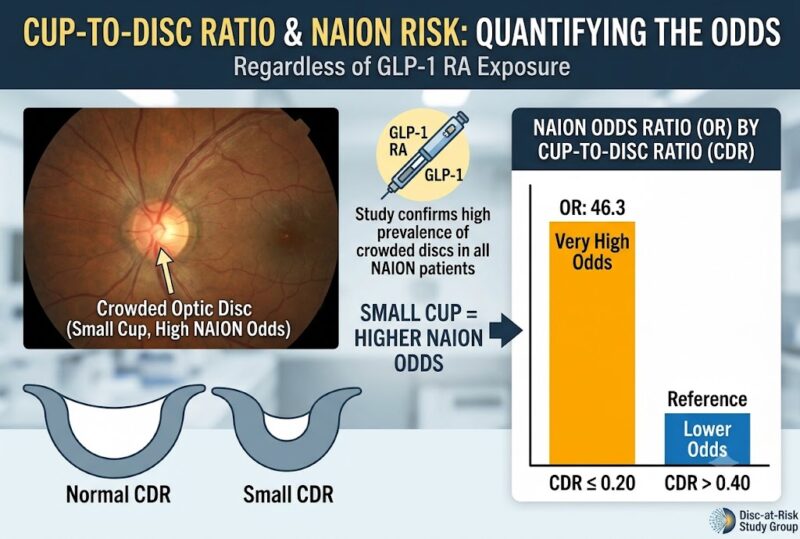
- Patients with a CDR ≤ 0.20 exhibit 46-fold higher odds of NAION compared to those with CDR > 0.40.
- GLP-1 RA exposure does not independently alter the risk of NAION related to optic disc morphology.
Study Background
Nonarteritic anterior ischemic optic neuropathy (NAION) is a common acute optic neuropathy characterized by sudden, painless vision loss due to ischemia of the optic nerve head. It typically affects older adults with vascular risk factors such as hypertension and diabetes mellitus. A recognized anatomical risk factor for NAION is a crowded optic disc, often quantified as a small cup-to-disc ratio (CDR), which predisposes the optic nerve head to ischemic events.
Glucagon-like peptide-1 receptor agonists (GLP-1 RAs) are increasingly used for glycemic control in type 2 diabetes mellitus, with potential vascular effects beyond glucose lowering. However, there have been sporadic reports suggesting an association between GLP-1 RA exposure and NAION. This has led to clinical concern regarding whether GLP-1 RA medications independently increase NAION risk or interact with established anatomical factors like optic disc morphology.
Given the paucity of large-scale data evaluating the relationship between GLP-1 RA use, optic disc anatomy, and NAION risk, this study sought to clarify these associations by examining the cup-to-disc ratio in NAION patients with and without GLP-1 RA exposure.
Study Design
This retrospective, multicenter, case-control study involved 16 neuro-ophthalmology centers comprising the Disc-at-Risk Study Group. The study analyzed medical records spanning 2018 to 2024, including 2,169 consecutive patients diagnosed with NAION and their unaffected fellow eyes (totaling 1,812 eyes).
Patients were stratified into three groups based on GLP-1 RA exposure prior to NAION diagnosis: (1) semaglutide users (117 eyes), (2) non-semaglutide GLP-1 RA users (83 eyes), and (3) no GLP-1 RA exposure (1,612 eyes). A control group consisted of both eyes from 465 individuals without NAION, serving to define the baseline CDR distribution in the general population.
The primary outcome measure was the cup-to-disc ratio (CDR) of the unaffected fellow eyes among NAION patients, assessed by both provider estimates and photographic measurements. Odds ratios (OR) for NAION were calculated based on measured CDR categories, comparing smaller CDR ranges to larger ones.
Key Findings
The study revealed several important findings:
- Similar CDR across GLP-1 RA exposure groups: Average provider-estimated CDR in unaffected fellow eyes was approximately 0.13, with no statistically significant difference between semaglutide users, other GLP-1 RA users, or non-users. This suggests GLP-1 RA exposure does not influence optic disc crowding in NAION patients.
- High prevalence of crowded discs in NAION patients: Among NAION fellow eyes, 94% had a measured CDR ≤ 0.40 compared to only 56% among controls (p < 0.001). Additionally, 54% of NAION fellow eyes had a very small CDR ≤ 0.20 versus only 9% of control eyes (p < 0.001), underscoring the strong association between small CDR and NAION risk.
- Markedly increased odds of NAION with smaller CDR: Eyes with a CDR ≤ 0.20 had an odds ratio (OR) of 46.3 (95% CI 23.0–93.4) for NAION relative to eyes with CDR > 0.40. Eyes with CDR between 0.20 and 0.40 also had increased NAION odds (OR 6.8; 95% CI 3.5–13.2), indicating a graded inverse relationship between CDR size and NAION risk.
- No indication that GLP-1 RAs independently affect NAION risk intensity from an anatomical perspective: The data do not indicate that GLP-1 RA medications alter risk via changes in optic disc morphology, as prevalence and magnitude of crowded discs were comparable irrespective of GLP-1 RA exposure.
Expert Commentary
This comprehensive multicenter analysis elegantly confirms that a “disc-at-risk” phenotype—a crowded optic disc characterized by a small cup-to-disc ratio—is the primary anatomical driver of NAION susceptibility. The lack of difference in CDR among GLP-1 RA exposed and nonexposed NAION cases implies that concerns about GLP-1 RAs inducing disc crowding or directly increasing NAION risk via this anatomical pathway are unfounded.
The finding that eyes with extremely small CDR (≤ 0.20) have over 45-fold increased odds of NAION highlights the clinical importance of optic disc evaluation in risk assessment. This well-quantified risk may aid clinicians in counseling patients with small optic discs and coexisting vascular risk factors.
However, this study is limited by its retrospective design and reliance on documented GLP-1 RA exposure without identifying other possible confounders. Prospective studies are needed to determine if GLP-1 RAs exert any independent risk mediated by vascular or metabolic mechanisms. Additionally, the absolute risk of NAION remains low even in high-risk disc phenotypes, so risk-benefit considerations of GLP-1 RA therapy should remain comprehensive.
Conclusion
This robust multicenter case-control study clarifies that nonarteritic anterior ischemic optic neuropathy overwhelmingly occurs in the setting of a crowded optic disc with a small cup-to-disc ratio, regardless of GLP-1 receptor agonist exposure. The odds of NAION increase markedly as the cup-to-disc ratio diminishes, with eyes exhibiting a CDR ≤ 0.20 having 46-fold higher odds compared to those with larger CDR.
While GLP-1 RA medications do not appear to alter optic disc anatomy related to NAION, clinicians should consider disc morphology when discussing NAION risk with patients. This study provides an important quantitative framework for predicting NAION risk based on optic disc measurements but does not establish GLP-1 RAs as independent risk factors.
Future prospective studies should aim to integrate anatomical, metabolic, and pharmacological factors to further elucidate NAION pathogenesis and guide optimal diabetes treatment choices.
Funding and Clinical Trials
The study was conducted by the Disc-at-Risk Study Group across multiple neuro-ophthalmology centers. Specific funding and clinical trial registration details were not provided in the source publication.
References
1. Robertson CM, Fung DS, Smith KH, et al. Cup-to-disc ratio in GLP-1 RA Associated Non-Arteritic Anterior Ischemic Optic Neuropathy. Ophthalmology. 2026 Aug 5; PMID: 42556433.
2. Hayreh SS. Ischemic optic neuropathy. Prog Retin Eye Res. 2009 Jan;28(1):34-62.
3. Beck RW, Servais GE, Hayreh SS. Vitamin and antiplatelet treatment in prevention of second eye involvement in ischemic optic neuropathy. Arch Ophthalmol. 1993.
4. Silva PS, Sun JK, Aiello LP. GLP-1 receptor agonists and cardiovascular outcomes: impact beyond glucose control. Diabetes Care. 2021.