Enhanced Healing and Zone-Specific Cartilage Protection With Concomitant Meniscal Centralization in Medial Meniscus Posterior Root Repair: Insights From a Rabbit Model
Concomitant centralization with medial meniscus posterior root repair (RR-CP) reduces cartilage degeneration compared to isolated root repair (RR).
RR-CP enhances meniscal root healing, with fewer nonhealed repairs observed.
High-resolution MRI identifies zone-specific cartilage thickness preservation in the central and posterior medial femoral condyle after RR-CP.
Meniscal extrusion did not significantly differ between RR and RR-CP groups, suggesting cartilage preservation is not solely related to extrusion reduction.
Study Background
The medial meniscus posterior root (MMPR) is critical in distributing load and maintaining knee joint stability. Tears to the MMPR disrupt hoop stresses leading to meniscal extrusion and subsequent articular cartilage degeneration, contributing to the progression of osteoarthritis (OA). Repair of the MMPR aims to restore meniscal function and delay OA development. However, isolated root repair (RR) may not fully prevent cartilage deterioration due to persistent extrusion or incomplete healing. Meniscal centralization procedures (CP), which aim to reposition and stabilize the meniscus, have emerged as adjuncts to RR, with promising short-term clinical outcomes. Despite this, their efficacy in chondroprotection and enhancing repair healing remains uncertain, and the biological effects on specific cartilage zones in the medial femoral condyle have not been fully elucidated. This study addresses these gaps using a controlled in vivo rabbit model.
Study Design
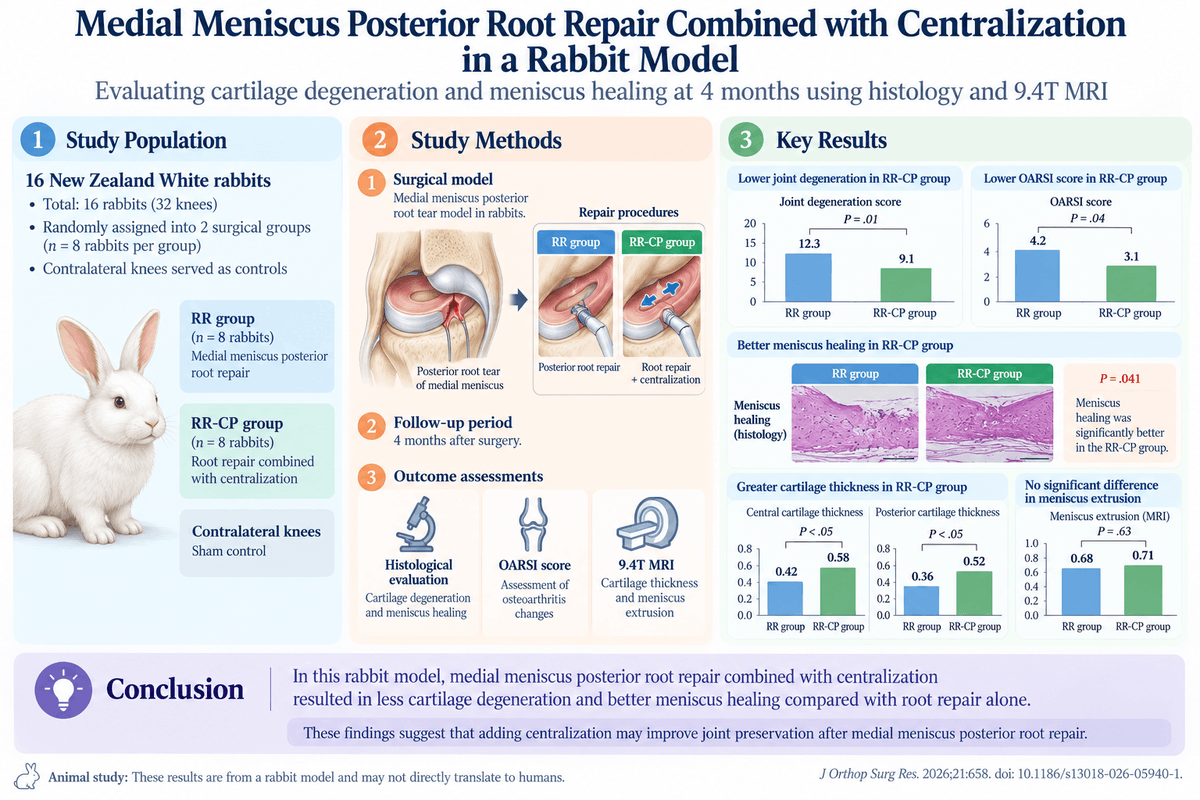
This controlled laboratory study involved 16 New Zealand White rabbits with surgically induced MMPR tears. Subjects were randomized to undergo either isolated MMPR repair (RR group, n=8) or MMPR repair augmented with a concomitant meniscal centralization procedure (RR-CP group, n=8). Contralateral limbs served as unoperated controls. The RR-CP utilized interlocking knotless anchors to centralize the meniscus. After four months post-surgery, animals were euthanized for tissue evaluation.
Primary outcomes included macroscopic joint degeneration scoring and microscopic cartilage assessment using the Osteoarthritis Research Society International (OARSI) scoring system. Repair tissue healing was also scored. Medial femoral condyle cartilage thickness and meniscal extrusion (ME) were quantitatively analyzed using high-resolution 9.4 Tesla magnetic resonance imaging (MRI). The femoral condyle was divided into anterior, central, and posterior regions of interest to assess zone-specific alterations.
Key Findings
Macroscopic and microscopic analyses revealed significant benefits of RR-CP over isolated RR. The gross joint degeneration score was markedly lower in RR-CP (9.1 ± 2.0) compared to RR (12.3 ± 2.2), indicating reduced cartilage damage (P = .01). Correspondingly, the OARSI microscopic scores showed less osteoarthritic changes in the RR-CP group (3.1 ± 1.6) relative to RR (4.2 ± 1.5, P = .04).
Repair healing outcomes favored RR-CP with significantly higher healing scores (2.5 ± 0.7 vs 1.75 ± 0.5; P = .041) and fewer nonhealed roots compared to RR alone. This underscores enhanced biological repair potential with the centralization procedure.
MRI-based cartilage thickness measurements demonstrated zone-specific differences. In the central and posterior zones of the medial femoral condyle, RR knees exhibited significant cartilage thinning relative to both RR-CP and uninjured control knees (P ≤ .02). The anterior cartilage thickness did not differ significantly between groups (P = .23), highlighting a localized chondroprotective effect of RR-CP in more load-bearing regions.
Meniscal extrusion, a key factor in meniscal function loss, was not significantly different between RR and RR-CP groups (P = .12), suggesting that cartilage preservation after RR-CP may involve mechanisms beyond extrusion control alone.
Both experimental groups exhibited greater chondral damage relative to contralateral controls (P < .001), confirming the injury’s impact on cartilage health despite repair.
Expert Commentary
The findings from this well-controlled in vivo experiment provide important mechanistic insights into the benefits of a concomitant meniscal centralization procedure with MMPR repair. Improved cartilage preservation and enhanced repair healing suggest that centralization may restore meniscal biomechanics more effectively by optimizing load distribution and meniscal positioning.
Zone-specific preservation of the central and posterior femoral condyle cartilage aligns with the typical loading patterns of the medial compartment, indicating the clinical relevance of targeted tissue protection. Interestingly, the lack of difference in meniscal extrusion between groups challenges the conventional assumption that extrusion reduction is the key mediator of cartilage preservation. Instead, centralization may improve meniscal tension and hoop stress restoration, supporting repair healing.
Limitations include the relatively short-term follow-up at four months and the use of a rabbit model, which might limit direct extrapolation to human knees due to anatomical and biomechanical differences. Longitudinal clinical studies are warranted to define patient selection criteria and further characterize long-term outcomes and OA progression.
Conclusion
Augmenting medial meniscus posterior root repair with a meniscal centralization procedure in a rabbit model leads to reduced cartilage degeneration and improved repair tissue healing compared to isolated root repair. This benefit is most pronounced in the central and posterior zones of the medial femoral condyle. Meniscal extrusion did not differ significantly, indicating alternative biomechanical or biological mechanisms for cartilage preservation. These findings provide a foundation for future clinical investigations to optimize surgical indications and enhance patient outcomes in meniscal root repair strategies.
Funding and Registration
The study was supported by institutional research grants; specific funding details were not provided. There is no clinicaltrials.gov registration since this is a preclinical animal study.
References
1. Dzidzishvili L, Nelson B, Santangelo K, et al. Concomitant Centralization Procedure With Medial Meniscus Posterior Root Repair May Have Zone-Specific Effects on the Medial Femoral Condyle and Enhance Repair Healing Compared With Isolated Root Repair: An In Vivo Experimental Study in Rabbit Knees. Am J Sports Med. 2026 Oct 20:3635465261492230. PMID: 42899379.
2. Allaire R, Muriuki M, Gilbertson L, Harner CD. Biomechanical Consequences of a Medial Meniscus Posterior Root Tear. A Cadaveric Study. Am J Sports Med. 2008;36(9):1716-1722.
3. LaPrade RF, Ellman MB, Rasmussen MT, James EW, Wascher DC. Clinical Diagnosis of Posterior Root Tears of the Medial Meniscus. Knee Surg Sports Traumatol Arthrosc. 2015;23(4):987-93.
4. Furumatsu T, Kodama Y, Tsuda E, et al. Meniscal Repair in the Knee: Current Concepts and Future Directions. J Orthop Sci. 2021;26(5):724-733.