Introduction and Context
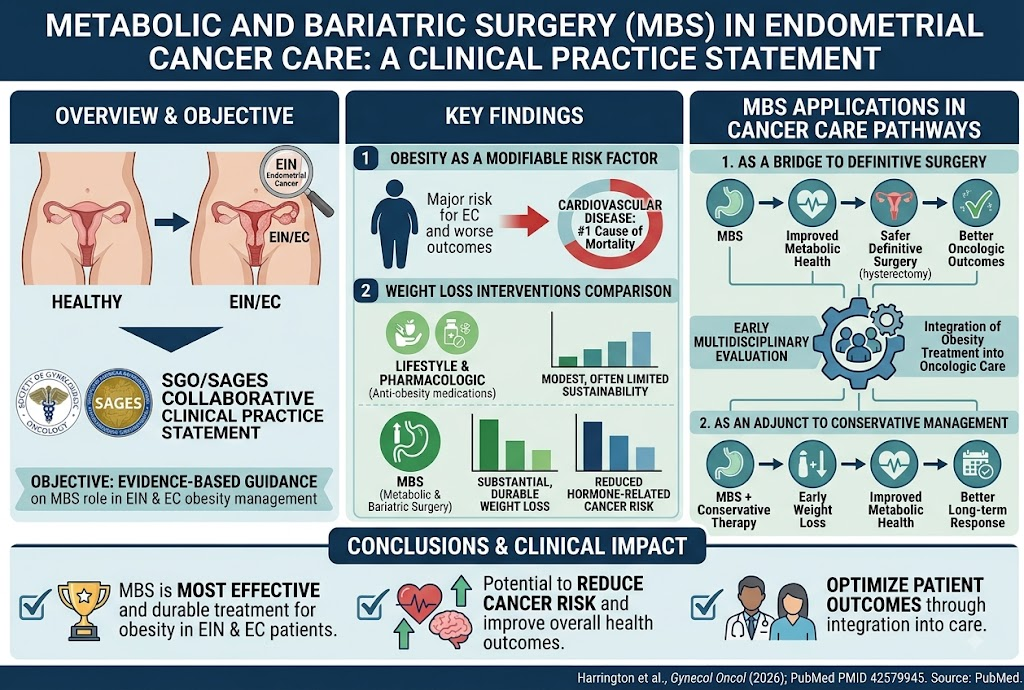
Obesity is one of the strongest modifiable risk factors for endometrial intraepithelial neoplasia (EIN) and endometrial cancer (EC). The rising prevalence of obesity worldwide has contributed to increased incidence of EC, particularly type I, estrogen-driven disease. Beyond cancer risk, excess adiposity worsens perioperative risk, compromises candidacy for minimally invasive surgery, increases cardiometabolic morbidity, and contributes to long-term mortality, often from cardiovascular disease rather than cancer itself.
In August 2026 the Society of Gynecologic Oncology (SGO) and the Society of American Gastrointestinal and Endoscopic Surgeons (SAGES) published a joint clinical practice statement addressing the role of metabolic and bariatric surgery (MBS) and other weight-loss interventions in women with EIN and EC (Harrington et al., Gynecologic Oncology 2026). The statement synthesizes current evidence and provides actionable, multidisciplinary guidance on when and how to integrate obesity treatment—ranging from lifestyle and medications to endoscopic and surgical therapies—into oncologic care.
This article summarizes the SGO–SAGES statement, explains why it was issued, highlights core recommendations and practice-changing themes, details diagnostic and treatment-related guidance, and offers expert commentary on controversies and implementation.
Why this statement was issued
– Clinical gap: Historically, obesity treatment and cancer care have been siloed. Women with EIN or EC frequently do not receive systematic obesity care, despite evidence that obesity strongly influences both cancer risk and overall survival.
– Emerging evidence: Large observational studies and meta-analyses have associated MBS with durable weight loss, improvement or resolution of cardiometabolic disease, and reductions in incidence of certain obesity-related cancers in women. Early reports also describe using MBS to improve surgical candidacy and reduce perioperative risk in oncologic patients.
– New therapeutic options: The past decade brought more effective anti-obesity medications (AOMs), refined endoscopic bariatric therapies, and growing data supporting MBS safety and feasibility in complex patients, prompting a reevaluation of when to offer such therapies in the oncology setting.
The SGO–SAGES statement fills an important need: it operationalizes current evidence for clinicians who treat patients with EIN and EC and advocates for early, multidisciplinary obesity management as part of comprehensive cancer care (Harrington et al., 2026).
New Guideline Highlights — Major recommendations and themes
– MBS is the most effective and durable treatment for severe obesity and should be offered to eligible women with EIN or EC as part of multidisciplinary care when obesity limits oncologic treatment options or when long-term health benefits are the goal.
– Early multidisciplinary evaluation — ideally at diagnosis or during initial oncology assessment — is recommended to identify patients who would benefit from obesity treatment and to coordinate timing relative to cancer-directed therapy.
– Obesity treatment should be individualized: options include lifestyle modification, AOMs, endoscopic therapies, and MBS. The choice depends on BMI, comorbidities, cancer stage, fertility desires, and patient goals.
– MBS may be used at several time points: as primary risk-reduction in EIN or premalignant disease, as a bridge to definitive cancer surgery (to improve candidacy for minimally invasive approaches), or as adjunctive therapy following cancer treatment to reduce comorbidity and potentially future cancer risk.
– Shared decision-making is essential; patients must understand cancer-specific risks, timing implications, reproductive considerations, and the expected benefits and risks of obesity interventions.
Key takeaways for clinicians
– Screen all women with EIN or EC for obesity-related risk and offer expedited referral to obesity specialists or bariatric surgery teams.
– Consider MBS in appropriate candidates rather than delaying referral until after cancer treatment is completed.
– Use a team-based approach (gynecologic oncologist, bariatric surgeon, medical weight-loss clinician, nutritionist, anesthesiologist, and reproductive specialist when applicable).
Updated Recommendations and Key Changes
The SGO–SAGES statement represents an important shift from framing obesity as a background comorbidity to recognizing it as a modifiable factor that should be actively managed within oncologic care. Compared with prior practice (where obesity management often awaited primary cancer therapy conclusion), major updates include:
– Earlier integration: explicit recommendation for early, often simultaneous, evaluation for obesity interventions at the time of EIN or EC diagnosis.
– Expanded scope of acceptable therapies: endorsement of AOMs and endoscopic bariatric therapies as adjuncts or temporizing measures for select patients while awaiting MBS or definitive cancer therapy.
– Surgical timing flexibility: acceptance of MBS both prior to and after oncologic surgery when clinically appropriate, including its use as a bridge to improve candidacy for minimally invasive gynecologic oncologic procedures.
Evidence driving the updates
– Long-term cohort studies and meta-analyses have demonstrated that bariatric surgery produces durable weight loss, improves or resolves diabetes and hypertension, and is associated with lower all-cause mortality in some cohorts (Sjöström et al., N Engl J Med 2007).
– Population and registry studies have linked bariatric surgery with reduced incidence of several obesity-associated cancers in women; mechanistic plausibility includes reduced estrogen exposure and improved metabolic milieu.
– Emerging case series and institutional experiences document feasibility and safety of combining or sequencing MBS with gynecologic oncologic care in selected patients.
Topic-by-Topic Recommendations
Below are condensed, actionable recommendations adapted from the SGO–SAGES statement. Where the statement provides explicit recommendation strength or evidence level, it is noted; where not specified, recommendations reflect the committee’s consensus.
1) Initial assessment and triage
– At diagnosis of EIN or EC, record weight, BMI, waist circumference, and a focused cardiometabolic history.
– Screen for obesity-related comorbidities (diabetes, dyslipidemia, sleep apnea, hypertension). Order preoperative optimization testing when surgery is planned.
– Offer expedited referral to a multidisciplinary obesity care team for any patient with BMI ≥30 kg/m2; prioritize evaluation for BMI ≥35 kg/m2 or when obesity impairs oncologic treatment options.
2) Risk stratification and fertility considerations
– For patients desiring fertility preservation (often offered progestin therapy for EIN or early EC), integrate weight management early: substantial weight loss can improve response to conservative management and reduce recurrence risk.
– Discuss timing: in some cases, rapid weight loss using AOMs or MBS prior to fertility treatments may be reasonable; coordinate with reproductive endocrinology.
3) Use of lifestyle modification and anti-obesity medications (AOMs)
– Lifestyle interventions (diet, exercise, behavioral therapy) are first-line but often yield modest, sometimes transient weight loss.
– AOMs (GLP-1 receptor agonists such as semaglutide/dulaglutide, tirzepatide where approved) can produce clinically significant weight loss and may be appropriate as an adjunct or bridge therapy when MBS is delayed or contraindicated.
– Consider potential interactions with oncologic therapy and monitor for treatment-specific side effects (nausea, GI symptoms).
4) Endoscopic bariatric therapies
– Endoscopic approaches (intragastric balloons, endoscopic sleeve gastroplasty) may be offered as temporizing or bridge therapies for carefully selected patients needing short-term weight loss prior to cancer-directed surgery.
– These therapies are less durable than MBS but can improve perioperative risk in the short term.
5) Metabolic and bariatric surgery (MBS)
– Recommendation: Offer MBS to appropriate candidates with obesity-related comorbidities, particularly when obesity limits oncologic options or threatens long-term survival; discuss potential cancer risk reduction benefits.
– Standard eligibility criteria follow established bariatric guidelines (e.g., BMI ≥40 kg/m2 or BMI ≥35 kg/m2 with significant comorbidity), with individualized consideration for those with BMI 30–34.9 kg/m2 and severe metabolic disease per contemporary metabolic-surgery guidance.
– Timing considerations:
– Preoncologic MBS: May be used as a risk-reduction strategy in EIN/premalignant disease or to optimize patients prior to definitive oncologic surgery when delays are oncologically safe.
– Peri-oncologic sequencing: Coordinate care; if immediate oncologic surgery is required, consider MBS afterward.
– Postoncologic MBS: May be offered after cancer therapy to reduce cardiometabolic risk and potential future cancer risk.
– Procedure selection (e.g., sleeve gastrectomy, Roux-en-Y gastric bypass) should be individualized based on comorbidity profile, need for adjuvant therapies, surveillance imaging, and nutritional implications.
6) Perioperative and survivorship care
– Preoperative optimization: assess cardio-pulmonary risk, obstructive sleep apnea, glycemic control; start nutritional and psychosocial preparation.
– Survivorship: integrate long-term nutritional follow-up, cancer surveillance, and cardiometabolic risk management. Emphasize that cardiovascular disease is a leading cause of mortality in EC survivors.
Recommendation Grading (summary)
The SGO–SAGES statement synthesizes available evidence (largely observational cohorts, mechanistic data, and expert consensus) to produce practical recommendations. In brief:
– Strong recommendation (consensus-based): Early multidisciplinary evaluation and integration of obesity treatment into oncologic care.
– Conditional/recommendation with moderate evidence: Consideration of MBS for eligible patients as part of comprehensive management; use of AOMs and endoscopic therapies as adjuncts or bridges.
– Evidence limits: Direct randomized trial data of MBS specifically for cancer outcomes in EIN/EC are limited; recommendations emphasize shared decision-making and individualization.
Expert Commentary, Controversies, and Research Needs
Expert panel perspectives (paraphrased from the SGO–SAGES committee and accompanying editorial commentary):
– Consensus view: Treating obesity is integral to comprehensive cancer care. MBS is an important tool that should not be withheld simply because a patient has a cancer diagnosis.
– Controversy: Timing of MBS relative to oncologic treatment is debated. For aggressive high-stage disease, immediate cancer-directed therapy takes precedence; for early-stage disease or EIN, earlier MBS may offer long-term benefits.
– Procedure selection debates: Some oncologists express concern about post-MBS alterations to imaging, absorption of oral therapies, and nutrient monitoring. Bariatric surgeons emphasize that procedure choice should reflect oncologic and metabolic priorities.
– Equity and access: There is concern that referral pathways for MBS are underused in marginalized populations. Experts recommend systematic screening and streamlined referral models to reduce disparities.
Key research needs identified by the committee:
– Prospective studies and randomized trials addressing whether MBS reduces EC recurrence or cancer-specific mortality.
– Comparative effectiveness studies of AOMs, endoscopic therapies, and MBS in the pre- and post-oncologic settings.
– Implementation research on models of multidisciplinary care and their impact on outcomes and access.
Practical Implications for Clinicians and Health Systems
– Operational steps for clinics:
– Implement routine BMI and cardiometabolic screening for all patients with EIN/EC.
– Create referral pathways linking gynecologic oncology clinics with bariatric surgery and medical weight-management services.
– Document candidacy discussions for obesity interventions in the medical record and include patient preferences in care plans.
– For individual clinicians:
– Discuss obesity early and without judgment; frame MBS as a cancer-relevant, evidence-based option when appropriate.
– Use shared decision-making to balance oncologic urgency, fertility desires, and obesity treatment timelines.
– System-level considerations:
– Insurers and health systems should consider coverage pathways that permit timely access to multidisciplinary obesity care for patients with EIN and EC, given potential to improve both cancer and cardiometabolic outcomes.
Patient vignette: Applying the guidance
Maria, a 42-year-old with BMI 44 kg/m2, is diagnosed with EIN and is interested in fertility preservation. Her oncology team recognizes obesity as a modifiable risk that may reduce her chance of successful conservative management. Using the SGO–SAGES guidance, the team initiates an expedited referral to a bariatric surgeon and a weight-management clinician. After counseling, Maria chooses a time-limited trial of an AOM and endoscopic therapy to achieve rapid weight loss while undergoing progestin therapy and fertility planning. The multidisciplinary team monitors her response and adjusts the plan; if conservative management fails, MBS remains an available, evidence-based option to improve long-term health and reduce future cancer risk.
Conclusions
The SGO–SAGES 2026 clinical practice statement marks an important paradigm shift: obesity is no longer an incidental comorbidity to be deferred, but a modifiable factor that should be addressed proactively as part of endometrial disease management. MBS is affirmed as the most effective and durable obesity treatment for eligible women with EIN and EC, with potential benefits that extend beyond weight loss to reduced comorbidity and possibly lower cancer risk. Early multidisciplinary evaluation, individualized treatment planning, and equitable access are the statement’s core calls to action. Moving forward, prospective studies are needed to quantify the cancer-specific benefits of MBS and to clarify best timing and patient selection.
References
– Harrington S, El Ghazal N, Tung C, Husain F, Pan K, Ramaswamy A, Shariff F, Jardine R, McCourt C, Ghanem O. The role of metabolic and bariatric surgery for obesity management in endometrial intraepithelial neoplasia and endometrial cancer: A Society of Gynecologic Oncology and Society of American Gastrointestinal and Endoscopic Surgeons clinical practice statement. Gynecol Oncol. 2026 Aug 11;212:31–42. PMID: 42579945.
– Sjöström L, Lindroos AK, Peltonen M, et al. Lifestyle, diabetes, and cardiovascular risk factors 10 years after bariatric surgery. N Engl J Med. 2004;351(26):2683–2693. (Swedish Obese Subjects long-term outcomes).
– Ligibel JA, Strickler HD, Schmitz KH, et al. American Society of Clinical Oncology Position Statement on Obesity and Cancer. J Clin Oncol. 2014;32(31):3568–3574.
– Mechanick JI, Apovian C, Brethauer S, et al. Clinical practice guidelines for the perioperative nutrition, metabolic, and nonsurgical support of the bariatric surgery patient—2013 update: cosponsored by American Association of Clinical Endocrinologists, The Obesity Society, and American Society for Metabolic & Bariatric Surgery. Obesity (Silver Spring). 2013;21 Suppl 1:S1–S27.
– Lauby-Secretan B, Scoccianti C, Loomis D, et al.; International Agency for Research on Cancer Handbook Working Group. Body fatness and cancer—viewpoint of the IARC Working Group. N Engl J Med. 2016;375(8):794–798.
(Additional cited literature and systematic reviews are referenced in the SGO–SAGES statement.)