Highlight
The FRAGILE randomized trial compared off-pump coronary artery bypass grafting (OPCAB) to traditional on-pump CABG (ONCAB) in prefrail and frail patients aged 60 years and above, focusing on 30-day major adverse events and 1-year neurocognitive outcomes. The study found no statistically significant difference in the primary composite outcome, with a trend favoring OPCAB. Surgical wound infections were significantly less frequent with OPCAB. No differences were observed in neurocognitive or quality-of-life outcomes at one year.
Study Background
Coronary artery bypass grafting (CABG) remains a cornerstone revascularization procedure for patients with complex coronary artery disease. However, older adults with frailty—a syndrome characterized by diminished physiologic reserves and increased vulnerability to stressors—experience higher perioperative risk and worse outcomes following CABG. Among surgical techniques, on-pump CABG (ONCAB) utilizes cardiopulmonary bypass and cardiac arrest, which may exacerbate oxidative stress, inflammation, and cognitive decline, potentially impacting frail patients differently compared to off-pump CABG (OPCAB), which avoids cardiopulmonary bypass.
Despite these considerations, evidence comparing the effectiveness and safety of OPCAB versus ONCAB specifically in prefrail and frail populations remains scarce. This gap informed the design of the FRAGILE trial, aiming to ascertain if OPCAB confers advantage or comparable safety in this vulnerable subgroup.
Study Design
The FRAGILE trial was a multicenter, randomized, open-label study enrolling 508 patients aged ≥60 years identified as prefrail or frail. Participants were randomly assigned 1:1 to undergo OPCAB or ONCAB between January 2018 and December 2024. The primary endpoint was a composite of death, myocardial infarction, stroke, renal failure, acute respiratory distress syndrome (ARDS), or reoperation for bleeding at 30 days post-surgery.
Secondary outcomes included ventilation duration, intensive care unit (ICU) and hospital length of stay, transfusion requirements, completeness of coronary revascularization, surgical wound infections at 30 days, and neurocognitive function assessed preoperatively and at 1-year follow-up. The trial adhered to the intention-to-treat principle for analyses, reporting relative risks (RR) with 95% confidence intervals (CIs).
Key Findings
The study population had a median age of 68 years (interquartile range 65–73), with 30.5% female. Distribution was nearly even between OPCAB (258 patients) and ONCAB (250 patients).
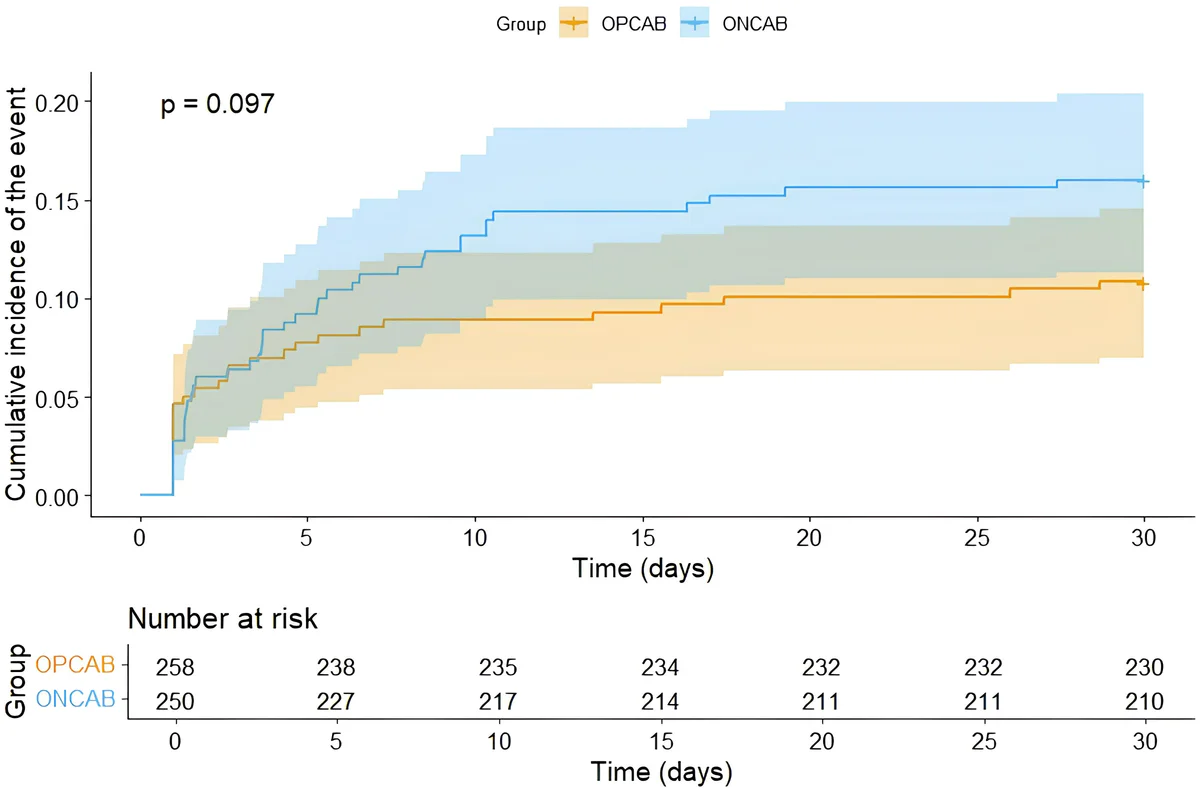
Primary Composite Outcome: Occurred in 10.9% of OPCAB patients versus 16.0% ONCAB patients (RR 1.47, 95% CI 0.94–2.31, P=0.09). Though not statistically significant, the trend suggested fewer major adverse events with OPCAB.
Surgical Wound Infection: Significantly higher in ONCAB group (8.0%) compared to OPCAB (3.5%), P=0.04, suggesting lower infectious complications with off-pump surgery.
Neurocognitive and Quality-of-Life Outcomes: No significant differences were found between groups at 1 year, indicating similar cognitive trajectories and patient-reported well-being postoperatively.
Survival: Estimated 1-year survival was 96.1% in OPCAB versus 92.8% in ONCAB cohorts (P=0.099), showing a non-significant survival benefit trend favoring OPCAB.
Other Secondary Outcomes: No clinically relevant differences were reported for ventilation time, ICU or hospital stay duration, or transfusion requirements. Completeness of revascularization was comparable, addressing concerns of potentially less complete grafting with off-pump approaches.
Expert Commentary
The FRAGILE trial provides important, prospective randomized data addressing a critical knowledge gap—optimal CABG strategy in the growing population of older adults with frailty. The similar composite adverse event rate challenges historical concerns about off-pump procedures leading to incomplete revascularization or inferior clinical outcomes. The statistically significant reduction in surgical wound infection rates with OPCAB is clinically relevant, as infection risk is a well-recognized complication that can profoundly affect frail patients.
Neurocognitive outcomes, a major consideration given the association of cardiopulmonary bypass with cognitive decline, were reassuringly similar, suggesting no cognitive disadvantage to either technique after one year. This might reflect improvements in perioperative care and careful patient selection.
Limitations include the open-label design, which could introduce performance bias, although objective outcome measures mitigate this risk. Longer-term follow-up may be needed to detect differences in survival or graft patency. Generalizability is strengthened by the multicenter design encompassing broad clinical settings but may be limited to centers with experienced OPCAB surgeons.
Conclusion
Among prefrail and frail patients undergoing coronary artery bypass surgery, OPCAB and ONCAB achieve comparable 30-day major adverse event rates and neurocognitive outcomes at one year. The lower incidence of surgical wound infection with OPCAB suggests potential perioperative advantage. These findings support individualized surgical planning incorporating frailty status and surgical expertise when selecting CABG technique. Future research should focus on longer-term clinical and functional outcomes to further guide treatment strategies in this vulnerable population.
Funding and Clinical Trials Registration
The FRAGILE trial was registered at ClinicalTrials.gov (NCT02338947). Details regarding funding sources were not specified in the summarized data.
References
Mejia OAV, Meneghini B, de Freitas FL, et al. Off-Pump versus On-Pump Coronary Artery Bypass Grafting in Prefrail and Frail Patients: 30-Day and 1-Year Outcomes From the FRAGILE Randomized Trial. Circulation. 2026 Nov 10; PMID: 43006184. Available from: https://pubmed.ncbi.nlm.nih.gov/43006184/
Arnold SV, Mehra MR. Managing frailty in cardiac surgery patients. Nat Rev Cardiol. 2018;15(6):339-340.
Gonzalez EA, Agrawal R, Flanigan DP, et al. Frailty and cardiac surgery: risk vs benefit. J Cardiothorac Surg. 2021;16(1):170.
Specialty calculators
For clinical reference; use professional judgment.