Highlight
This landmark study reveals that low-density fractional microablative CO2 laser treatment provides significantly greater symptom relief in women with vulvar lichen sclerosus compared to standard topical clobetasol propionate therapy. The study provides data supporting laser therapy’s advantages in symptom control, physician-perceived skin improvement, and quality of life, with a favorable safety profile. Sequential treatment combining both modalities may further enhance outcomes.
Study Background
Lichen sclerosus (LS) is a chronic inflammatory dermatosis predominantly affecting the vulvar region of women. It is characterized by symptoms of burning, itching, and pain, which can substantially impair quality of life. The traditional first-line treatment consists of potent topical corticosteroids such as clobetasol propionate. However, corticosteroid resistance or adverse effects often limit their long-term utility. Emerging laser therapies offer promise by inducing dermal remodeling and symptomatic relief without some drawbacks of corticosteroids. This study aimed to directly compare the efficacy and safety of low-density fractional microablative CO2 laser treatment against topical clobetasol in symptomatic vulvar LS.
Study Design
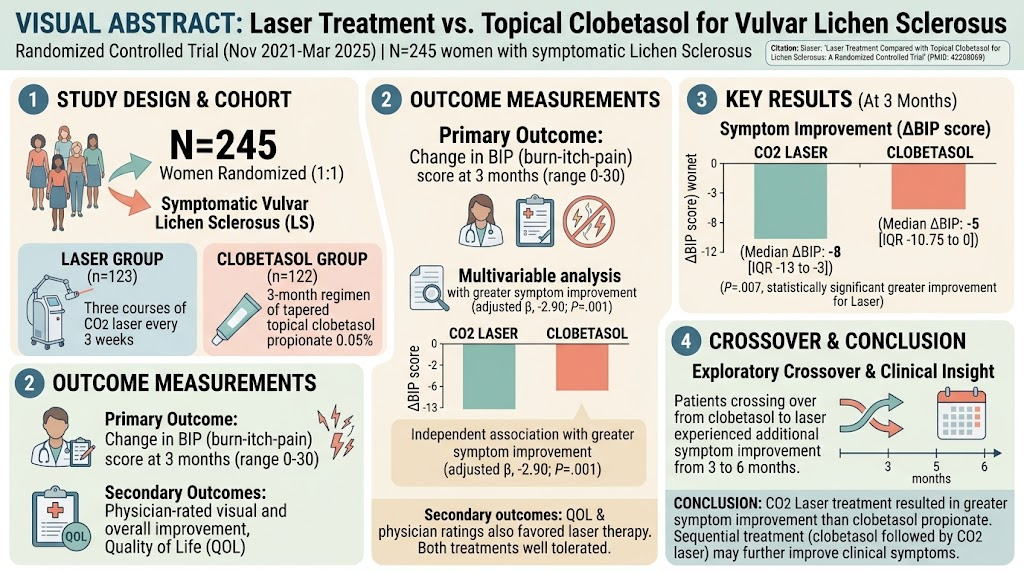
This prospective, randomized, open-label trial enrolled 245 women diagnosed with symptomatic vulvar LS. Participants were randomized into two groups: one receiving three sessions of low-density fractional microablative CO2 laser treatment at 3-week intervals, and the other undergoing a 3-month tapered regimen of topical clobetasol propionate 0.05%. The primary outcome was measured by changes in the BIP (burn-itch-pain) symptom score from baseline to 3 months. Secondary outcomes included physician-rated visual and overall clinical improvement and disease-specific quality of life assessments. The sample size provided 90% power to detect clinically meaningful differences between groups, with analyses performed under the intention-to-treat principle and adjustment for baseline characteristics.
Key Findings
At the 3-month primary endpoint, the laser treatment group demonstrated significantly greater symptom improvement compared to the clobetasol group. The median change in BIP score was −8 (interquartile range [IQR] −13 to −3) versus −5 (IQR −10.75 to 0) respectively, with a p-value of .007. Multivariable linear regression adjusted for confounders reinforced that laser therapy independently contributed to superior symptom relief (adjusted β = −2.90; 95% confidence interval: −4.64 to −1.15; P = .001).
Physician assessments corroborated patients’ symptom reports, showing improved visual signs and overall clinical status in the laser group. Disease-specific quality of life measures also favored laser therapy, indicating a meaningful positive impact on daily functioning and wellbeing. Both treatments were generally safe and well tolerated, with no serious adverse events related to the interventions reported.
Notably, an exploratory postrandomization phase allowed participants to switch therapies after the initial 3 months. Patients who transitioned from clobetasol to laser showed additional symptom improvement between 3 and 6 months, suggesting that sequential treatment might optimize therapeutic outcomes in refractory cases.
Expert Commentary
This study contributes important evidence advancing the management of vulvar LS, a challenging condition with limited therapeutic options beyond corticosteroids. The biological plausibility for laser efficacy likely relates to its ability to induce collagen remodeling, reduce fibrosis, and modulate local inflammation. While clobetasol remains a cornerstone, laser treatment offers a non-pharmacologic alternative or adjunct that could reduce corticosteroid exposure and cumulative side effects.
However, the open-label design and relatively short primary follow-up period are limitations. Longer-term data on durability of response and comparative side effects remain necessary. Additionally, cost and availability of laser treatment may limit widespread implementation. Guideline committees may soon consider integrating fractional CO2 laser as a second-line or adjunct therapy based on accumulating evidence.
Conclusion
Low-density fractional microablative CO2 laser therapy demonstrates superior efficacy over topical clobetasol in controlling vulvar LS symptoms, improving clinical appearance and quality of life, with an excellent safety profile. Sequential treatment combining corticosteroids followed by laser may further benefit patients. These findings herald a promising addition to the therapeutic arsenal against vulvar LS, warranting wider clinical adoption and further research to optimize protocols and long-term outcomes.
Funding and Clinical Trials Registration
This trial was registered at ClinicalTrials.gov under identifier NCT05010421. The study received institutional support, with no report of external funding conflicts reported in the primary publication.
References
Hecken JM, Shoham I, Tempfer CB, Rezniczek GA. Laser Treatment Compared with Topical Clobetasol for Lichen Sclerosus: A Randomized Controlled Trial. Obstet Gynecol. 2026 May 28;148(4):451-461. PMID: 42208069.