Highlight
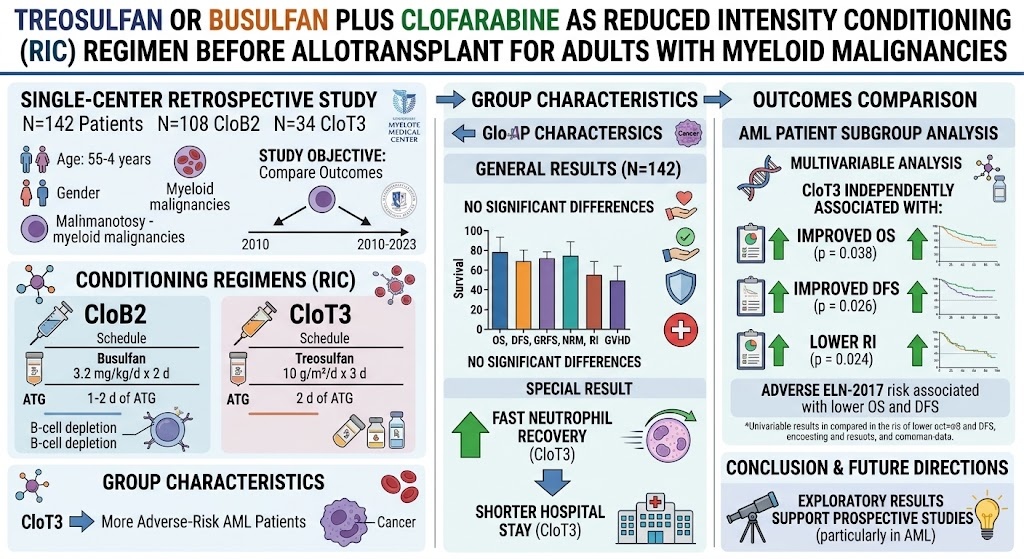
This retrospective single-center study evaluated 142 adults with myeloid malignancies undergoing allogeneic hematopoietic stem cell transplantation (allo-HSCT) with two clofarabine-based reduced intensity conditioning (RIC) regimens: treosulfan plus clofarabine (CloT3) and busulfan plus clofarabine (CloB2). Key findings include significantly faster neutrophil recovery and shorter hospitalization with CloT3, with no significant differences in graft-versus-host disease (GVHD) or non-relapse mortality (NRM). In multivariable analysis, CloT3 independently associated with improved overall survival (OS), disease-free survival (DFS), and lower relapse incidence (RI), particularly in acute myeloid leukemia (AML) patients, supporting further prospective validation.
Study Background
Allogeneic hematopoietic stem cell transplantation remains the only potentially curative treatment modality for various myeloid malignancies, including acute myeloid leukemia (AML) and myelodysplastic syndromes (MDS). Reduced intensity conditioning regimens are often employed to minimize treatment-related toxicity, particularly in older or comorbid patients. Busulfan-based regimens are established but carry risks of toxicity and graft complications. Treosulfan, an alkylating agent with a different toxicity profile, combined with clofarabine has emerged as a promising alternative RIC approach. However, comparative data assessing these conditioning options remain limited, creating a clinical need for studies to inform optimal conditioning regimen selection based on efficacy and safety outcomes.
Study Design
This single-center retrospective study included 142 adult patients with myeloid malignancies undergoing allo-HSCT with peripheral blood stem cells from matched related or unrelated donors between 2010 and 2023. Patients received one of two RIC regimens: CloB2, comprising busulfan 3.2 mg/kg/day over 2 days plus 1 or 2 days of anti-thymocyte globulin (ATG), versus CloT3, consisting of treosulfan 10 g/m²/day for 3 days plus 2 days of ATG. The study population included both AML and other myeloid malignancy patients, with the CloT3 group containing a higher proportion of patients with adverse-risk AML according to the European LeukemiaNet (ELN) 2017 classification. Outcomes assessed included hematologic recovery, length of hospitalization, overall survival (OS), disease-free survival (DFS), graft-versus-host disease (GVHD)-free/relapse-free survival, relapse incidence (RI), non-relapse mortality (NRM), and acute and chronic GVHD incidence. Both univariable and multivariable statistical analyses were conducted to evaluate the impact of conditioning regimen and prognostic factors.
Key Findings
Hematologic Recovery and Hospitalization
Neutrophil recovery was significantly faster in patients receiving CloT3 compared to CloB2, corresponding with a shorter hospital stay duration. Faster engraftment suggests potential advantages of treosulfan in facilitating hematopoietic recovery and reducing short-term morbidity post-transplant.
Survival and Relapse Outcomes
No statistically significant differences were initially observed between CloT3 and CloB2 groups in overall survival (OS), disease-free survival (DFS), or GVHD-free/relapse-free survival in unadjusted analyses. However, among AML patients, univariable analyses indicated higher relapse incidence and slower neutrophil recovery with CloB2.
Importantly, multivariable analyses controlling for risk factors, including the ELN-2017 adverse risk category, demonstrated CloT3 conditioning to be independently associated with improved OS (p = 0.038), DFS (p = 0.026), and lower relapse incidence (p = 0.024). Conversely, adverse-risk AML by ELN-2017 classification predicted significantly worse OS and DFS, underscoring the strong prognostic influence of disease biology.
Graft-versus-Host Disease and Non-Relapse Mortality
Rates of acute and chronic GVHD, as well as non-relapse mortality, were comparable between the two conditioning cohorts, suggesting that treosulfan does not increase GVHD risk despite faster hematologic recovery.
Expert Commentary
This study offers important exploratory data supporting treosulfan combined with clofarabine as a potentially superior alternative to busulfan-based RIC regimens, particularly in AML patients with higher risk features. Faster neutrophil recovery and shorter hospitalization may translate into improved patient quality of life and reduced healthcare resource utilization. The independent survival benefit of CloT3 in multivariable analysis adds biological plausibility given treosulfan’s distinct myeloablative and immunosuppressive properties compared to busulfan.
Limitations include the retrospective single-center design, modest sample size, and imbalanced risk profiles between cohorts that may confound results despite statistical adjustments. Prospective randomized trials are warranted to clarify comparative efficacy definitively and explore long-term safety. Furthermore, mechanistic studies could elucidate the differential immune and marrow microenvironment effects elicited by these agents.
Conclusion
The retrospective comparison indicates that treosulfan plus clofarabine RIC is associated with faster neutrophil engraftment, shorter hospitalization, and improved survival outcomes, especially in adverse-risk AML patients, without increasing GVHD or non-relapse mortality. These findings justify prospective trials to validate treosulfan-clofarabine as a frontline RIC regimen choice for adult myeloid malignancies undergoing allo-HSCT.
Funding and ClinicalTrials.gov
The original study does not specify funding sources or clinical trial registration.
References
1. Prin-Felix L, Jullien M, Peterlin P, et al. Treosulfan or busulfan plus clofarabine as reduced intensity conditioning regimen before allotransplant for adults with myeloid malignancies. Bone Marrow Transplant. 2026 Aug 19. PMID: 42618729.
2. European LeukemiaNet recommendations for AML management and risk stratification (Döhner et al., Blood 2017).
3. Niederwieser D, Baldomero H, et al. Conditioning regimens in allogeneic transplantation for AML: evidence-based review and clinical practice (Blood Rev. 2020).