Highlight
This randomized clinical trial demonstrated that an online, team-based connected health (TCH) model provides equivalent improvement in atopic dermatitis severity compared to conventional in-person care. Both children and adults with AD showed similar clinical improvements at one year when managed via asynchronous teledermatology. The findings support telehealth as a scalable, effective alternative for chronic dermatologic disease management, bridging geographic and access disparities.
Study Background
Atopic dermatitis (AD) is a chronic inflammatory skin condition affecting children and adults worldwide, characterized by recurrent eczematous lesions, intense pruritus, and substantial impact on quality of life. Effective management often requires specialist input, yet access to dermatologists can be limited, especially in rural or underserved areas. Traditional in-person dermatologic care may pose logistical and economic barriers. Integrating telehealth into dermatology promises to overcome such hurdles. However, definitive evidence confirming clinical equivalence of online models compared to in-clinic visits remains limited. This trial addresses the unmet need for validated scalable care models connecting primary care providers, specialists, and patients to manage AD effectively across geographic boundaries.
Study Design
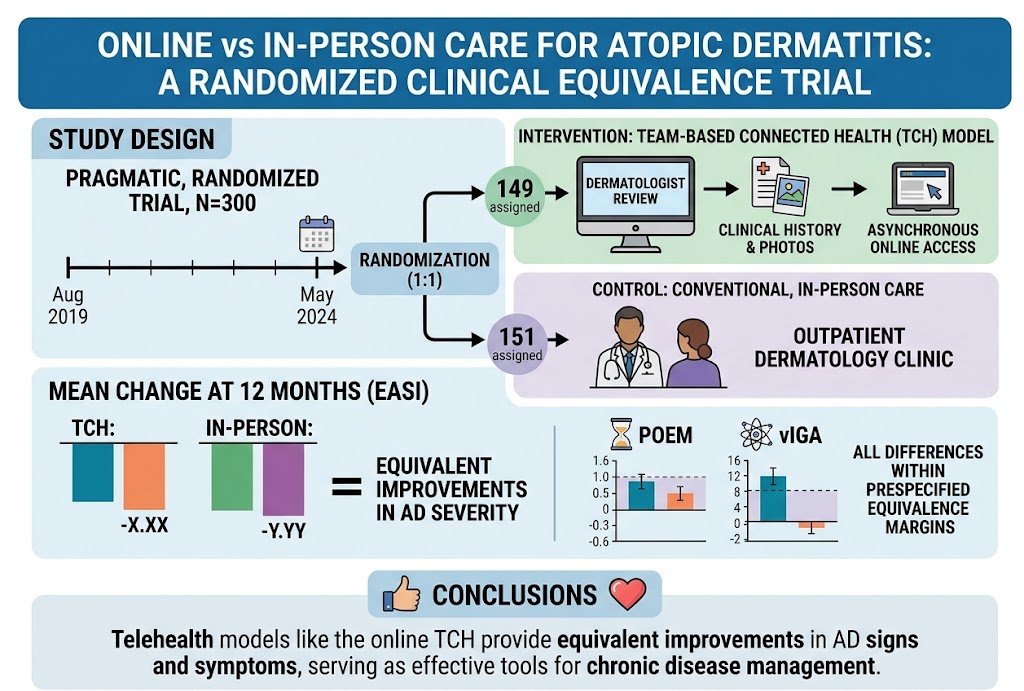
This pragmatic, randomized clinical equivalence trial enrolled 300 patients with physician-diagnosed atopic dermatitis from eight outpatient dermatology clinics in California between August 2019 and May 2024. Participants were aged ≥1 year with internet access and the ability to send photographs, including both established and new patients. They were randomized 1:1 to either the online team-based connected health (TCH) intervention or usual in-person care.
The TCH model enabled asynchronous communication; dermatologists reviewed patients’ clinical history and submitted photographs remotely to assess disease severity and guide treatment. The control group received standard face-to-face dermatologic care at outpatient clinics. The primary outcome was change in Eczema Area and Severity Index (EASI) at 12 months, a validated instrument quantifying extent and severity of eczema. Secondary outcomes included Patient-Oriented Eczema Measure (POEM) evaluating symptom burden from the patient perspective and Investigator Global Assessment (vIGA) of disease severity, both assessed quarterly.
Key Findings
Among the 300 participants (mean age 34.6 years, 70.3% female), 149 were assigned to TCH and 151 to in-person care. At 12 months, mean changes in EASI scores were nearly identical between groups: the difference in mean change was -0.01 (95% CI, -0.22 to 0.20), demonstrating clinical equivalence according to predefined margins.
Secondary outcomes also supported equivalence between treatment arms. The difference in mean POEM scores was 0.38 (95% CI, 0.03–0.73), and for vIGA was 0.06 (95% CI, 0.00–0.11), all within established equivalence thresholds. Importantly, no safety concerns were reported related to the teledermatology approach. These findings confirm that asynchronous online care with specialist input effectively controls both objective signs and patient-reported symptoms of AD to the same degree as conventional in-person dermatologic visits.
Expert Commentary
These results underscore the potential for telehealth to transform chronic dermatology care by improving access without compromising clinical outcomes. They align with emerging data validating teledermatology’s role in various skin conditions. The asynchronous TCH model leverages technology to accommodate patient and provider schedules while maintaining specialist oversight—a pragmatic innovation especially relevant during the COVID-19 pandemic and beyond.
Limitations include the study’s regional focus within California and requirement for internet and photograph access, which may limit generalizability to populations with limited digital resources. Further research should explore cost-effectiveness, patient satisfaction, and long-term adherence. Additionally, integration with primary care workflows and insurance reimbursement policies will be key determinants of widespread implementation.
Conclusion
This large, pragmatic randomized trial provides compelling evidence that online, team-based connected health care models achieve equivalent improvements in atopic dermatitis severity and symptoms compared to traditional in-person care. Telehealth represents a robust, patient-centered strategy to expand access and continuity of dermatologic care for chronic skin diseases. As healthcare systems evolve, innovative digital models such as this can address access disparities, optimize resource use, and improve patient outcomes.
Funding and Clinical Trial Registration
This study was supported by institutional and external grants (not specified in abstract). Trial was registered on ClinicalTrials.gov (NCT03981926).
References
Armstrong AW, Roberts AM, Kostandy G, et al. Online vs In-Person Care for Atopic Dermatitis: A Randomized Clinical Trial. JAMA Dermatol. 2026;162(8):795–803. doi:10.1001/jamadermatol.2026.408