Highlight
- Implementation of a multidisciplinary Chronic Care Management (CCM) model under the Johns Hopkins Care Transformation Organization (CTO) significantly reduces acute hospitalizations and emergency department visits in high-risk patients.
- Propensity-score-matched analysis reveals CCM lowers acute care utilization and reduces associated healthcare expenditures by approximately $3000 over six months.
- No significant effect on 30-day hospital readmissions was observed, indicating CCM’s impact is more pronounced on initial acute care events rather than rehospitalizations.
Study Background
Chronic diseases contribute substantially to morbidity, mortality, and healthcare spending in the United States. High-risk patients with multiple or complex chronic conditions frequently experience avoidable acute care encounters such as hospital admissions and emergency department (ED) visits, which not only reflect gaps in ambulatory care but also pose a financial burden to health systems and patients. Chronic Care Management programs aim to address these challenges through improved care coordination, leveraging multidisciplinary teams to deliver proactive, patient-centered care. However, prior evidence evaluating CCM effectiveness, especially in high-risk populations, has been mixed, necessitating robust investigations to clarify its real-world impact on healthcare utilization and costs.Study Design
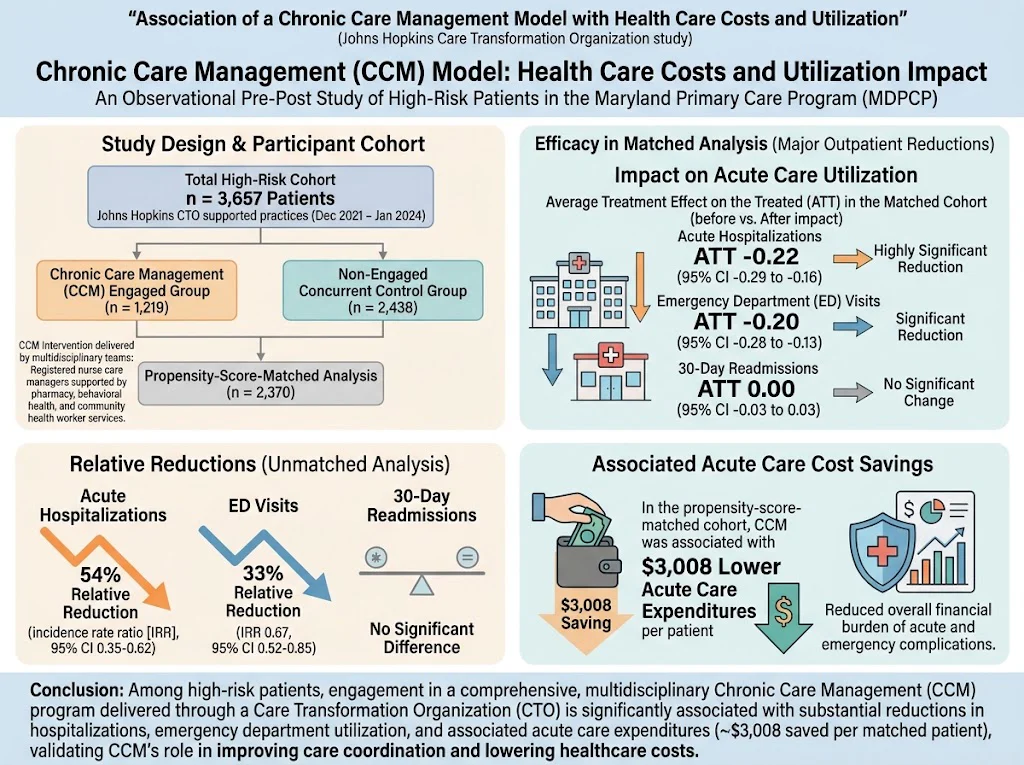
This observational pre-post study incorporated a concurrent control group and propensity-score matching to rigorously evaluate the effect of a comprehensive CCM program administered through the Johns Hopkins Care Transformation Organization (CTO). The target population comprised high-risk patients attributed to Maryland Primary Care Program (MDPCP) practices from December 2021 to January 2024. Among 3657 patients, 1219 engaged in the multidisciplinary CCM intervention, while 2438 non-engaged patients served as controls, randomly sampled to mirror the eligibility criteria. The intervention included registered nurse care managers supported by pharmacy, behavioral health, and community health worker services delivered according to clinical need. The primary endpoints encompassed acute hospitalizations, emergency department visits, 30-day hospital readmissions, and acute care expenditures, measured over six months before and after a defined index date.Key Findings
Baseline data indicated that CCM participants had substantially higher rates of acute care utilization than controls, reflective of their elevated clinical complexity and risk profile. Analysis without matching demonstrated that CCM participation was associated with a 54% reduction in hospitalizations (incidence rate ratio [IRR] 0.46, 95% confidence interval [CI] 0.35–0.62) and a 33% reduction in ED visits (IRR 0.67, 95% CI 0.52–0.85), without significant differences observed in 30-day readmissions. Following propensity-score matching, which balanced baseline characteristics to reduce confounding, CCM retained its association with meaningful reductions in hospitalizations (average treatment effect on the treated [ATT] –0.22 hospitalizations per patient, 95% CI –0.29 to –0.16) and ED visits (ATT –0.20 visits per patient, 95% CI –0.28 to –0.13). Notably, readmission rates remained unaffected (ATT 0.00, 95% CI –0.03 to 0.03), suggesting CCM primarily prevented new acute care events rather than rehospitalizations. Importantly, CCM participants incurred on average $3008 lower acute care expenditures in the matched cohort, underscoring the program’s potential cost-saving impact.Interpretation and Clinical Significance
The substantial reduction in hospitalizations and ED visits highlights the potential of CCM models to improve care delivery for medically complex populations by addressing underlying care gaps, proactively managing chronic conditions, and coordinating multi-domain interventions including behavioral health and pharmacy supports. These outcomes align with broader health system goals to reduce avoidable acute care utilization and contain escalating costs. The absence of effect on readmissions may reflect the multifactorial nature of rehospitalizations, which often involve social determinants and health system factors beyond the scope of CCM alone.Expert Commentary
Experts recognize that chronic care management’s impact depends on the intensity and integration of services provided. The multidisciplinary approach in this Johns Hopkins program exemplifies an advanced CCM structure that extends beyond traditional nursing case management by incorporating behavioral health and community health resources, addressing the biopsychosocial needs of high-risk patients. This design likely underpins the observed reductions in initial hospital and emergency visits, evidencing the importance of comprehensive care coordination. Nonetheless, limitations include the observational nature of the study, potential residual confounding despite matching, and the relatively short follow-up period focused on six months. Further research is warranted to examine long-term outcomes, scalability, and patient-centered endpoints such as quality of life.Conclusion
This study provides compelling real-world evidence that a robust, multidisciplinary Chronic Care Management program delivered through a Care Transformation Organization can significantly reduce acute hospitalizations, emergency department visits, and related acute care expenditures among high-risk patients. These findings support broader implementation of integrated CCM services as a strategic approach to improve health outcomes and reduce costs in vulnerable populations. Ongoing evaluation should explore optimizing program components, extending follow-up, and integrating social determinants to further enhance CCM effectiveness.Funding and Disclosures
Funding details and potential conflicts of interest were not specified in the source study abstract. The Johns Hopkins CTO and MDPCP affiliation suggest programmatic and institutional support.References
1. Bhatla A, Mueller AK, Fu J, Norman T, Eldridge J, Tschudy MM, Berkowitz SA. Association of a Chronic Care Management Model with Health Care Costs and Utilization. Journal of General Internal Medicine. 2026 Oct 21. PMID: 42907693. 2. Bodenheimer T, Wagner EH, Grumbach K. Improving primary care for patients with chronic illness. JAMA. 2002;288(14):1775-1779. 3. Coleman K, Austin BT, Brach C, Wagner EH. Evidence on the Chronic Care Model in the new millennium. Health Aff (Millwood). 2009;28(1):75-85. 4. Jackson GL, Powers BJ, Chatterjee R, et al. The Patient-Centered Medical Home: A Systematic Review. Ann Intern Med. 2013;158(3):169-178.Specialty calculators
For clinical reference; use professional judgment.