Highlights
- Orforglipron, a novel oral non-peptide GLP-1 receptor agonist, demonstrated robust and dose-dependent bodyweight reduction in Japanese adults with obesity disease.
- The ATTAIN-J trial showed statistically significant improvements in co-primary endpoints, with up to ~9% mean bodyweight loss at 72 weeks versus placebo.
- Orforglipron exhibited a safety profile consistent with other GLP-1 receptor agonists, primarily mild-to-moderate gastrointestinal adverse events.
- This oral treatment modality offers a promising addition to obesity pharmacotherapy, particularly suitable for Japanese patients with metabolic comorbidities.
Background
Obesity constitutes a significant global health challenge, associated with increased risk for cardiovascular disease, type 2 diabetes mellitus (T2DM), hypertension, and dyslipidaemia. In Japan, prevalence patterns and diagnostic thresholds differ culturally and biologically; therefore, regulatory indications specify treatment criteria such as BMI ≥27 kg/m2 with multiple obesity-related disorders or BMI ≥35 kg/m2 with at least one obesity-related disorder. Current pharmacotherapies including GLP-1 receptor agonists (GLP-1RAs) have demonstrated efficacy in weight reduction and cardiometabolic risk mitigation, yet access and tolerability remain areas for improvement. Orforglipron, a small-molecule oral non-peptide GLP-1RA, was developed to overcome limitations of injectable agents, offering convenience and patient adherence advantages. The ATTAIN-J trial aimed to evaluate the long-term efficacy and safety of orforglipron in a Japanese population with obesity disease reflective of clinical practice indications.Key Content
Trial Design and Population
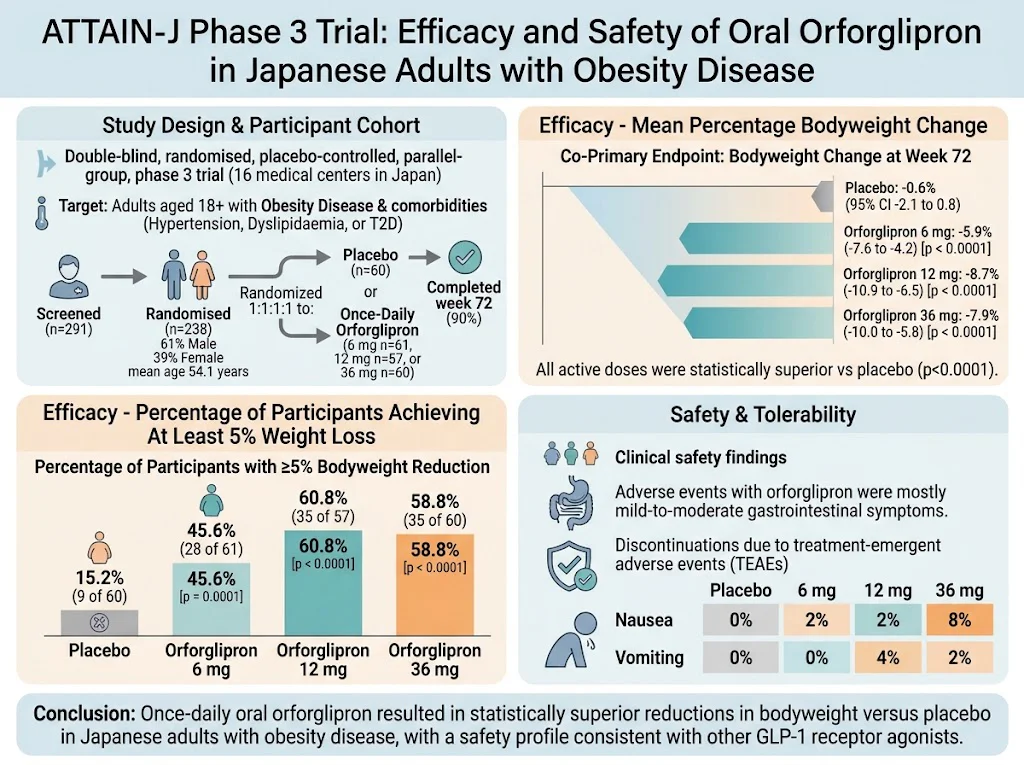
ATTAIN-J was a multicenter, double-blind, randomized, placebo-controlled, parallel-group phase 3 study enrolling adult Japanese participants aged ≥18 years with BMI criteria aligning with Japanese clinical practice guidelines, plus obesity-related comorbidities such as hypertension, dyslipidaemia, or T2DM (~25% targeted participants with T2DM). Participants had to have documented prior unsuccessful weight loss attempts through diet. Randomization assigned participants (n=238) equally to receive once-daily oral orforglipron at doses of 6 mg, 12 mg, 36 mg, or placebo. The primary efficacy endpoints were mean percentage change in bodyweight and proportion achieving ≥5% weight loss at week 72, assessed under the treatment regimen estimand to include all randomized subjects.Efficacy Outcomes
At week 72, orforglipron groups exhibited significant dose-dependent reductions in bodyweight: –5.9% (6 mg), –8.7% (12 mg), and –7.9% (36 mg) compared to –0.6% for placebo (p<0.0001 for all comparisons). The proportion achieving ≥5% weight loss was markedly higher in orforglipron-treated participants: 45.6% (6 mg), 60.8% (12 mg), and 58.8% (36 mg), versus 15.2% with placebo. Notably, the 12 mg dose provided the greatest efficacy, with only marginal incremental benefit observed for 36 mg. These findings align with the established efficacy of GLP-1RAs such as semaglutide and tirzepatide in obesity management, but uniquely, orforglipron's oral non-peptide chemistry offers a distinct therapeutic option.Safety Profile
Adverse events (AEs) were predominantly mild to moderate, notably gastrointestinal (GI) in nature — including nausea and vomiting — reflecting the GLP-1RA class effects. Treatment discontinuation due to AEs was low; nausea led to discontinuation in 2–8% depending on dose, with higher rates at 36 mg. No serious unexpected safety signals emerged, and no placebo participants discontinued due to GI AEs. This tolerability profile parallels long-acting injectable GLP-1RAs, suggesting orforglipron is generally well tolerated by Japanese patients over prolonged treatment.Comparison With Other GLP-1 Receptor Agonists
Injectable semaglutide and tirzepatide have shown bodyweight reductions in the range of 10–15% over similar durations. While orforglipron’s efficacy is slightly lower, its oral route, and favorable safety, may enhance patient acceptance and adherence, crucial in chronic obesity management. The ATTAIN-J results affirm orforglipron as an efficacious and safer alternative within the weighted GLP-1RA axis, extending the therapeutic arsenal, especially in Japanese populations where pharmacogenomic factors may influence outcomes.Implications for Japanese Clinical Practice
The trial’s design reflected local therapeutic guidelines and targeted a population with metabolic complications aligned with obesity disease definitions in Japan. The demonstrated efficacy supports orforglipron’s potential for integration into obesity disease treatment frameworks, complementing lifestyle approaches and offering alternative to injectable GLP-1RAs.Expert Commentary
The ATTAIN-J trial provides robust phase 3 evidence supporting the use of oral orforglipron in a Japanese cohort at risk for cardiorenal-metabolic complications due to obesity. Its significant weight loss efficacy and favorable safety profile addressing GI tolerability issues affirm the mechanistic rationale underlying GLP-1 receptor agonism — enhancement of satiety, delayed gastric emptying, and improved glycemic control. Differences in pharmacokinetics, pharmacodynamics, and tolerability between Japanese and non-Japanese populations necessitate localized data; this study fills a critical gap. The observed plateau of efficacy between 12 mg and 36 mg doses suggests an optimal therapeutic window, balancing efficacy and tolerability. Nonetheless, longer-term data beyond 72 weeks are desirable to confirm maintenance of weight loss and long-term safety. Additionally, real-world effectiveness studies assessing patient adherence and quality of life impacts would be invaluable. The mild-to-moderate GI adverse event profile warrants discussion in clinical practice to optimize dose titration and patient counseling. Comparatively, orforglipron’s oral formulation might resolve adherence barriers linked with injectable therapies.Conclusion
The ATTAIN-J phase 3 trial establishes oral orforglipron as an effective and safe therapeutic option for Japanese adults with obesity disease, offering a significant mean weight reduction and substantial responder rates over 72 weeks. Its oral delivery confers convenience and potential for enhanced patient acceptance relative to injectable GLP-1RAs. This agent expands therapeutic choices amid a growing obesity burden, aligning with metabolic disease management guidelines in Japan. Further post-marketing and real-world evidence will be critical to confirming durability and broader applicability, while ongoing mechanistic studies may elucidate novel pathways enhancing weight regulation.References
- Yokote K, Yamauchi T, Shingaki T, et al. Efficacy and safety of oral orforglipron in Japanese participants with obesity disease (ATTAIN-J): a double-blind, randomised, placebo-controlled, parallel-group, phase 3 trial. Lancet Diabetes Endocrinol. 2026; Published online Oct 30. PMID: 42962687.
- Wilding JPH, Batterham RL, Calanna S, et al. Once-Weekly Semaglutide in Adults with Overweight or Obesity. N Engl J Med. 2021;384(11):989-1002. doi:10.1056/NEJMoa2032183
- Frias JP, Davies M, Rosenstock J, et al. Tirzepatide versus semaglutide once weekly in patients with type 2 diabetes. N Engl J Med. 2021;385(6):503-515. doi:10.1056/NEJMoa2107519
- Kawasaki S, Tanaka S, Kawasaki Y, et al. Obesity-related cardiometabolic risk factors in East Asian populations. Nutrition. 2022;94:111503. doi:10.1016/j.nut.2021.111503
- Ghosh A, Sandoval DA. Evaluating GLP-1 Receptor Agonists in Treating Obesity and Diabetes: Current Status and Future Directions. Curr Diab Rep. 2023;23(3):110-122. doi:10.1007/s11892-023-01660-0
Specialty calculators
For clinical reference; use professional judgment.