Highlight
- CRT significantly improves left ventricular ejection fraction (LVEF) in patients with advanced heart failure.
- Post-CRT plasma metabolomic profiling shows decreased ketone bodies and branched-chain amino acids, particularly isoleucine.
- Distinct metabolomic changes are observed between ischemic and nonischemic cardiomyopathy groups after CRT.
- Improvement in LVEF correlates positively with reductions in ketone bodies and isoleucine, suggesting metabolic remodeling with CRT.
Study Background
Heart failure with reduced ejection fraction (HFrEF) poses a significant clinical challenge due to its high morbidity and mortality, despite advances in pharmacotherapy and device interventions. Cardiac resynchronization therapy (CRT) is an established treatment that improves cardiac function and symptoms in selected patients with HFrEF and ventricular dyssynchrony. However, while the mechanical benefits of CRT on cardiac contraction are well documented, its systemic biochemical effects, particularly on circulating metabolites, remain underexplored. Metabolomics—the comprehensive study of metabolites in biological samples—can provide insights into heart failure pathophysiology and treatment responses by capturing systemic metabolic alterations. Understanding how CRT influences the plasma metabolomic profile may shed light on mechanisms underlying its therapeutic benefits and potentially help tailor patient management.
Study Design
This observational cohort study prospectively enrolled 92 patients with advanced heart failure with reduced LVEF (≤35%) who underwent CRT implantation with defibrillator support according to contemporary guidelines. Patients included both ischemic cardiomyopathy and nonischemic cardiomyopathy etiologies. Clinical assessments comprised standard echocardiography evaluating LVEF and device interrogation. Plasma samples for metabolomic analysis were collected immediately before CRT implantation and at 6 months post-procedure. The metabolomic profiling employed both gas chromatography-mass spectrometry and proton nuclear magnetic resonance (1H-NMR) to detect and quantify a broad range of plasma metabolites. The primary endpoint was change in LVEF at 6 and 12 months, with correlation to metabolomic alterations.
Key Findings
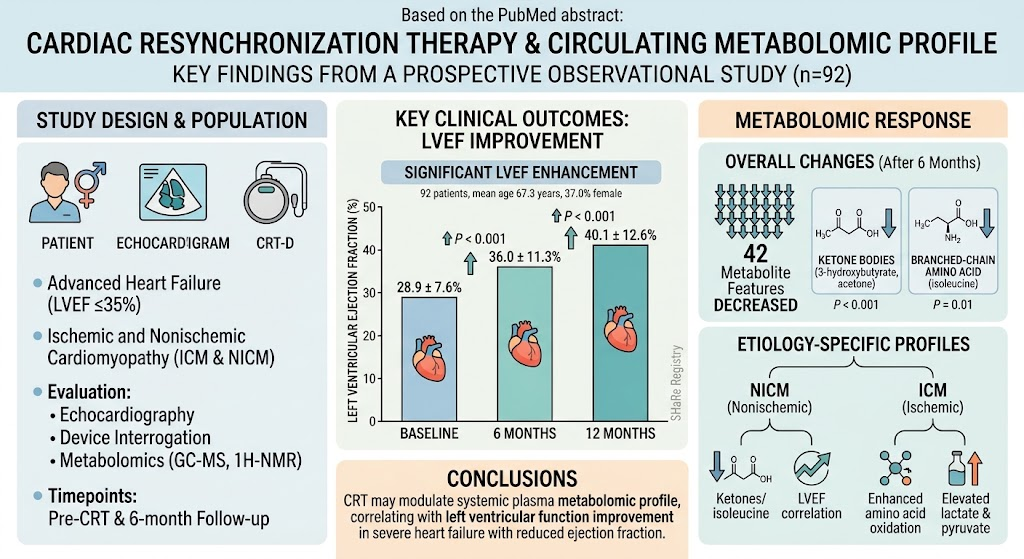
The cohort’s mean age was 67.3±11.3 years, with 37% female participants. Baseline mean LVEF was 28.9±7.6%. Following CRT, mean LVEF improved significantly to 36.0±11.3% at 6 months and further to 40.1±12.6% at 12 months (both P<0.001). This confirms the efficacy of CRT in enhancing left ventricular performance in advanced heart failure.
Metabolomic profiling revealed that 42 plasma metabolites decreased significantly after CRT compared to baseline. Notably, ketone bodies such as 3-hydroxybutyrate (P<0.001) and acetone (P=0.01) were reduced. The branched-chain amino acid isoleucine also decreased (P=0.01). Importantly, these metabolomic changes were predominantly observed in the nonischemic cardiomyopathy subgroup.
In contrast, the ischemic cardiomyopathy group exhibited a different metabolomic signature post-CRT, characterized by enhanced amino acid oxidation and elevated lactate and pyruvate levels, suggesting altered substrate utilization and possibly ongoing anaerobic metabolism or mitochondrial dysfunction.
Correlation analysis demonstrated that the degree of LVEF improvement positively correlated with the ratio of changes in ketone bodies and isoleucine levels. This finding suggests that the metabolic remodeling reflected by decreased ketone body reliance and branched-chain amino acid metabolism associates with reverse remodeling of cardiac function induced by CRT.
Expert Commentary
This study provides valuable insights into the systemic metabolic effects of CRT in patients with severe heart failure. The observed reductions in circulating ketone bodies may reflect improved myocardial energy efficiency or shifting substrate preference away from ketones, which are elevated in heart failure as alternative fuels. The decline in isoleucine, a branched-chain amino acid, may indicate less catabolic stress or improved amino acid utilization with cardiac function recovery.
Differentiating metabolomic responses between ischemic and nonischemic cardiomyopathy highlights the heterogeneity in heart failure pathophysiology and CRT response mechanisms. The ischemic group’s persistent elevations in lactate and pyruvate could denote residual ischemia or metabolic inflexibility despite mechanical resynchronization. These findings underscore the importance of personalized approaches to heart failure treatment guided by metabolic profiling.
Limitations include the observational design and lack of mechanistic experiments to fully elucidate causal pathways. The time points for metabolite sampling may miss dynamic changes beyond 6 months. Larger studies with functional metabolic assays and integration of imaging and clinical endpoints are warranted to validate these findings.
Conclusions
Cardiac resynchronization therapy not only improves left ventricular function in advanced heart failure but also induces significant systemic metabolic alterations detectable in plasma. The observed decreases in ketone bodies and branched-chain amino acids, especially in nonischemic cardiomyopathy patients, correlate with LVEF improvement and may represent beneficial metabolic remodeling.
Metabolomic profiling could emerge as a useful biomarker strategy to monitor CRT response and guide precision heart failure care. Future research should clarify the mechanistic links between CRT, cardiac metabolism, and clinical outcomes to optimize therapeutic algorithms.
Funding and ClinicalTrials.gov
The original study did not specify funding sources or clinical trials registration in the abstract. Further details can be obtained from the full publication.
References
1. Qian Z, Lee HC, Mulpuru SK, et al. Cardiac Resynchronization Therapy and Circulating Metabolomic Profile in Patients With Advanced Heart Failure. Circulation: Heart Failure. 2026;doi:10.1161/CIRCHEARTFAILURE.126.014148.
2. Maisel WH, Stevenson LW. Cardiac Resynchronization Therapy in Heart Failure. N Engl J Med. 2018;379:1249–1258.
3. Murphy SP, Gorecki AM, Jurcut R. Metabolomic Profiling in Heart Failure: The Emerging Role of Ketone Metabolism. JACC Basic Transl Sci. 2021;6(9-10):772-785.
4. Neubauer S. The failing heart — an engine out of fuel. N Engl J Med. 2007;356(11):1140-51.