Highlight
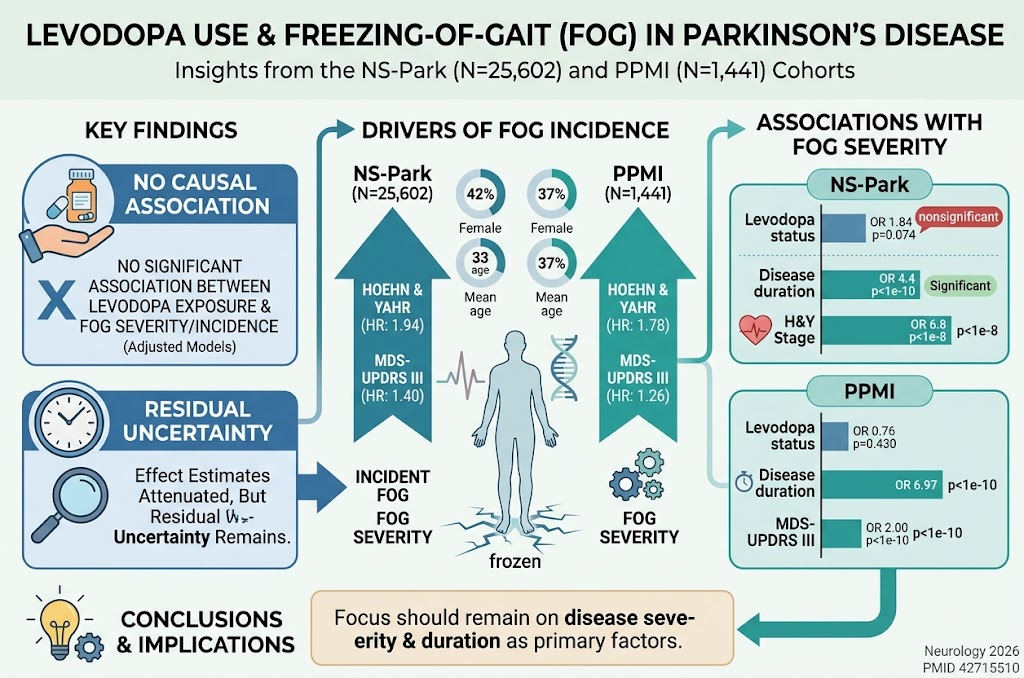
- No consistent or significant link was found between levodopa exposure and freezing of gait (FOG) in Parkinson’s disease once adjusted for disease severity and duration.
- Disease duration, Hoehn and Yahr stage, and motor impairment scores were strongly associated with FOG severity and incidence.
- Future levodopa use did not predict new onset of freezing of gait in patients without baseline FOG.
Study Background
Freezing of gait (FOG) is a disabling motor phenomenon in Parkinson’s disease (PD), characterized by transient episodes where patients are unable to initiate or continue forward movement, often leading to falls and reduced quality of life. While levodopa remains the gold standard symptomatic treatment for PD, empirical observations and some clinical reports have suggested that chronic levodopa exposure might contribute to the emergence or worsening of FOG. However, delineating this relationship is challenging due to confounding factors such as disease duration and severity, which are themselves strong predictors of FOG. Understanding whether levodopa independently influences FOG risk has important implications for PD management and treatment strategies.
Study Design
This study utilized two large, prospective multicenter cohorts: the French NS-Park cohort and the international Parkinson’s Progression Markers Initiative (PPMI). A total of 25,602 and 1,441 patients with Parkinson’s disease from NS-Park and PPMI, respectively, were included, each with at least two clinical visits. Three nested subcohorts were analyzed based on variables including disease duration, baseline FOG status, and levodopa exposure.
FOG was evaluated using item 2.13 of the Movement Disorder Society-Unified Parkinson’s Disease Rating Scale (MDS-UPDRS) Part II. The primary analyses applied mixed-effects ordered logistic regression models to assess FOG severity, while Kaplan-Meier survival analyses and Cox proportional hazards models were used to evaluate the incidence of de novo FOG. All models were adjusted for key confounders: disease duration, Hoehn and Yahr (H&Y) stage, and MDS-UPDRS Part III motor scores.
Key Findings
In unadjusted analyses within the NS-Park cohort, levodopa use was associated with increased FOG incidence and severity. Interestingly, this association was not observed in the PPMI cohort, where levodopa use did not significantly correlate with FOG.
After adjusting for disease duration and motor severity, levodopa exposure did not show statistically significant associations with FOG severity. Specifically, the odds ratio (OR) for levodopa use on FOG severity was 1.84 (95% CI 0.94-3.61, p=0.074) in NS-Park and 0.76 (95% CI 0.38-1.51, p=0.430) in PPMI, reflecting no meaningful effect. Conversely, disease duration (OR 4.4-6.97, p<10^-14), H&Y stage (NS-Park OR 6.8, p<10^-8; PPMI borderline), and MDS-UPDRS Part III motor scores (OR ~1.85-2.00, p<10^-5) were robustly associated with increased FOG severity.
Regarding incident FOG, no statistically significant relationship was found between future levodopa initiation and new-onset FOG. Instead, H&Y stage (hazard ratios [HR] approximately 1.8-1.9) and motor impairment scores (HR approximately 1.25-1.4) emerged as primary drivers.
Expert Commentary
This comprehensive analysis supports the notion that levodopa itself is not a direct causative factor for FOG when controlling for disease progression. The initially observed associations may largely reflect confounding by indication, where more severe disease necessitates levodopa therapy and is also tied to greater FOG risk.
Strengths of the study include the large sample size spanning two independent cohorts and rigorous statistical modeling accounting for important confounders. Some limitations include the observational nature of the data, which precludes definitive causal inference, and potential heterogeneity in levodopa dosing and formulations. FOG assessment used an established MDS-UPDRS item but lacked objective gait analysis or FOG-specific scales.
Clinically, these findings attest to the critical role of disease progression markers in FOG development and alleviate concerns that levodopa therapy per se exacerbates this disabling symptom. They emphasize a need for therapeutic strategies targeting underlying disease mechanisms and motor complications rather than rationing levodopa use out of FOG fears.
Conclusion
In summary, levodopa exposure does not independently increase the risk or severity of freezing of gait in Parkinson’s disease after adjustment for disease duration and severity. Instead, FOG is predominantly associated with disease progression and motor impairment levels. These data have important implications for managing motor symptoms in PD, reassuring clinicians and patients about the safety of levodopa concerning FOG, and guiding future research toward addressing the pathophysiology of gait disturbances.
Funding and ClinicalTrials.gov
The original study was supported by the French NS-Park network and other Parkinson’s disease research initiatives. The PPMI cohort is a well-known publicly funded observational study supported by the Michael J. Fox Foundation. ClinicalTrials.gov identifiers were not specified.
References
Barbosa R, Bastos P, Rascol O, et al. Levodopa Use and Characteristics of Freezing-of-Gait in Patients With Parkinson Disease in the NS-Park and PPMI Cohorts. Neurology. 2026 Sep 9;107(7):e218515. PMID: 42715510.
Additional literature on FOG pathophysiology, levodopa pharmacology, and PD motor complications can be explored for comprehensive understanding.