Highlight
- AF prevalence and incidence vary significantly across DCM genotypes, with LMNA mutations showing the highest risk.
- Genotype-positive LMNA carriers have more than fivefold increased risk of developing AF compared with genotype-negative patients.
- Incident AF independently predicts adverse clinical outcomes including heart failure progression, ventricular arrhythmias, and mortality.
- Findings support implementing genotype-guided AF surveillance and management strategies in DCM populations.
Study Background
Dilated cardiomyopathy (DCM), characterized by ventricular dilation and impaired systolic function, is a leading cause of heart failure and arrhythmias. Among arrhythmias, atrial fibrillation (AF) is the most common in DCM and is strongly linked to morbidity and mortality. Despite its recognized clinical significance, the genetic underpinnings that modify the risk of AF in DCM have not been fully elucidated. Particularly, how specific pathogenic variants influence AF development and prognosis remains unclear. Understanding these genotype-specific risks may improve personalized monitoring and therapeutic strategies for DCM patients.
Study Design
This observational cohort study utilized data from the Sarcomeric Human Cardiomyopathy Registry (SHaRe), encompassing 3117 genotyped patients with clinically diagnosed DCM. Patients were stratified into genotype-positive [G(+)] if harboring pathogenic or likely pathogenic variants in known DCM-associated genes, and genotype-negative [G(-)] when genetic testing was negative.
Key metrics assessed included AF prevalence at baseline, incidence of new-onset AF during follow-up (median 4.5 years), and cumulative prevalence. Cox proportional hazards regression evaluated factors associated with incident AF. AF was modeled as a time-dependent covariate to determine its effect on composite clinical outcomes (heart failure events, ventricular arrhythmias, and all-cause mortality).
Key Findings
Of the 3117 patients studied (mean age 48±15 years; 39% female; 35% genotype-positive), 12.3% had prevalent AF at baseline. In patients initially free of AF (n=2491), 12.5% developed AF during follow-up, resulting in a cumulative AF prevalence of 23.6% across the cohort.
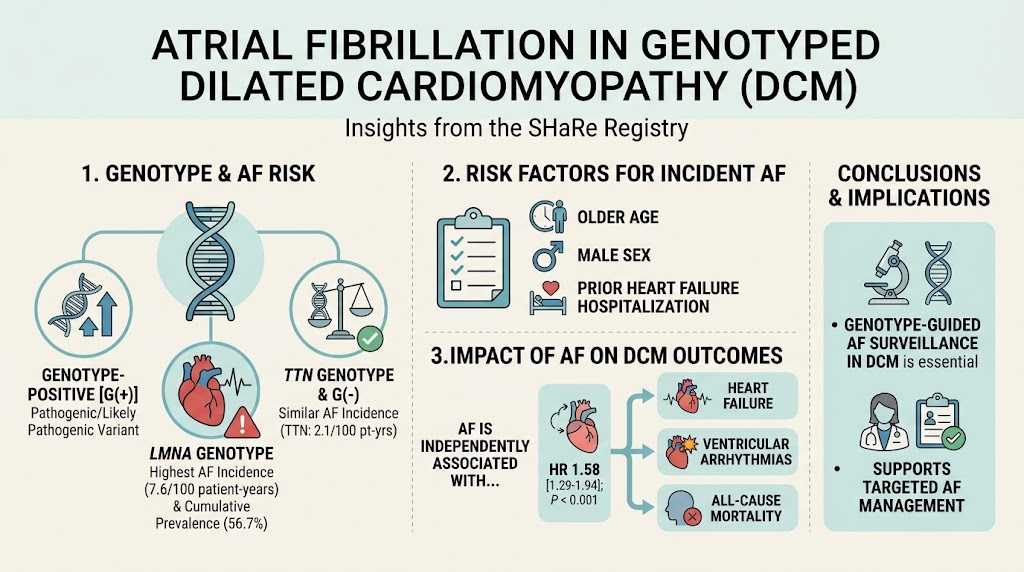
Genotype-specific analysis showed the LMNA gene mutation subgroup had a dramatically elevated AF incidence rate of 7.6 per 100 patient-years and a cumulative AF prevalence of 56.7%. This was statistically significant: LMNA mutations conferred a hazard ratio (HR) of 5.52 (95% confidence interval [CI], 3.84–7.95; P<0.001) for incident AF compared with genotype-negative patients. In contrast, TTN mutation carriers had an AF incidence similar to genotype-negative patients (2.1 per 100 patient-years; cumulative prevalence 24.4%).
Other independent factors associated with incident AF included older age, male sex, and prior heart failure hospitalizations.
Importantly, incident AF was independently linked to increased risk of adverse outcomes, with an adjusted HR of 1.58 (95% CI, 1.29–1.94; P<0.001) for the composite endpoint encompassing heart failure, ventricular arrhythmias, and all-cause mortality.
Expert Commentary
This landmark study provides robust genotype-phenotype correlation in DCM, elucidating how LMNA mutations uniquely predispose patients to AF, a known driver of clinical deterioration. The strong association of LMNA variants with AF incidence highlights a possible arrhythmogenic substrate inherently linked to nuclear envelope dysfunction. Conversely, TTN mutations, the most common genetic etiology in DCM, do not confer additional AF risk, suggesting distinct mechanistic pathways for atrial arrhythmogenesis.
The independent prognostic impact of AF, beyond traditional clinical factors, underscores the need for early and targeted rhythm monitoring in genotype-defined risk groups. These findings align with emerging guideline recommendations advocating for personalized management based on genetic profiling.
Limitations of the study include its observational design and potential referral bias inherent to registry data. Furthermore, detailed mechanistic studies are warranted to dissect the molecular basis of genotype-specific AF risk.
Conclusion
The SHaRe Registry data definitively establish genotype-dependent variability in AF risk among patients with DCM, with LMNA mutations conveying a significant predisposition to incident AF. AF onset portends worse outcomes, reinforcing its role as a critical therapeutic target. This evidence supports incorporating genetic testing results into clinical decision-making to enable tailored surveillance and intervention strategies designed to mitigate AF-related morbidity and mortality in DCM.
Funding and ClinicalTrials.gov
The SHaRe Registry is an international collaborative effort supported by institutional grants and research funding. No clinical trial registration was applicable as this was an observational cohort analysis.
References
Balakrishnan ID, et al. Atrial Fibrillation in Genotyped Dilated Cardiomyopathy: Epidemiology, Risk Factors, and Outcomes: Insights From the SHaRe Registry. Circ Heart Fail. 2026 Sep 10;e014322. PMID: 42717878.
Cappola TP, et al. Genetic determinants of atrial fibrillation: Lessons from dilated cardiomyopathy. Circ Arrhythm Electrophysiol. 2022;15(3):e010341.
Holm H, et al. Genome-wide association study of atrial fibrillation identifies genetic loci associated with DCM susceptibility. Nat Genet. 2020;52(2):1-8.
McNair WP, et al. LMNA mutations cause dilated cardiomyopathy and are associated with early atrial fibrillation. J Am Coll Cardiol. 2004;44(9):1429-36.