Highlight
Chronic lung allograft dysfunction (CLAD) significantly impairs long-term outcomes after lung transplantation. Recent findings reveal that alveolar nitric oxide concentration (CalvNO), derived via multiple-flow fractional exhaled nitric oxide (FeNO) measurement, robustly discriminates CLAD presence and predicts future CLAD development. A multimodal diagnostic model including CalvNO and lung function parameters demonstrates improved accuracy in CLAD surveillance.
Study Background
Chronic lung allograft dysfunction (CLAD) is the primary factor limiting long-term survival following lung transplantation. CLAD encompasses progressive pathologies leading to irreversible graft function decline, with limited early biomarkers available for risk stratification. Traditionally, forced expiratory volume in 1 second (FEV1) decline serves as a clinical marker but lacks sensitivity and specificity in capturing early inflammatory changes within graft tissue.
Fractional exhaled nitric oxide (FeNO) is a well-established noninvasive biomarker reflecting airway inflammation primarily studied in asthma and pulmonary diseases. In lung transplant recipients, the potential of FeNO—to differentiate proximal (airway) and distal (alveolar) inflammation—remains under investigation. Identifying reliable, noninvasive markers to detect CLAD early could enable timely interventions and improve patient outcomes.
Study Design
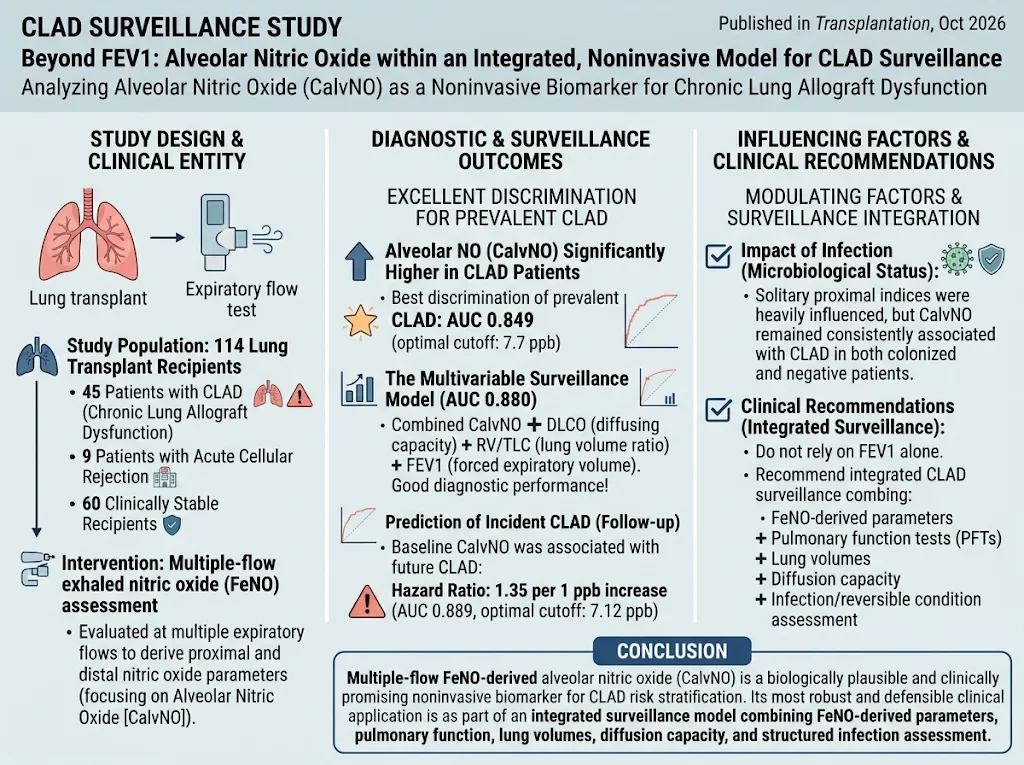
This retrospective observational study enrolled 114 lung transplant recipients categorized into three clinical groups at the time of assessment: 45 with CLAD, 9 experiencing acute cellular rejection (ACR), and 60 who were clinically stable. The study aimed to evaluate whether multiple expiratory flow FeNO measurements, allowing derivation of proximal and distal nitric oxide parameters, could assist in CLAD risk stratification.
FeNO was measured at various expiratory flows to calculate alveolar nitric oxide concentration (CalvNO) and proximal airway nitric oxide levels, reflecting inflammation extent in respective lung compartments. Additional pulmonary function tests (PFTs) assessed diffusing capacity for carbon monoxide (DLCO), lung volumes including residual volume/total lung capacity ratio (RV/TLC), and FEV1. Microbiological status was also considered due to its potential confounding effect on FeNO interpretation.
Key Findings
CalvNO was significantly elevated in patients with established CLAD compared to those clinically stable, indicating greater distal airway/alveolar inflammation. Among all FeNO-derived parameters, CalvNO showed the best discriminatory power for prevalent CLAD (area under the curve [AUC] = 0.849) with an optimal cutoff of 7.7 parts per billion (ppb).
A multivariable diagnostic model integrating CalvNO with DLCO, RV/TLC, and FEV1 yielded enhanced accuracy for detecting prevalent CLAD (AUC = 0.88), underscoring the complementary value of combining inflammation biomarkers with functional lung measurements.
In a subset of initially stable recipients (n=60), 9 subsequently developed CLAD during follow-up. Baseline CalvNO predicted incident CLAD with high accuracy (AUC = 0.889) and a hazard ratio of 1.35 per 1 ppb increase in CalvNO, suggesting strong prognostic value. The identified cutoff for incident CLAD risk was 7.12 ppb.
Microbiological colonization appeared to influence proximal airway FeNO indices more significantly, likely due to localized airway inflammation linked to infection. However, CalvNO remained consistently associated with CLAD regardless of microbial colonization status, suggesting its robustness as a biomarker for distal lung inflammation independent of infection.
Expert Commentary
These findings advance the understanding of inflammatory processes in lung allograft dysfunction by distinguishing airway versus alveolar compartments, crucial for early CLAD detection. The biologic plausibility that alveolar nitric oxide elevation reflects small airway and alveolar inflammation correlates well with known pathophysiology of CLAD.
Integrating CalvNO measurement into routine surveillance could enhance current diagnostic algorithms largely reliant on FEV1, which may be a late indicator of graft injury. The combination of PFT parameters with FeNO-derived indices represents a promising noninvasive approach that captures multifaceted disease aspects including inflammation, lung mechanics, and gas exchange abnormalities.
Nevertheless, these observations require validation in prospective cohorts and standardized FeNO measurement protocols specific to lung transplant populations. The influence of infection and acute rejection episodes on FeNO parameters also warrants further elucidation to refine clinical interpretation.
Conclusion
Multiple-flow FeNO analysis providing alveolar nitric oxide concentration is an innovative, noninvasive biomarker with significant potential for improving CLAD risk stratification and surveillance. Its integration with standard physiologic tests and microbiological assessments in a comprehensive monitoring framework could facilitate earlier intervention and ultimately improve lung transplant outcomes.
Further prospective studies should focus on standardizing measurement techniques, establishing longitudinal biomarker trajectories, and evaluating the impact of FeNO-guided management strategies in clinical practice.
Funding and Clinical Trials
The study was supported by institutional research funds with no reported conflicts of interest. Details on clinical trial registration were not provided in the original publication.
References
1. Fanetti M, Milli C, Salvadori E, et al. Beyond FEV1: Alveolar Nitric Oxide Within an Integrated, Noninvasive Model for CLAD Surveillance. Transplantation. 2026 Oct 28; PMID: 42950132.
2. Verleden GM, Glanville AR, Lease ED, et al. Chronic lung allograft dysfunction: Definition, diagnostic criteria, and approaches to clinical management—a consensus report from the Pulmonary Council of the ISHLT. J Heart Lung Transplant. 2019 Oct;38(10):493-503.
3. Dweik RA, Boggs PB, Erzurum SC, Irvin CG, Leigh MW, Lundberg JO, Olin AC, Plummer AL, Taylor DR, American Thoracic Society Committee on Interpretation of Exhaled Nitric Oxide Levels (FeNO) for Clinical Applications. An Official ATS Clinical Practice Guideline: Interpretation of Exhaled Nitric Oxide Levels (FeNO) for Clinical Applications. Am J Respir Crit Care Med. 2011 Sep 15;184(5):602-15.
Specialty calculators
For clinical reference; use professional judgment.