Highlight
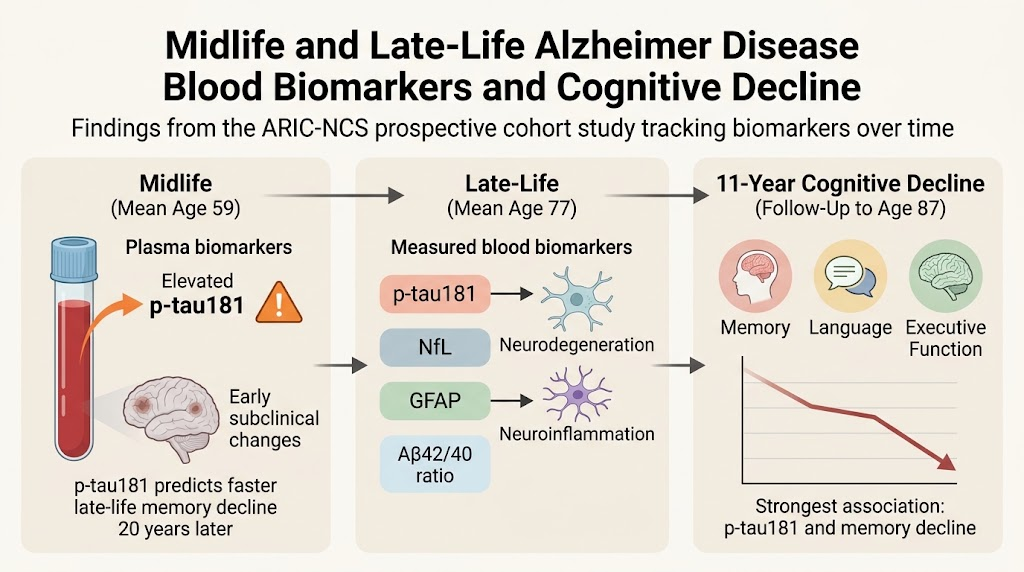
This prospective cohort study from the ARIC Neurocognitive Study demonstrates that elevated plasma phosphorylated tau at threonine 181 (p-tau181) measured in midlife predicts faster memory decline over an 11-year period, beginning approximately 20 years later. Late-life measurements of p-tau181, neurofilament light (NfL), and glial fibrillary acidic protein (GFAP) were associated with more rapid cognitive decline across memory, executive function, and language domains, with p-tau181 showing the strongest association particularly with memory.
Study Background
Alzheimer’s disease (AD) is a progressive neurodegenerative disorder characterized by cognitive decline and distinct neuropathological features including amyloid-β plaques, tau neurofibrillary tangles, neurodegeneration, and neuroinflammation. The burden of AD continues to increase globally with ageing populations. Blood-based biomarkers have emerged as accessible tools to detect AD pathology and predict disease progression. While cross-sectional late-life associations between plasma biomarkers and cognition have been established, less is known about whether biomarker levels measured in midlife predict cognitive decline decades later and whether these biomarkers relate distinctly to specific cognitive domains.
Study Design
The Atherosclerosis Risk in Communities Neurocognitive Study (ARIC-NCS) employed a prospective cohort design involving participants from four U.S. communities. Plasma biomarkers including amyloid-β42/40 ratio (Aβ42/40), phosphorylated tau at threonine 181 (p-tau181), neurofilament light (NfL), and glial fibrillary acidic protein (GFAP) were analyzed from stored specimens collected during midlife (ARIC visit 3, 1993-1995, mean age 59.0 years) and late-life (visit 5, 2011-2013, mean age 76.8 years). A total of 1,515 participants were included, with biomarker levels standardized to midlife values to evaluate changes over time and associations with subsequent cognitive decline across memory, language, executive function, and global cognition domains. Cognitive outcomes were measured longitudinally from visit 5 through visit 9 (2021-2022) using validated factor scores. Statistical analyses utilized linear mixed-effect models adjusted for demographic and clinical covariates.
Key Findings
The primary finding was that each standard deviation (SD) increase in midlife p-tau181 was associated with a statistically significant faster decline in late-life memory (β = -0.030 SD; 95% CI -0.059 to -0.001). This suggests that elevated plasma p-tau181 levels measured nearly two decades earlier portend a long prodromal phase of memory deterioration potentially leading to AD. Midlife levels of Aβ42/40 ratio, NfL, and GFAP were not predictive of cognitive decline in any domain.
In contrast, late-life biomarkers demonstrated broader associations: higher p-tau181, NfL, and GFAP levels were linked with faster decline in executive function, language, and global cognition. Among these, p-tau181’s association with memory decline was strongest (β = -0.091 SD; 95% CI -0.123 to -0.058), followed by NfL and GFAP. These findings emphasize that in late-life, plasma biomarkers reflect overlapping but distinct pathological processes of AD neurodegeneration and neuroinflammation, which together contribute to cognitive deterioration.
Notably, the study population included a substantial proportion of females (60.7%) and Black participants (25.5%), enhancing the generalizability of findings across diverse demographic groups.
Expert Commentary
This study robustly supports a mechanistic role for plasma p-tau181 as an early detectable biomarker indicating underlying tau pathology well before clinical dementia onset. The ability to measure p-tau181 in midlife to predict long-term memory decline opens a critical window for early intervention and potential preventive strategies. The differentiated biomarker associations in late-life highlight the complex interplay of AD pathological cascades and neuroinflammatory mechanisms contributing to cognitive decline beyond memory.
Limitations include the observational design which cannot prove causality and potential residual confounding despite adjustments. Additionally, plasma biomarkers may be influenced by peripheral factors and are not direct brain measures. However, large sample size, longitudinal design, and repeated biomarker assessments strengthen reliability. Future studies integrating neuroimaging and cerebrospinal fluid biomarkers could refine understanding of these dynamics.
Conclusion
Elevated plasma p-tau181 levels measured in midlife represent a promising biomarker for forecasting accelerated memory decline over the ensuing decade or more, indicating a prolonged prodromal phase for AD. Late-life elevations in p-tau181, NfL, and GFAP correlate with accelerating decline across cognitive domains, reinforcing their role as indicators of ongoing neuropathology and neurodegeneration. These findings have important implications for early diagnosis, monitoring progression, and targeting therapeutic interventions during windows of greatest potential impact.
Further research is warranted to explore how these blood biomarkers could be integrated into routine clinical assessments and combined with other modalities to optimize precision medicine approaches in Alzheimer’s disease.
Funding and Clinicaltrials.gov
The ARIC-NCS was supported by grants from the National Institutes of Health. Detailed funding sources and clinical trial registration information can be accessed at the original publication. No conflicts of interest were disclosed.
References
Smith JR, Pike JR, Lu Y, et al. Midlife and Late-Life Alzheimer Disease Blood Biomarkers and 11-Year Cognitive Decline. Neurology. 2026 Oct 16;107(9):e218692. PMID: 42886876.
Jack CR Jr, Bennett DA, Blennow K, et al. NIA-AA Research Framework: Toward a biological definition of Alzheimer’s disease. Alzheimers Dement. 2018 Apr;14(4):535-562.
Hansson O, et al. Cerebrospinal fluid biomarkers of Alzheimer’s disease. Nat Rev Neurol. 2018 Jun;14(6):353-367.
Mattsson N, Cullen NC, Andreasson U, et al. Association Between Longitudinal Plasma Neurofilament Light and Neurodegeneration in Patients With Alzheimer Disease. JAMA Neurol. 2019;76(7):791–799.