Highlights
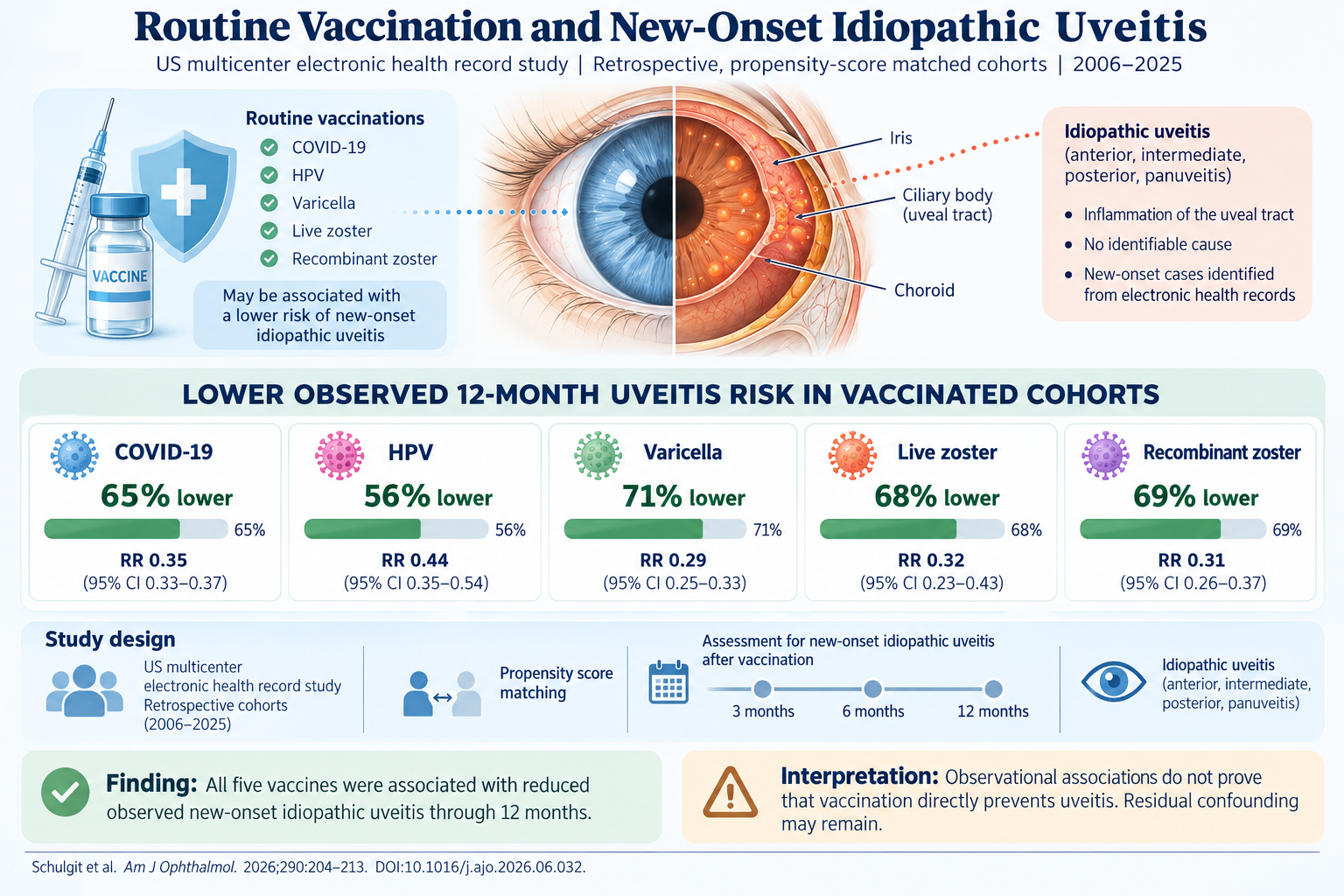
- Recent large-scale cohort studies demonstrate that routine vaccinations, including COVID-19, HPV, varicella, and herpes zoster vaccines, are associated with significantly reduced risk of new-onset idiopathic uveitis (NIU).
- Antiviral treatments early after COVID-19 infection further reduce uveitis risk, suggesting a role of viral immune modulation in uveitis pathogenesis.
- Post-vaccine autoimmune/inflammatory syndromes manifest milder uveitis phenotypes compared to idiopathic forms, indicating distinct immunopathogenic mechanisms.
- Immunogenicity of vaccines can be attenuated in patients with autoimmune inflammatory rheumatic diseases and immunodeficiencies, necessitating tailored clinical management.
Background
Idiopathic uveitis is a sight-threatening intraocular inflammatory disorder lacking identifiable infectious or systemic causes. It significantly contributes to ocular morbidity globally. The pathogenesis involves complex immune dysregulation, and triggers remain incompletely understood. Vaccinations—key public health tools—have been scrutinized for their potential role in either precipitating or preventing uveitis. As widespread immunization campaigns for COVID-19 and other viruses have progressed, understanding how vaccines influence NIU risk is critical to informing clinical practice and addressing vaccine hesitancy.Key Content
Associations Between Routine Vaccinations and New-Onset Idiopathic Uveitis
The seminal study by Schulgit et al. (2026) performed a retrospective cohort analysis using aggregated electronic health records across the United States, comparing vaccinated individuals (COVID-19, HPV, varicella, recombinant herpes zoster, live herpes zoster) with propensity-score matched non-vaccinated controls over a 19-year period (2006–2025). They demonstrated that vaccination was significantly associated with reduced incidence of NIU at 3, 6, and 12 months. Relative risk reductions ranged from 56% (HPV) to 71% (varicella), with COVID-19 vaccination showing a 65% risk reduction (RR 0.35; 95% CI 0.33–0.37). Importantly, exclusions of patients with prior viral infections did not attenuate these associations, underscoring a potential immune modulatory rather than merely protective effect against pathogen-induced uveitis. These findings suggest vaccination may promote immune tolerance or reduce aberrant inflammation leading to NIU, highlighting a complex interplay between host immunity and ocular inflammation.Impact of Early Antiviral Therapy Post-COVID-19
Complementing vaccine data, a large multi-institutional retrospective cohort investigation (2026) assessed antiviral therapy’s role in uveitis incidence after COVID-19 infection. Patients treated early with antivirals, particularly Paxlovid, exhibited significantly lower rates of new uveitis onset at multiple intervals up to three years (e.g., HR at 3 months 0.62, 95% CI 0.45–0.87), suggesting that control of viral replication and inflammation might prevent ocular immune activation and subsequent uveitis development. Subgroup analyses indicated enhanced protection among females and patients with diabetes or cardiovascular comorbidities, groups traditionally at higher inflammatory risk.Clinical Phenotypes in Vaccine-Associated Uveitis and Autoimmune Syndromes
Contrasting idiopathic uveitis, anterior uveitis presenting in the context of Autoimmune/Inflammatory Syndrome Induced by Adjuvants (ASIA) post-BNT162b2 COVID-19 vaccination exhibited notably milder clinical courses. A retrospective study (2025) found reduced anterior chamber inflammation and fewer complications compared to idiopathic cases, with all post-vaccine ASIA uveitis cases responding to topical steroids without systemic immunosuppression. Visual recovery was also faster and more complete, supporting the differentiation of vaccine-associated immune phenomena from classical idiopathic uveitis and underscoring the importance of tailored diagnostic criteria and management.Immunogenicity and Safety in Immunocompromised Populations
Patients with autoimmune inflammatory rheumatic diseases (AIIRD) or immunodeficiencies demonstrate diminished vaccine-induced serological responses. A multicenter observational study (2021) on BNT162b2 mRNA COVID-19 vaccination showed lower seropositivity rates (86% vs. 100% in controls) and antibody titers, especially among those treated with immunosuppressants like rituximab or mycophenolate mofetil. Despite attenuated immunogenicity, no significant post-vaccination exacerbation of disease activity was noted, and adverse events including herpes zoster and rare uveitis instances were minimal, implying a favorable risk-benefit ratio. Moreover, adolescent patients with immune deficiencies showed reduced immunogenicity to meningococcal ACWY conjugate vaccines, emphasizing the need for vigilant monitoring and possible booster strategies in these populations.Mechanistic Insights
The protective association of vaccines against NIU may reflect modulation of host immune responses, including enhanced antiviral immunity, reduced viral reactivation, and immunologic resetting to prevent aberrant ocular autoimmunity. Conversely, rare post-vaccine inflammatory ocular events likely arise via adjuvant-induced innate immune activation or molecular mimicry triggering transient autoimmunity as observed in ASIA. The beneficial role of antivirals supports a pathogenic contribution of viral persistence or reactivation (e.g., varicella zoster virus) in some uveitis phenotypes, aligning with reports of VZV reactivation following COVID-19 vaccines that manifest with pole-to-pole ocular involvement but typically respond well to treatment.Expert Commentary
The convergent evidence from epidemiological, clinical, and mechanistic studies robustly supports the safety and potential protective benefits of routine vaccinations against NIU. These observations challenge prior concerns that vaccinations might trigger autoimmune ocular inflammation and provide reassurance to clinicians and patients, particularly amid ongoing mass COVID-19 vaccination efforts. However, the retrospective design and reliance on electronic health records introduce limitations including potential residual confounding, incomplete infection histories, and diagnostic heterogeneity. Prospective studies and mechanistic investigations are warranted to delineate causality, evaluate long-term outcomes, and clarify immune pathways involved. For patients with AIIRDs or immunosuppression, attenuated vaccine responses necessitate personalized vaccination schedules and close monitoring. Awareness of milder post-vaccine uveitis phenotypes can optimize therapeutic approaches, avoiding overtreatment. Guidelines from ophthalmology and immunology societies increasingly reflect these findings, endorsing vaccination as a preventive measure for ocular inflammation and urging vigilance for rare adverse events without undermining vaccine confidence.Conclusion
Recent high-quality evidence indicates that routine vaccinations—including COVID-19, HPV, and herpes zoster vaccines—are associated with significantly reduced risk of new-onset idiopathic uveitis, likely mediated by complex immune modulation. Early antiviral therapy post-COVID-19 infection further decreases uveitis risk, highlighting viral contributions to pathogenesis. Vaccine-associated uveitis linked to autoimmune syndromes generally exhibits mild, self-limited courses distinct from idiopathic forms, informing tailored clinical management. Immunocompromised patients require specialized vaccination strategies to maximize immunogenicity and safety. Future research priorities include prospective cohort studies, controlled trials elucidating immunological mechanisms, and evaluation of booster vaccination impacts across diverse patient populations. This evolving knowledge base supports vaccination as a critical component of ocular health preservation and immune system modulation.References
- Schulgit MJ, et al. Associations Between Routine Vaccinations and the Risk of New-Onset Idiopathic Uveitis. Am J Ophthalmol. 2026 Jun 23;290:204-213. PMID: 42336229.
- Impact of Early COVID-19 Antiviral Therapy on the Incidence of Uveitis: A Retrospective Cohort Study Using the TriNetX Database. Immun Inflamm Dis. 2026 May;14(5):e70455. PMID: 42093120.
- Anterior Uveitis Associated with ASIA Syndrome: A Distinct Clinical Entity? Ocul Immunol Inflamm. 2025 Oct;33(8):1712-1718. PMID: 40638894.
- Immunogenicity and safety of the BNT162b2 mRNA COVID-19 vaccine in adult patients with autoimmune inflammatory rheumatic diseases and in the general population: a multicentre study. Ann Rheum Dis. 2021 Oct;80(10):1330-1338. PMID: 34127481.
- Meningococcal ACWY conjugate vaccine immunogenicity in adolescents with primary or secondary immune deficiencies, a prospective observational cohort study. Pediatr Rheumatol Online J. 2023 Jul 20;21(1):73. PMID: 37475057.
- Pole-to-pole involvement of varicella zoster virus reactivation following COVID-19 vaccination. Indian J Ophthalmol. 2023 May;71(5):2001-2007. PMID: 37203073.