Liver biopsy has long been the gold standard for direct histologic assessment of the hepatic parenchyma. Over the past decade noninvasive tools—serum fibrosis panels and elastography—have reduced the need for routine biopsy for many chronic liver disorders. Yet tissue remains essential in a range of situations: establishing a definitive diagnosis, grading/staging inflammation and fibrosis when noninvasive tests are equivocal, and guiding therapy in complex or atypical cases.
In October 2026 the American Association for the Study of Liver Diseases (AASLD) Practice Guidelines Committee published an Expert Practice Opinion (EXPO) focused on liver biopsy (Verna et al., 2026). Unlike formal guideline documents graded by GRADE methodology, EXPOs synthesize contemporary evidence and experienced clinical judgement; the statements in this document were the product of a targeted literature review and unanimous expert consensus from the appointed writing group. This article summarizes the EXPO’s core recommendations, practical thresholds and procedural options, highlights what is new compared with prior practice, and reviews implications for clinicians and health systems.
New Guideline Highlights
– Purpose and scope: The EXPO emphasizes three principal roles for liver histopathology—(1) establish a diagnosis when less invasive testing is insufficient, (2) stage the severity of inflammation and/or fibrosis, and (3) influence or refine clinical management decisions.
– Procedural options: Percutaneous, transjugular, and endoscopic ultrasound-guided liver biopsy (EUS-LB) are reviewed as valid approaches. Choice should be individualized to clinical context, local expertise and available resources.
– Safety framing: The writing group reinforces that different approaches have comparable safety profiles when performed by experienced operators and that proper patient selection is the primary determinant of complication risk.
– Emerging applications: The EXPO highlights growing utility of tissue for molecular profiling, digital pathology, and assessment of response to therapeutics—advances that support the ongoing relevance of biopsy in precision hepatology.
Key takeaways for clinicians:
– Reserve biopsy for situations where histology will meaningfully change management.
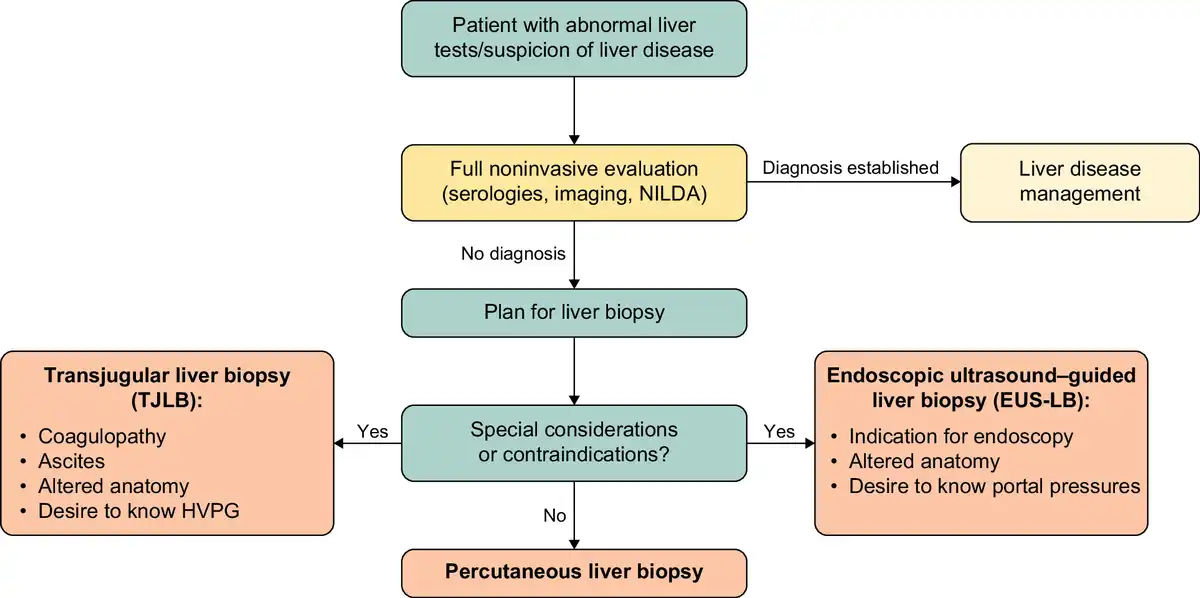
– Use transjugular approach for patients with clinically significant coagulopathy or uncontrolled ascites and when hepatic venous pressure gradient (HVPG) measurement is required.
– Consider EUS-guided biopsy when concurrent endoscopy is planned (e.g., variceal evaluation) or when access to EUS expertise produces superior yield.
Updated Recommendations and Key Changes
Major updates and clarifications compared with prior practice statements include:
– Formal recognition of EUS-guided liver biopsy as an established, contemporary option when performed by experienced endoscopists. The EXPO cites accumulating evidence that EUS-LB yields adequate tissue and has safety comparable to other techniques.
– Explicit framing of transjugular liver biopsy (TJLB) as the preferred route in patients with clinically significant coagulopathy, thrombocytopenia, or large-volume ascites, and also when HVPG measurement is desired to inform portal hypertension management (links to Baveno consensus on portal hypertension assessment).
– Practical sample adequacy thresholds: the EXPO endorses standards consistent with prior literature—longer core lengths and more portal tracts improve diagnostic yield. Many centers continue to target core lengths ≥20–25 mm and ≥10–11 portal tracts when possible.
– Emphasis on individualized risk assessment rather than strict “one-size-fits-all” cutoffs; the document encourages shared decision-making and local protocols that reflect operator experience and institutional complication rates.
Why these updates? The last decade has seen broader adoption of EUS-LB, more robust comparative series of biopsy routes, and accelerating demand for tissue for molecular and digital analyses. The EXPO updates reflect this evolving landscape.
Topic-by-Topic Recommendations
1) Indications for liver biopsy (when histology is likely to change management)
– Establish a specific diagnosis when noninvasive testing is inconclusive (e.g., unexplained aminotransferase elevations, suspected autoimmune hepatitis with atypical serologies, suspected drug-induced liver injury with diagnostic uncertainty).
– Stage inflammation or fibrosis when noninvasive measures are discordant or when histologic grade will inform therapeutic choices (e.g., immunosuppression for autoimmune hepatitis, antiviral therapy decisions in select scenarios).
– Evaluate atypical imaging or focal lesions when concomitant pathology cannot be excluded.
– Assess response to therapy or disease activity in select research and clinical circumstances where tissue-level information will alter care.
2) Choice of technique: percutaneous vs transjugular vs EUS-guided
– Percutaneous biopsy remains the most commonly used route and is appropriate for most patients without significant ascites or coagulopathy.
– Transjugular liver biopsy is preferred when: large-volume ascites is present, platelet count or international normalized ratio (INR) suggests increased bleeding risk, or when HVPG measurement is required. Advantages: reduced risk of intraperitoneal hemorrhage, ability to concurrently measure portal pressure.
– EUS-guided liver biopsy is attractive when endoscopy is already indicated (variceal evaluation/therapy) or when local EUS expertise yields efficient access to both lobes of the liver; evidence suggests adequate tissue yield and favorable safety in experienced hands.
3) Coagulation and procedural safety thresholds
– The EXPO frames coagulation thresholds as guidance rather than absolute rules and emphasizes individualized-risk discussions. Typical institutional practices often follow these pragmatic thresholds:
– Platelets: many centers avoid percutaneous biopsy when platelet count is 1.5 is commonly considered higher risk for percutaneous approaches; transjugular route reduces bleeding risk in coagulopathy.
– Correction strategies (platelet transfusion, plasma, desmopressin) should be used selectively and in alignment with local transfusion policies.
– The writing group recommends institutional protocols that reflect local operator experience and complication rates.
4) Sample adequacy and pathology considerations
– Core length and number of portal tracts matter: aim for cores ≥20–25 mm and ≥10–11 portal tracts when clinically feasible.
– Use of core biopsy needles (rather than fine-needle aspiration) is standard for parenchymal biopsy when histology is required.
– Communicate clinical context clearly on requisitions—relevant history, suspected diagnosis, and clinical questions guide pathologic evaluation and special stains.
– Recognize limitations: sampling variability exists (disease heterogeneity across the liver), and interobserver variation can affect interpretation; consider second opinions for challenging cases.
5) Complications and informed consent
– Common complications include pain and transient hypotension; major bleeding is uncommon but the most feared complication. Historic series report major hemorrhage in the low single-digit percentages and mortality extremely rare when procedures are done by experienced teams.
– Patients should be counseled about procedure-specific risks and alternative diagnostic options. The EXPO underscores documentation of shared decision-making.
6) Special populations
– Children: pediatric considerations require pediatric-trained proceduralists and size-appropriate needles; safety thresholds may differ and should follow pediatric hepatology recommendations.
– Pregnant patients: biopsy is generally deferred unless the result will immediately change management; transjugular routes may be preferred if urgency exists.
– Patients on antithrombotic therapy: balance thrombotic vs bleeding risk; coordinate with prescribing clinicians to time holds, bridging, or alternative procedural strategies.
7) Emerging and research uses
– Molecular profiling: tissue enables genomic, transcriptomic, and proteomic analyses that may inform diagnosis and personalized therapy in certain conditions and clinical trials.
– Digital pathology and artificial intelligence: the EXPO highlights potential value for standardized scoring, reduction of interobserver variability, and extraction of objective features from biopsies.
– Serial biopsies for therapeutic response: while noninvasive biomarkers are often preferable, histologic endpoints remain relevant for some trials and complex clinical scenarios.
Expert Commentary and Insights
The EXPO writing group emphasizes pragmatism and multidisciplinary decision-making. Key panel perspectives include:
– Consensus view: ‘‘Biopsy when the result will change management’’ remains the central heuristic—unnecessary biopsies should be avoided, but clinicians should not withhold tissue when it is likely to influence care.
– Procedural choice is nuanced: operator experience and local infrastructure are as important as theoretical advantages of each route.
– Controversy persists regarding absolute coagulation cutoffs for percutaneous biopsy; the panel favors individualized assessment and lower thresholds for choosing transjugular approaches rather than reflexive transfusions.
– A shared aspiration across the panel is to integrate tissue-based molecular data with clinical phenotyping to move toward precision hepatology; this will require standardized tissue handling and collaboration between clinicians, pathologists, and researchers.
Future research needs identified by the EXPO:
– Comparative effectiveness trials of percutaneous, transjugular and EUS-guided routes in diverse populations.
– Standardized protocols for tissue procurement optimized for molecular assays and digital pathology.
– Better tools to predict post-biopsy bleeding risk beyond simple platelet/INR thresholds.
Practical Implications for Clinical Practice
– Institutional pathways: Centers should adopt clear, pragmatic biopsy pathways that specify preferred approaches for common clinical scenarios (e.g., ascites, coagulopathy, need for HVPG, concurrent endoscopy).
– Multidisciplinary coordination: Optimal biopsy practice requires collaboration among hepatology, interventional radiology, endoscopy, transfusion medicine and pathology.
– Documentation and patient counseling: Ensure informed consent addresses risks, benefits, and alternatives; record how the biopsy result is expected to change management.
– Tissue handling: Standardize specimen labeling, fixation and triage for ancillary studies (immunostains, special stains, molecular assays) to maximize clinical and research value.
Patient vignette (illustrative)
– Maria, a 58-year-old woman with unexplained elevated aminotransferases despite negative viral hepatitis serologies and mixed serologic results for autoimmune markers. Noninvasive fibrosis assessment is indeterminate. The hepatologist discusses options and concludes a percutaneous core biopsy is indicated because histology would determine the need for immunosuppressive therapy. Her platelets are 180,000/µL and INR 1.1, making bedside percutaneous biopsy appropriate. Pathology confirms autoimmune hepatitis and Maria starts targeted therapy.
References
– Verna EC, Adler DG, Kappus MR, Rand EB, Tapper EB, Rockey DC. AASLD EXPO: Liver biopsy. Hepatology (Baltimore, Md.). 2026 Oct 7. PMID: 42841770. https://pubmed.ncbi.nlm.nih.gov/42841770/
– Rockey DC, Caldwell SH, Goodman ZD, Nelson RC, Smith AD. Liver biopsy. Hepatology. 2009;49(3):1017–1044. (Comprehensive review of indications, technique, and complications.)
– de Franchis R, Bosch J, Garcia-Tsao G, et al. Baveno VII — Renewing consensus in portal hypertension. Journal of Hepatology. 2022;76(3):959–974. (Consensus on portal hypertension assessment and use of HVPG.)
Note: The AASLD EXPO is an expert practice opinion document rather than a GRADE-based guideline. Recommendations reflect targeted literature review and unanimous expert consensus; clinicians should integrate these recommendations with local practice patterns, operator expertise, and individual patient circumstances.

 By
No Comments