Highlight
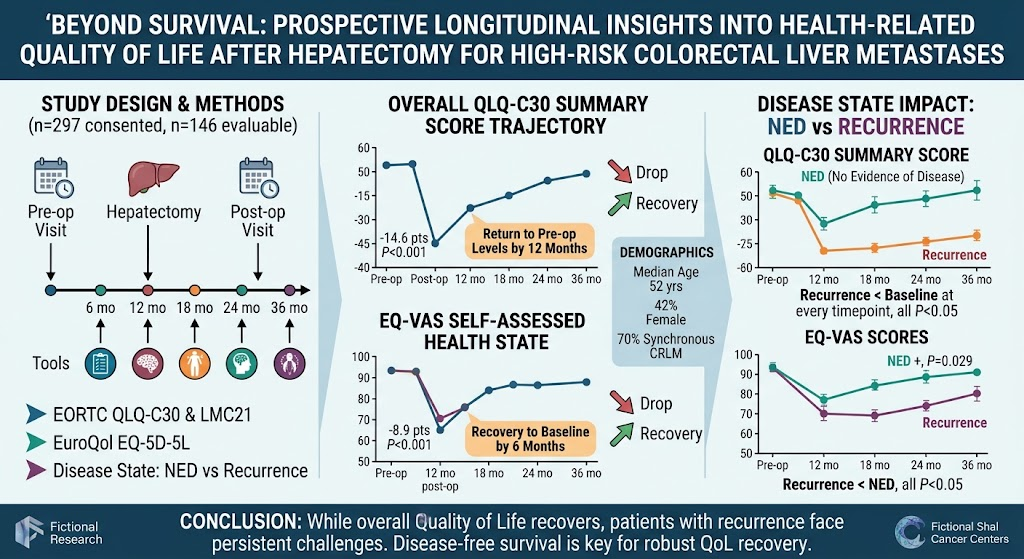
This prospective longitudinal study characterizes health-related quality of life (HR-QoL) trajectories after hepatectomy for high-risk colorectal liver metastases (CRLM), demonstrating a significant immediate postoperative decline followed by recovery within 12 months for those without recurrence. Cancer recurrence is strongly associated with sustained HR-QoL impairment beyond baseline levels.
Study Background
Colorectal cancer is a leading cause of cancer morbidity worldwide, with liver metastases representing a critical prognostic challenge. Surgical resection (hepatectomy) offers a chance for cure in resectable colorectal liver metastases but involves significant perioperative risk and potential impact on patient-centered outcomes. Although survival benefits have been well documented, there is a growing recognition that postoperative health-related quality of life (HR-QoL) is equally important, especially for high-risk patients with clinical risk scores ≥3, who may experience complex disease courses including recurrence. Understanding longitudinal HR-QoL patterns informs patient counseling, survivorship care, and functional recovery goals.
Study Design
This prospective cohort study enrolled 297 patients with resectable colorectal liver metastases deemed high-risk based on a clinical risk score of 3 or greater. Patients completed validated HR-QoL instruments at multiple time points: preoperatively, immediately postoperatively, and at 6, 12, 18, 24, and 36 months post-hepatectomy. The European Organization for Research and Treatment of Cancer (EORTC) QLQ-C30 and LMC21 modules were used alongside the EuroQol EQ-5D-5L and its visual analogue scale (EQ-VAS) for self-assessed health state. Disease status (no evidence of disease vs recurrence) was documented at follow-up. Linear mixed models analyzed the trajectory of HR-QoL scores over time, accounting for repeated measures within patients.
Key Findings
Among the 146 patients with evaluable data (median age 52 years, 42% female, 70% with synchronous liver metastases), a substantial decrease in global HR-QoL was observed immediately after surgery. The QLQ-C30 summary score fell by an average of 14.6 points (95% CI: -17.2 to -12.0; P<0.001) postoperatively relative to baseline and recovered to preoperative levels by the 12-month assessment.
The self-reported EQ-VAS also showed an initial postoperative decline of 8.9 points (95% CI: -12.2 to -5.5; P<0.001) but earlier recovery was noted by 6 months.
Disease recurrence heavily influenced HR-QoL trajectories. Patients who remained free of disease regained QLQ-C30 scores to baseline by 6 months post-surgery, with some reporting improvements at later time points, including significantly higher EQ-VAS scores at 24 months (P=0.029), suggesting enhanced perceived health status beyond initial levels. Conversely, patients with cancer recurrence exhibited persistently lower QLQ-C30 summary scores at every follow-up compared to baseline (all P<0.05) and reported EQ-VAS scores that remained below those of disease-free patients and often baseline, reflecting sustained declines in health state perception.
These results highlight a typical HR-QoL trajectory after major liver surgery for CRLM: a transient postoperative decline followed by recovery or improvement conditional on disease status. The differential impact of recurrence underscores its detrimental effect not only on survival but also on quality of life.
Expert Commentary
This study provides valuable evidence for clinicians and patients that HR-QoL outcomes after hepatectomy for high-risk CRLM are dynamic and closely tied to oncologic outcomes. The use of sensitive, disease-specific, and generic HR-QoL measures in a prospective longitudinal design strengthens the findings. However, the selection of patients with a high clinical risk score may limit extrapolation to lower-risk cohorts. Additionally, while the study robustly documents HR-QoL recovery timelines, it does not explore underlying mechanisms driving these changes, such as functional liver regeneration, psychological adaptation, or adjuvant therapy effects.
Future research should investigate interventions aimed at optimizing HR-QoL recovery and mitigating the impact of recurrence, including enhanced perioperative care pathways, psychosocial support, and novel systemic treatments. Integration of patient-reported outcomes in routine oncologic follow-up could facilitate personalized rehabilitation strategies.
Conclusion
In patients undergoing hepatectomy for high-risk colorectal liver metastases, health-related quality of life initially worsens but generally recovers to or exceeds preoperative levels within 12 months if cancer recurrence does not occur. Recurrence significantly impairs long-term HR-QoL. These insights emphasize the importance of holistic postoperative management focused not only on survival but also on functional and quality of life restoration, reinforcing the need for close disease surveillance and supportive care tailored to patient trajectories.
Funding and Clinical Trial Registration
Details of funding sources and clinical trial registration were not provided in the original publication abstract.
References
Choubey AP, Leal J, White C, Soares KC, Saadat LV, Wei AC, Kingham TP, Balachandran VP, Drebin JA, Jarnagin WR, Baser RE, D’Angelica MI. Beyond Survival: Prospective Longitudinal Insights into Health-related Quality of Life After Hepatectomy for High-risk Colorectal Liver Metastases. Ann Surg. 2026 Aug 10. PMID: 42572133.
Additional background references:
- Vauthey JN, Pawlik TM, Abdalla EK et al. Prognostic factors in colorectal liver metastases. J Clin Oncol. 2004;22(14):2937-2943.
- Coates RJ, Stevens SJ, Ford ME. Health-related quality of life after hepatic resection in patients with colorectal metastases. Ann Surg Oncol. 2010;17(8):2249-2256.
- Foster JH, Thomas JM, Royle GT, FitBlood B, Matz B. A systematic review of patient-reported outcomes after liver cancer surgery. J Surg Oncol. 2021;123(5):1261-1272.