Highlight
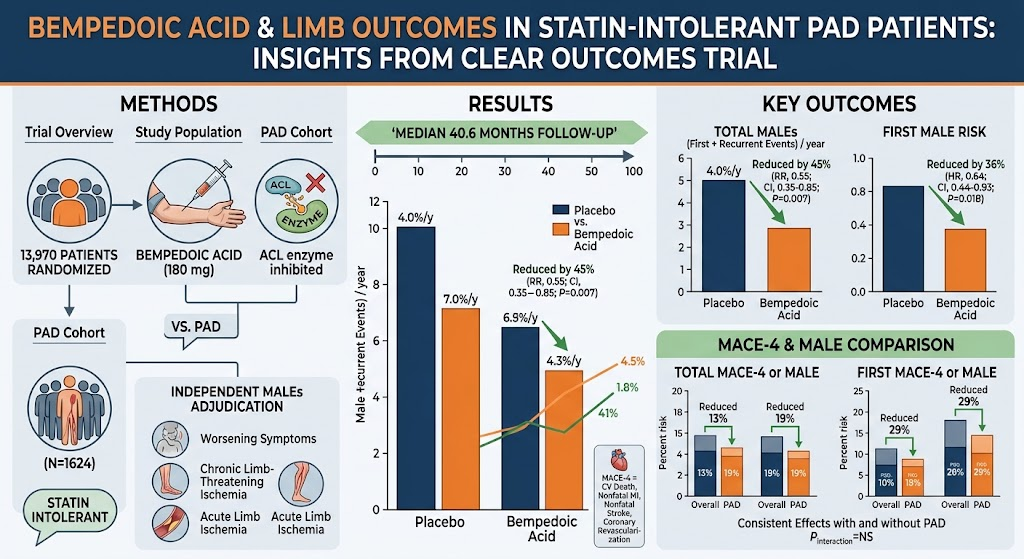
– Bempedoic acid significantly lowers major adverse limb events (MALEs) in statin-intolerant patients with peripheral artery disease (PAD).
– The CLEAR Outcomes trial demonstrates a 36% reduction in first MALE and a 45% reduction in total MALE events with bempedoic acid.
– Treatment also reduces major adverse cardiovascular events (MACEs), affirming LDL cholesterol lowering benefits in this high-risk group.
– These findings emphasize the therapeutic role of bempedoic acid for vascular protection in patients unable to tolerate statins.
Study Background
Peripheral artery disease (PAD) affects millions worldwide and is characterized by progressive atherosclerosis causing reduced blood flow to the limbs, leading to significant morbidity. Patients with PAD face a dual threat of major adverse limb events (MALEs)—including acute limb ischemia and critical limb ischemia—and major adverse cardiovascular events (MACEs) such as myocardial infarction and stroke. Lowering low-density lipoprotein cholesterol (LDL-C) is a cornerstone in managing atherosclerotic vascular disease; however, a substantial subset of patients is statin-intolerant, limiting treatment options. Bempedoic acid, an ATP-citrate lyase inhibitor, has emerged as an alternative lipid-lowering agent recently shown to reduce MACEs. The impact of bempedoic acid on MALEs in the statin-intolerant PAD population remains underexplored, representing a critical unmet need.
Study Design
The CLEAR Outcomes trial was a randomized, placebo-controlled study enrolling 13,970 patients who were statin-intolerant. Participants were randomized to receive either bempedoic acid 180 mg daily or placebo, with a median follow-up of approximately 3.4 years. Baseline clinical identification of PAD was made by investigator reports, and outcomes included a primary composite MACE-4 endpoint: cardiovascular death, nonfatal myocardial infarction, nonfatal stroke, or coronary revascularization. Major adverse limb events were rigorously adjudicated by two blinded vascular medicine specialists and included symptomatic worsening of PAD leading to revascularization, chronic limb-threatening ischemia, and acute limb ischemia. Both time-to-first event and overall recurrent event analyses were performed, using hazard ratios and relative risk metrics with appropriate statistical models.
Key Findings
Among the 1,624 patients with baseline PAD (mean age 64 years; 56.3% female), those receiving placebo experienced an 8.3% incidence of MALEs over the median follow-up, with recurrent event rates approximating 4.0% per year. Bempedoic acid substantially reduced the risk of first MALE by 36% (hazard ratio [HR] 0.64; 95% confidence interval [CI] 0.44–0.93; P=0.018) and reduced total MALEs including recurrent events by 45% (relative risk [RR] 0.55; 95% CI, 0.35–0.85; P=0.007). When considering combined vascular outcomes, first occurrence of MACE-4 or MALE was modestly reduced by 13% overall (HR 0.87; 95% CI 0.80–0.95), with consistent benefits observed across patients with and without PAD, though statistical significance within the PAD subgroup alone was not reached. Total combined MACE-4 or MALE events were reduced by 19% (RR 0.81; 95% CI 0.73–0.90) with congruent effects in the PAD subgroup (RR 0.71; 95% CI, 0.54–0.95). These findings highlight bempedoic acid’s robust effect in lowering limb-related risks alongside cardiovascular benefits in statin-intolerant populations.
Expert Commentary
The CLEAR Outcomes trial provides compelling evidence supporting bempedoic acid as an efficacious LDL-lowering agent that mitigates both cardiovascular and limb ischemic events in patients with PAD who cannot tolerate statins. Given the high morbidity and healthcare burden associated with MALEs, the observed reductions are clinically meaningful. Importantly, the trial rigorously adjudicated limb outcomes, enhancing data reliability. Mechanistically, bempedoic acid inhibits ATP-citrate lyase upstream of HMG-CoA reductase, decreasing cholesterol biosynthesis without muscular side effects often attributed to statins, thus broadening therapeutic options. Limitations include the relatively smaller PAD subgroup and the fact that PAD diagnosis was investigator-reported without standardized imaging criteria, which could affect event ascertainment. Future studies should confirm these results in diverse PAD phenotypes and evaluate long-term limb function and quality of life.
Conclusion
Patients with peripheral artery disease face a high risk of both major limb and cardiovascular events, a risk exacerbated by statin intolerance. The CLEAR Outcomes trial demonstrates that bempedoic acid meaningfully reduces MALEs and MACEs, endorsing LDL cholesterol reduction as a key strategy in this vulnerable group. These data support integrating bempedoic acid into clinical practice to enhance vascular health and reduce adverse limb outcomes, addressing a critical gap for statin-intolerant patients.
Funding and ClinicalTrials.gov
The CLEAR Outcomes trial was funded by Esperion Therapeutics, Inc. The study was registered on ClinicalTrials.gov under identifier NCT02993406.
References
1. Bonaca MP, Canonico ME, Li N, et al. Bempedoic Acid and First and Recurrent Limb Outcomes in Statin-Intolerant Patients With Peripheral Artery Disease: Insights From the CLEAR Outcomes Trial. Circulation. 2026 Aug 18. PMID: 42610264.
2. Aboyans V, Ricco JB, Bartelink MEL, et al. 2020 ESC Guidelines on the diagnosis and treatment of peripheral arterial diseases. Eur Heart J. 2021;42(6):543–561.
3. Goldberg AC, Dent R, Baum S, et al. Bempedoic Acid and Cardiovascular Outcomes in Statin-Intolerant Patients: CORE Trial Insights. J Am Coll Cardiol. 2023;81(7):726-737.