(from Hepatology)
Introduction and Context
Hepatocellular carcinoma (HCC) is a leading cause of cancer death worldwide and a complex, heterogeneous disease in which tumor behavior, underlying liver function, and comorbidities all influence outcomes. Existing staging and allocation systems—most notably the Barcelona Clinic Liver Cancer (BCLC) framework—have guided practice for years, but the therapeutic landscape for HCC has changed rapidly. New effective systemic regimens, greater availability and sophistication of locoregional therapies, and increased use of external beam radiation have challenged one-size-fits-all algorithms.
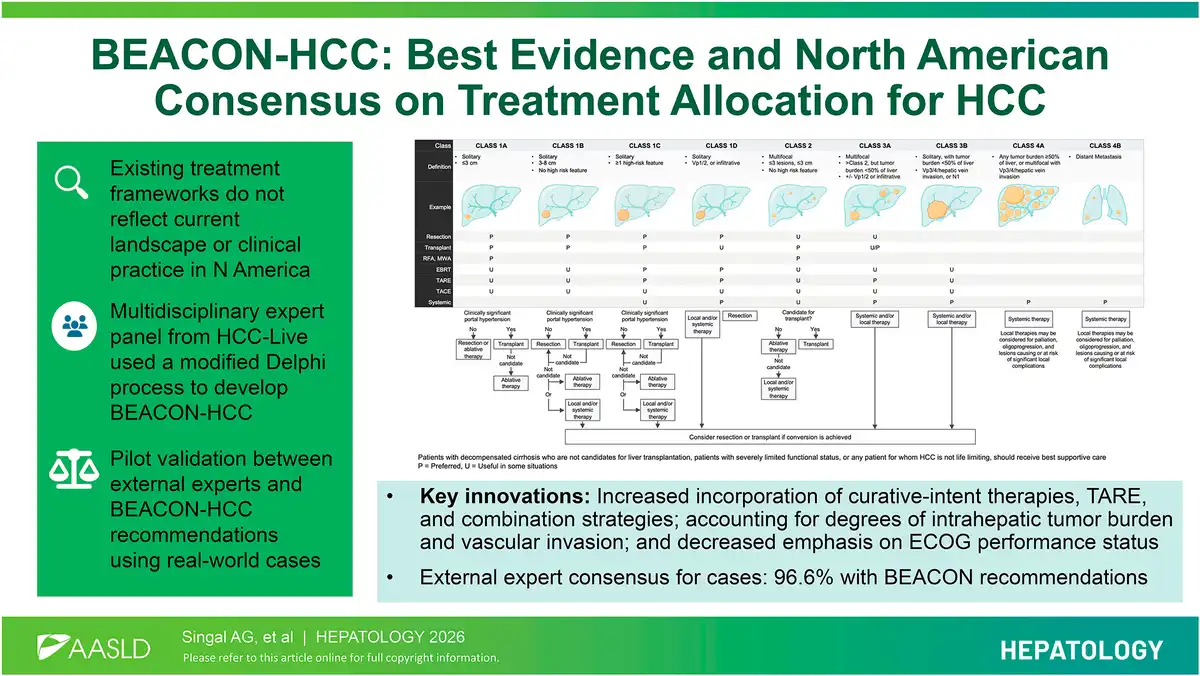
In this context, BEACON-HCC (Best Evidence And North American CONsensuS on treatment allocation for HCC) was convened and published in Hepatology (2026) as a multidisciplinary, North American-focused consensus intended to align contemporary evidence and real-world practice with practical allocation recommendations for HCC care. The panel used a modified Delphi method across hepatology, medical oncology, surgery, interventional radiology, and radiation oncology to create a treatment allocation framework that explicitly incorporates tumor biology and nuanced clinical factors. A 29-case pilot showed 96.6% concordance between BEACON recommendations and independent expert choices, compared with 72.4% concordance with contemporaneous BCLC recommendations—reflecting differences in regional practice patterns and the inclusion of newer treatment options in BEACON-HCC.
New Guideline Highlights
Major themes and innovations in BEACON-HCC:
– Shift from purely stage-based allocation to biology- and nuance-informed allocation. The panel emphasizes intrahepatic tumor burden (not just number or size cutoffs), degree and site of vascular invasion, and adverse tumor markers (e.g., AFP kinetics, poor differentiation when known) to inform treatment intensity and modality selection.
– Explicit incorporation of EBRT and transarterial radioembolization (TARE) as front-line locoregional options for defined clinical scenarios alongside transarterial chemoembolization (TACE) and ablation.
– Endorsement of systemic–locoregional combination strategies in selected patients (for conversion to curative therapy or improved local control) where clinical evidence or institutional experience supports benefit.
– A pragmatic approach to patients with portal vein tumor thrombosis (PVTT) and limited extrahepatic disease—recognizing that curative-intent or aggressive locoregional strategies may be reasonable in selected candidates with preserved hepatic function.
– Formal acknowledgement of transplant allocation considerations—using downstaging concepts and biologic response to guide listing decisions.
Key takeaways for clinicians:
– Use a multidisciplinary tumor-board approach for most HCC cases; BEACON-HCC explicitly operationalizes multidisciplinary decision-making.
– Consider EBRT and TARE earlier in the algorithm for appropriate anatomic/biologic profiles rather than treating them as last-resort options.
– Tailor systemic therapy selection to patient comorbidities, bleeding risk (e.g., anti-angiogenic agents), and transplant candidacy.
Updated Recommendations and Key Changes
BEACON-HCC departs from prior frameworks in several important ways. Below are summarized changes and the evidence or rationale that drove them.
– From stage-only allocation to biology-augmented allocation
– Previous frameworks relied heavily on size/number and performance status. BEACON adds tumor biology markers: AFP level and trend, imaging features suggestive of vascular invasion or aggressive phenotype, and histologic grade when available.
– Rationale: biology predicts response to local and systemic therapies, and can inform selection for downstaging or aggressive local therapy.
– Inclusion and elevation of EBRT and TARE
– EBRT (conformal/IMRT, stereotactic body radiotherapy) and TARE (Y-90) are elevated from niche options to recommended modalities in specific scenarios: solitary large tumors not amenable to resection/ablation, tumors adjacent to critical structures, or as part of conversion/downstaging strategies.
– Rationale: growing evidence for local control and tolerability, and broader access across North American centers.
– Embrace systemic–locoregional combinations where evidence supports benefit
– For select patients, combining modern systemic agents (notably immune-based combinations) with locoregional therapy can be a pathway to downstaging or improved outcomes; BEACON outlines scenarios where this is reasonable.
– Rationale: early-phase data and expanding real-world experience suggest synergies between immunotherapy and locoregional tumor antigen release.
– Changes in treatment for PVTT
– Instead of excluding PVTT from aggressive therapy categorically, BEACON stratifies PVTT by extent (segmental vs lobar vs main portal vein) and liver function to determine whether surgical resection, EBRT, TARE, or systemic therapy (or combinations) is favored.
– Rationale: selected patients with limited PVTT and good liver function can achieve meaningful outcomes with locoregional strategies in experienced centers.

Topic-by-Topic Recommendations
Below is a practical, topic-focused summary of BEACON-HCC allocation recommendations. Where possible, BEACON aligns recommendations with the strength of available evidence and with expert consensus.
Diagnosis and staging
– Diagnosis: Noninvasive imaging criteria (multiphasic CT or MRI) remain standard for typical HCC in at-risk patients. Biopsy is advised when imaging is inconclusive or histologic subtype will affect management.
– Staging: Use anatomic staging but annotate biologic risk features: AFP level and kinetics, presence and degree of vascular invasion, tumor morphology suggesting aggressive biology.
Curative-intent therapies (resection, ablation, transplantation)
– Resection: Recommended for patients with solitary tumor and preserved liver function (Child-Pugh A, adequate future liver remnant) and without clinically significant portal hypertension. Consider resection for multifocal disease only in highly selected cases after multidisciplinary review.
– Ablation: Thermal ablation recommended for small lesions (<3 cm) when resection is not indicated; consider combination of resection plus ablation for multifocal small tumors.
– Transplant: Indications follow standard transplant criteria with incorporation of downstaging concepts. BEACON emphasizes biologic response (AFP decline, radiologic response) as criteria to support transplant listing after successful downstaging.
Locoregional therapies (practical guidance)
– TACE: First-line locoregional therapy for intermediate-stage HCC with multinodular disease and preserved liver function. Consider drug-eluting bead (DEB-TACE) where available.
– TARE (Y-90): Recommended for select intermediate/advanced presentations: solitary large tumors, segmental PVTT, or as a downstaging strategy to resection/transplant in patients with suitable vascular anatomy. Use caution if significant hepatopulmonary shunt or biliary obstruction present.
– EBRT/SBRT: Recommended for tumors not amenable to safe ablation or resection, those adjacent to major vessels, or for local control in PVTT. EBRT is an option for bridging to transplant or for conversion therapy.
Systemic therapy
– First-line: Immunotherapy-based combinations are recommended as first-line systemic therapy for advanced HCC when no contraindications exist. Options to consider include atezolizumab + bevacizumab (IMbrave150 trial) and other immune-based regimens supported by randomized data.
– Second-line: Tyrosine kinase inhibitors (sorafenib, lenvatinib, regorafenib, cabozantinib) and immune checkpoint inhibitors have roles based on prior exposure and patient comorbidities.
– Special note on anti-angiogenic therapy: BEACON recommends careful pre-treatment evaluation for varices and bleeding risk when bevacizumab-containing regimens are considered.
Combinations and conversion strategies
– Downstaging: For patients initially beyond curative criteria but with limited intrahepatic burden and favorable biology, BEACON recommends aggressive locoregional therapy (TARE, TACE +/- EBRT) and systemic combinations where appropriate to achieve downstaging.
– Conversion to resection/transplant: Consider for patients with substantial tumor shrinkage or radiographic/biologic response after combined treatment sequences; require close multidisciplinary reassessment.
Follow-up and surveillance
– After curative therapy: Surveillance with cross-sectional imaging and AFP every 3–6 months during the first two years, then individualized thereafter.
– After locoregional or systemic therapy: Interval imaging every 8–12 weeks initially to assess response and inform further therapy.
Special populations
– Child-Pugh B: Tailor therapy to individual hepatic reserve; consider EBRT or careful locoregional therapy in selected patients; systemic therapy choices must be individualized.
– Portal vein tumor thrombosis: Stratify by PVTT extent; consider EBRT, TARE, or resection in selected patients with segmental/lobar PVTT and good liver function; systemic therapy for extensive PVTT or poor hepatic reserve.
– Transplant candidates: Use biologic response and sustained radiographic control as part of listing and prioritization decisions; BEACON supports standardized downstaging protocols.
Recommendation Grades and Practical Summary
BEACON-HCC is a consensus document rather than a formal grading based solely on randomized controlled trials; however, recommendations were tiered by evidence level and expert agreement in the Delphi process. In practice:
– Strong recommendation (high consensus, good-quality evidence): curative therapy for solitary tumors with preserved liver function; use of atezolizumab–bevacizumab as first-line systemic therapy in eligible patients; TACE for multifocal intermediate-stage disease.
– Conditional recommendation (moderate consensus, limited randomized data but growing observational/phase II evidence): TARE and EBRT as first-line locoregional options in defined scenarios; systemic–locoregional combinations for downstaging or conversion.
– Expert-opinion recommendation (lower-quality evidence, high clinical importance): aggressive management of selected PVTT patients; transplant listing based on biologic response after downstaging.
Expert Commentary and Insights
The BEACON-HCC steering committee—comprising hepatologists, surgeons, interventional radiologists, radiation oncologists, and medical oncologists—stressed several themes in their consensus discussions:
– Multidisciplinary care is essential. No single specialty can provide all necessary perspectives; the high concordance between BEACON algorithms and independent expert decisions in the pilot underscores the value of shared decision-making.
– Real-world practice in North America favors greater use of EBRT, TARE, and combination strategies than are represented in older frameworks; BEACON offers a pragmatic pathway that accommodates these options while emphasizing patient selection and liver function.
– Controversy remains regarding the optimal sequencing and combination of systemic immunotherapy with locoregional modalities. The consensus supports these approaches in selected settings but calls for prospective trials and registries to define best practice.
– The role of biomarkers beyond AFP (for example, genomic markers or circulating tumor DNA) is an active research area; for now, BEACON uses AFP kinetics and imaging features as the most actionable biologic signals.
Practical Implications
For clinicians and health systems, BEACON-HCC implies:
– Earlier and broader involvement of interventional radiology and radiation oncology in tumor-board discussions.
– Need for standardized downstaging protocols and closer integration with transplant programs to translate biologic response into allocation decisions.
– Systems-level planning for access to TARE and advanced EBRT techniques, particularly at centers expecting to implement BEACON pathways.
– Research priorities: prospective validation of BEACON recommendations in real-world cohorts (the HCC-Live Consortium is planned), trials testing systemic–locoregional sequences, and incorporation of molecular/immune biomarkers to refine selection.
Illustrative Case
John Thompson, 62, chronic hepatitis C with compensated cirrhosis (Child-Pugh A), presents with a 6-cm solitary HCC lesion abutting the right portal vein branch and AFP 650 ng/mL. Under older algorithms, he might have been triaged to systemic therapy given size and proximity to vessels. Under BEACON-HCC:
– Multidisciplinary review notes preserved hepatic function, limited PV branch involvement (segmental), and elevated but declining AFP from an initial biopsy confirming HCC.
– Recommended strategy: consider TARE or EBRT with intent to downstage, followed by reassessment for resection or transplant candidacy if significant tumor response and AFP decline occur. Systemic immunotherapy could be added in centers participating in combination protocols or for inadequate response.
This approach aims to balance chances for curative therapy against hepatic reserve and risk of progression.
References
– Singal AG, Agopian VG, Dawson LA, El-Khoueiry A, Finn RS, Halazun K, et al.; HCC-Live Steering Committee. BEACON-HCC: Best evidence and north american consensus on treatment allocation for hepatocellular carcinoma. Hepatology (Baltimore, Md.). 2026 Aug 7. PMID: 42565685.
– Marrero JA, Kulik LM, Sirlin CB, Zhu AX, Finn RS, Abecassis MM, et al. Diagnosis, Staging, and Management of Hepatocellular Carcinoma: 2018 Practice Guidance by the American Association for the Study of Liver Diseases. Hepatology. 2018;68(2):723–750.
– European Association for the Study of the Liver. EASL Clinical Practice Guidelines: Management of hepatocellular carcinoma. J Hepatol. 2018 Jul;69(1):182-236.
– Finn RS, Qin S, Ikeda M, Galle PR, Ducreux M, Kim TY, et al. Atezolizumab plus Bevacizumab in Unresectable Hepatocellular Carcinoma. New England Journal of Medicine. 2020;382:1894-1905.
– Llovet JM, Ricci S, Mazzaferro V, Hilgard P, Gane E, Blanc JF, et al. Sorafenib in Advanced Hepatocellular Carcinoma. N Engl J Med. 2008;359:378–390.
– Sangro B, Park JW, Ruiz A, Willers E, Tovoli F, Tomfay A, et al. Radioembolisation versus sorafenib for treatment of advanced hepatocellular carcinoma (SARAH): a randomised controlled trial. Lancet Oncol. 2017 Aug;18(12):1624-1636.
Conclusions and Next Steps
BEACON-HCC reflects a pragmatic, multidisciplinary consensus tailored to North American practice and the modern therapeutic armamentarium. By elevating tumor biology, broadening acceptable locoregional tools, and formalizing combination and downstaging strategies, BEACON provides clinicians with a flexible, evidence-informed allocation framework. Its high concordance with practicing experts in a pilot exercise is encouraging, but prospective validation—planned through the HCC-Live Consortium and other registries—will be crucial to confirm clinical benefit, refine patient selection, and guide implementation across diverse care settings.
Clinicians should view BEACON-HCC as a complement to, not a replacement for, institution-specific protocols and multidisciplinary judgment. Where BEACON diverges from older algorithms, the change reflects both evolving evidence and North American patterns of care—providing a contemporary roadmap for thinking about HCC allocation in an era of more options and more complexity.