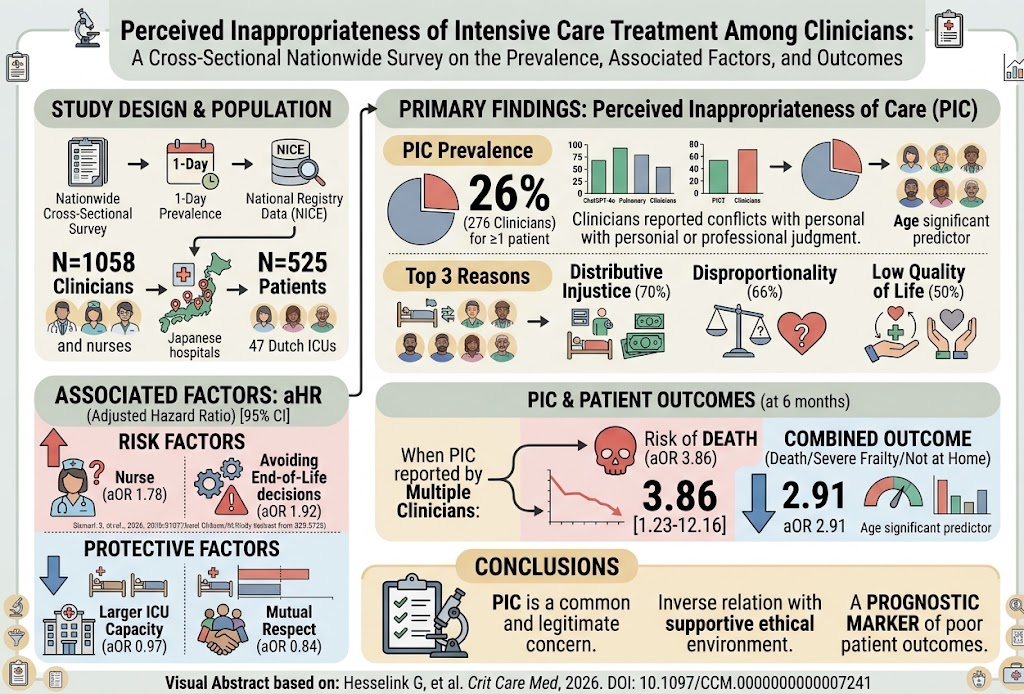
Study Background
Intensive care units (ICUs) play a critical role in managing life-threatening conditions with advanced interventions. However, the complexity of clinical decisions, especially at the end of life, can lead to ethical dilemmas and professional distress. One frequently encountered issue is the perception among clinicians that certain treatments may be inappropriate, either because they conflict with personal or professional values, or because they do not align with the patient’s prognosis or wishes. The prevalence, determinants, and consequences of this perceived inappropriateness of care (PIC) have clinical relevance, contributing to moral distress, interprofessional tension, and potentially impacting patient outcomes. Yet, robust, large-scale data on the prevalence and implications of PIC in ICU settings remain limited.
Study Design
This investigation was a single-day, cross-sectional nationwide survey conducted in the Netherlands, involving 47 ICUs. The study population comprised 1058 physicians and nurses directly involved in patient care on the survey day, and 525 ICU patients receiving care during that same period. Responses were collected via validated questionnaires capturing factors related to PIC, ethical work environment, and clinician characteristics, supplemented with patient data from the National Intensive Care Evaluation registry. The primary objective was to determine the prevalence of PIC, explore organizational and individual factors associated with PIC, and evaluate the association between PIC and clinical outcomes at 6 months.
Key Findings
Prevalence of PIC: Among surveyed clinicians, 26% (276/1058) reported perceiving at least one instance of inappropriate care on the survey day. This common experience underscores that ethical concerns about intensive care provision are widespread.
Reasons for PIC: The most frequently cited reasons for PIC were distributive injustice, noted by 70% of respondents indicating PIC, and disproportionate care, noted by 66%. Distributive injustice here reflects concerns about resource allocation fairness, while disproportionate care refers to situations where treatment intensity outweighs potential benefits.
Factors Associated with Higher PIC Risk: Multivariate analysis showed that being a nurse significantly increased the odds of perceiving care as inappropriate (adjusted odds ratio [aOR] 1.78; 95% CI 1.37-2.33; p < 0.001). Working in ICU cultures that avoid or delay end-of-life decision-making further heightened PIC risk (aOR 1.92; 95% CI 1.51-2.45; p < 0.001), indicating the impact of institutional ethics climate on clinician perceptions.
Protective Organizational Factors: Larger ICU bed capacity was associated with a slightly reduced risk of PIC (aOR 0.97; 95% CI 0.94-0.99; p = 0.004). Additionally, mutual respect within interdisciplinary teams lowered PIC risk (aOR 0.84; 95% CI 0.70-1.00; p = 0.045), highlighting the importance of cohesive team environments.
Impact on Patient Outcomes: Importantly, when multiple clinicians reported PIC for the same patient, there was a significant independent association with adverse outcomes at 6 months. Specifically, death risk increased nearly fourfold (aOR 3.86; 95% CI 1.23-12.16; p = 0.02), and the composite endpoint of death, severe frailty, or loss of home living nearly tripled (aOR 2.91; 95% CI 1.14-7.42; p = 0.03). These findings suggest that PIC acts as a prognostic marker for poor long-term outcomes.
Expert Commentary
The findings from this robust nationwide study confirm that perceived inappropriateness of care is a prevalent and clinically meaningful phenomenon among ICU clinicians. The higher prevalence of PIC reported by nurses may reflect their unique bedside perspective and role in patient advocacy. The link between PIC and an unethical or avoidant organizational culture points to a modifiable risk factor. Interprofessional respect and larger ICU capacity appear to mitigate feelings of inappropriateness, possibly by facilitating better shared decision-making and resource availability.
Clinicians and institutions should regard PIC not merely as subjective discomfort but as a legitimate ethical and clinical concern warranting structured team reflection, ethics consultation, and perhaps adjustment of care plans. The association between PIC and worse patient outcomes underscores the importance of addressing these perceptions proactively.
Limitations include the snapshot nature of the survey, which may not capture longitudinal change in perceptions or causality, potential response bias given the 72% clinician response rate, and confinement to Dutch ICUs, which may limit generalizability.
Conclusion
Perceived inappropriateness of care is common across ICU clinicians and strongly influenced by ethical work environment and team dynamics. Its presence serves as an important prognostic indicator of adverse patient outcomes at 6 months post-ICU. Healthcare organizations should prioritize fostering an ethical climate that encourages open dialogue about appropriateness and supports consensus-building for end-of-life and high-stakes clinical decisions. Future research should explore interventions to reduce PIC and assess their impact on clinician well-being and patient-centered outcomes.
Funding and ClinicalTrials.gov
The study did not involve interventional treatments and no specific funding or clinical trial registration was reported.
References
1. Hesselink G, Ramakers B, Fikkers BG, et al. Perceived Inappropriateness of Intensive Care Treatment Among Clinicians: A Cross-Sectional Nationwide Survey on the Prevalence, Associated Factors, and Outcomes. Crit Care Med. 2026 Jun 12;54(9):2373-2385. PMID: 42283554.
2. Hamric AB, Blackhall LJ. Nurses’ perceptions of futile care and its effect on burnout. Am J Crit Care. 2007;16(6):575-582.
3. Azoulay E, Timsit JF, Sprung CL, et al. Prevalence and factors of intensive care unit conflicts: the conflicus study. Am J Respir Crit Care Med. 2009;180(9):853-860.
4. Schneiderman LJ, Jecker NS, Jonsen AR. Medical futility: its meaning and ethical implications. Ann Intern Med. 1990;112(12):949-954.
5. Chlan LL, Weinert CR, Savik K. Assessment of patient and nurse perceptions of appropriateness of care in the ICU. J Clin Nurs. 2014;23(23-24):3557-3565.