Highlight
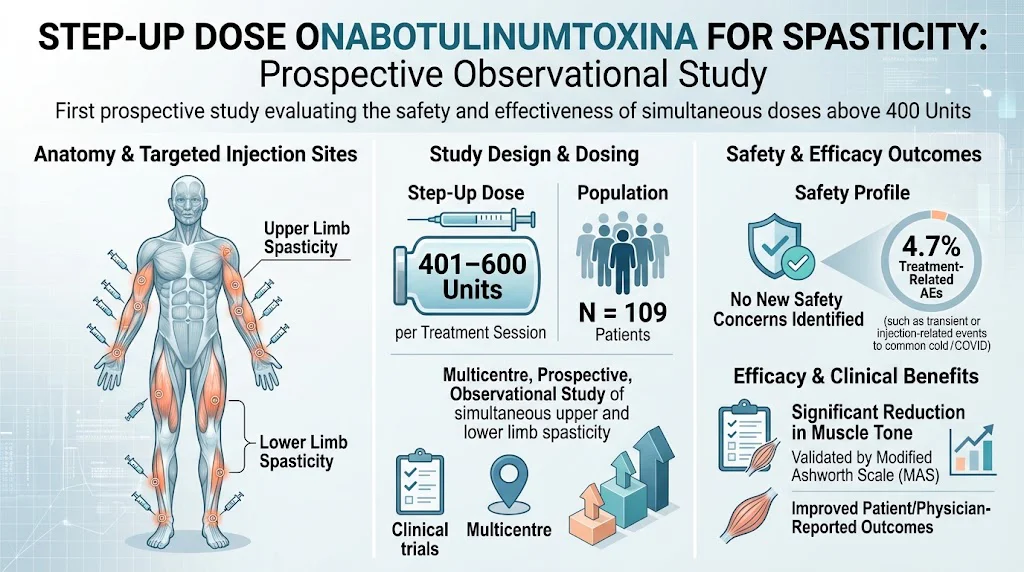
This prospective observational study is the first to evaluate the safety and effectiveness of a “step-up dose” (401-600 units) of onabotulinumtoxinA administered simultaneously to treat upper and lower limb spasticity. The treatment was generally well tolerated, with adverse events consistent with known safety profiles and few treatment-related events. Significant reductions in muscle tone and improvements in patient and physician-reported outcomes were observed, suggesting the potential clinical benefit of higher dosing.
Study Background
Spasticity, characterized by increased muscle tone and reflexes, is a common and debilitating complication following neurological injuries such as stroke, multiple sclerosis, cerebral palsy, or traumatic brain injury. It often affects upper and lower limbs, leading to impaired mobility, pain, and diminished quality of life. Management commonly includes physiotherapy, oral medications, and focal treatments such as botulinum toxin injections.
OnabotulinumtoxinA (Botox) is established as an effective and safe focal treatment for spasticity, typically administered in doses tailored to patient needs. The standard approved dose usually does not exceed 400 units per treatment session. However, in patients with extensive spasticity involving multiple limb areas, higher doses may be clinically necessary to achieve adequate symptom control. Despite its use in practice, systematic prospective evaluation of the safety and effectiveness of higher doses administered simultaneously, referred to as a “step-up dose,” has been lacking.
This unmet need motivated the current multicentre, prospective observational study investigating onabotulinumtoxinA doses between 401 and 600 units in patients receiving treatment for upper and lower limb spasticity.
Study Design
This was a single-arm, multicentre, prospective observational study designed to assess the safety primarily and effectiveness secondarily of step-up doses of onabotulinumtoxinA (401-600 units) in patients with upper and lower limb spasticity.
A convenience sample of 109 patients scheduled for their first or second treatment with this high dosage was enrolled across multiple centers. Eligible patients had spasticity impacting both upper and lower limbs and were deemed suitable for the increased dose based on their clinical status.
The primary endpoint was the overall safety profile, summarized through the incidence and nature of adverse events (AEs). Effectiveness was assessed through changes in muscle tone measured by the Modified Ashworth Scale (MAS) and both patient- and physician-reported outcomes related to spasticity symptoms and function.
Key Findings
Of the 109 enrolled patients, 107 comprised the safety analysis population. Adverse events were reported in 49 patients (45.8%), with Coronavirus disease 2019 (COVID-19) and nasopharyngitis being the most frequent events observed; these were unrelated to treatment. Importantly, only 5 patients (4.7%) experienced AEs considered related to either onabotulinumtoxinA or the injection procedure itself, consistent with the established safety profile of onabotulinumtoxinA in spasticity treatment. Notably, no new or unexpected safety concerns emerged from employing doses above 400 units.
Effectiveness data suggested clinically relevant improvements in spasticity. Muscle tone reductions measured by the MAS indicated a decrease in the severity of spasticity following the treatment, with benefits reported in both upper and lower limbs. Additionally, patient and physician assessments documented better functional outcomes, symptom relief, and enhanced quality of life parameters after step-up dose administration.
Although this was an observational study without a control arm, the findings align with prior controlled clinical studies using onabotulinumtoxinA at lower doses and support dose intensification strategies in selected cases.
Expert Commentary
The findings of this study provide valuable prospective evidence supporting the safety of increasing onabotulinumtoxinA doses beyond 400 units when treating both upper and lower limb spasticity simultaneously. Clinicians often face the challenge of managing widespread spasticity requiring larger total toxin doses; these data help reassure that higher dosing within the 401-600 unit range does not substantially alter the safety profile. This supports a personalized and aggressive approach where warranted to optimize spasticity control and functional improvement.
However, the study’s observational design and lack of a comparator group limit definitive conclusions on efficacy magnitude and long-term outcomes. Future randomized controlled trials comparing standard versus step-up dosing with structured follow-up may better define optimal dosing strategies. Additionally, mechanistic studies could elucidate if higher toxin amounts affect neuromuscular junction properties differently or have implications for antibody development.
Conclusion
This study is the first to prospectively evaluate the safety and effectiveness of onabotulinumtoxinA administered at doses above 400 units simultaneously for upper and lower limb spasticity. The step-up dose ranging from 401 to 600 units was well tolerated, with no new safety signals detected. Clinical benefits were suggested by reductions in muscle tone and improvements in patient and physician assessments. These findings provide important evidence to support the use of higher onabotulinumtoxinA doses in patients requiring comprehensive spasticity management, offering a potential avenue to enhance outcomes in this challenging clinical population.
Despite encouraging results, further controlled investigations with larger cohorts and longer-term follow-up will be essential to confirm the optimal dosing paradigms and maximize patient-centered treatment efficacy.
Funding and Clinical Trials Registration
The original publication did not specify funding sources or clinical trial registration numbers. Further inquiry into institutional study registries may be warranted.
References
1. Abo M, Kawakita S, Kikuchi N, et al. Prospective observational study of step-up dose treatment with onabotulinumtoxinA in patients with spasticity. J Rehabil Med. 2026 Oct 28;58:jrm45826. PMID: 42949201.
2. Wissel J, Ward AB, Erztgaard P, et al. European consensus table on the use of botulinum toxin type A in adult spasticity. J Rehabil Med. 2009;41(1):13–25.
3. Simpson DM, Gracies JM, Graham HK, et al. Assessment: Botulinum neurotoxin for the treatment of spasticity (an evidence-based review): report of the Therapeutics and Technology Assessment Subcommittee of the American Academy of Neurology. Neurology. 2008;70(19):1691–1698.
4. Raghavan P. Spasticity, motor recovery, and neural plasticity after stroke. Front Neurol Neurosci. 2015;37:30–36.
Specialty calculators
For clinical reference; use professional judgment.