Highlight
This article introduces a resting metabolic rate (RMR) predictive equation specifically developed for elite cyclists, addressing limitations of existing equations that inadequately capture the unique physiology of endurance athletes. The new formula shows improved accuracy in predicting RMR based on height, mass, and sex metrics within this athletic cohort, enabling better personalized nutrition planning and performance optimization.
Key highlights include: 1) The study measured RMR in 78 elite cyclists (male and female) using indirect calorimetry, the gold standard assessment method; 2) A regression-derived equation incorporating height, mass, and sex was developed, reflecting their partial correlations with RMR; 3) Validation via leave-one-out cross-validation demonstrated minimal bias and superior accuracy relative to existing equations originally designed for the general population.
Study Background
Resting metabolic rate constitutes the largest component of daily energy expenditure in humans and serves as a critical foundation on which to calculate personalized energy needs. For elite endurance athletes such as pro cyclists, accurate RMR assessment is essential to formulating tailored nutritional strategies that maintain metabolic health, support recovery, and optimize race-day performance. However, standard RMR prediction equations, such as the Harris-Benedict or Mifflin-St Jeor formulas, were developed on general or sedentary populations and often lead to errors when applied to highly trained athletes. This discrepancy arises from differences in body composition, particularly lean mass, and variations in habitual energy expenditure patterns prevailing in elite athletic populations.
Recognizing these limitations, the present study sought to develop and validate a resting metabolic rate equation calibrated specifically for elite cyclists competing at the UCI ProTeam or WorldTour levels, encompassing both male and female athletes. The goal was to improve precision in estimating basal energy needs in order to support optimal nutritional interventions.
Study Design
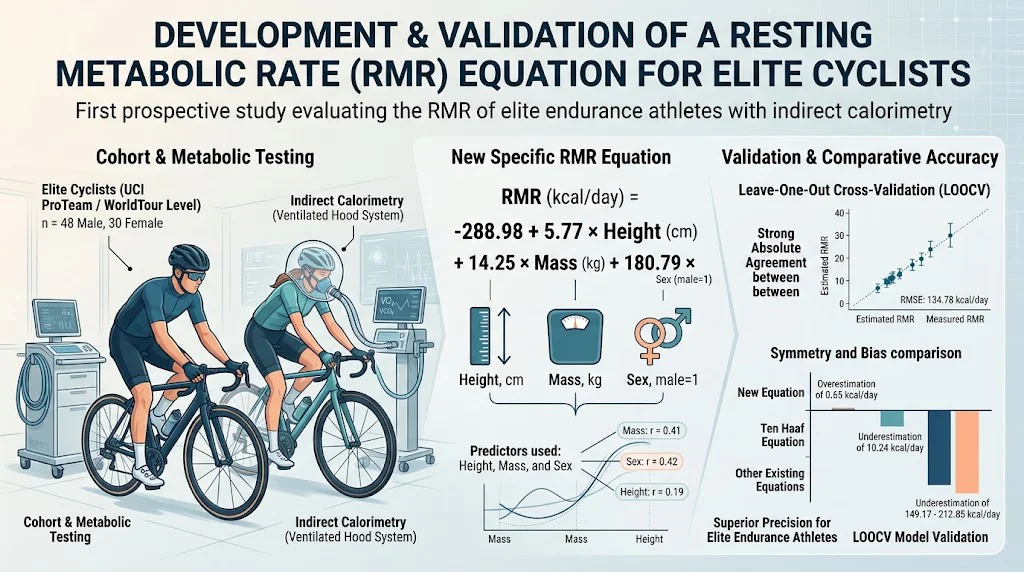
The cross-sectional study enrolled 78 elite cyclists (48 males, 30 females) who met inclusion criteria based on competitive status at the highest levels of professional road cycling. Resting metabolic rate was measured using indirect calorimetry with a ventilated hood system, considered the gold standard method for assessing energy expenditure at rest. This technique quantifies oxygen consumption and carbon dioxide production to calculate energy expenditure accurately.
The research team assessed the relationship between measured RMR and anthropometric variables including height, body mass, and sex. Stepwise forward regression analyses were applied to identify significant predictors to be included in the predictive equation. Partial correlation coefficients quantified the strength of association between these variables and RMR. To validate the resulting equation, the researchers employed leave-one-out cross-validation (LOOCV), comparing predicted and measured RMR values within the cohort. The newly developed equation’s performance was further contextualized by comparison to several widely used existing RMR equations.
Key Findings
The regression analysis yielded a final predictive model for RMR (kcal/day) as follows:
RMR = -288.98 + (5.77 × height in cm) + (14.25 × mass in kg) + (180.79 × sex [male=1, female=0])
Partial correlations revealed that mass (partial r=0.41) and sex (partial r=0.42) were stronger predictors of RMR than height (partial r=0.19), consistent with the known metabolic contributions of lean body mass and physiological differences between sexes.
Validation with LOOCV demonstrated that the new equation had minimal bias, overestimating RMR by only 0.65 kcal/day on average, reflecting excellent agreement with measured values. The root mean squared error was 134.78 kcal/day, indicating tight prediction accuracy within the cohort. By comparison, the Ten Haaf equation demonstrated a slight underestimation bias (10.24 kcal/day), while other existing widely used RMR formulas underpredicted RMR to a greater extent, with biases ranging from 149.17 to 212.85 kcal/day.
These findings underscore the superior suitability of the newly derived formula for the elite cyclist population relative to prior equations, which were not designed to account for the unique metabolic characteristics of high-performance endurance athletes.
Expert Commentary
The study by Cox et al. represents a significant advancement in personalized energy assessment in sport science and nutrition. The careful validation approach and the large elite athlete sample strengthen the equation’s clinical relevance. Accurate RMR estimation is crucial in professional cycling, where finely tuned energy availability impacts performance, recovery, and injury risk.
Nevertheless, while the model accounts for sex, height, and mass, it does not explicitly incorporate lean body mass, fat mass, or other metabolic modifiers such as training load or hormonal status, which may further refine individual predictions. Future research might expand on this to improve individualized precision. Additionally, external validation in diverse endurance athlete populations, including different age groups, ethnicities, and sports, would enhance generalizability.
Conclusion
This investigation provides the largest resting metabolic rate data set reported for elite cyclists to date and establishes a novel predictive equation with high accuracy and specificity. The newly developed formula outperforms existing models in predicting RMR for elite endurance athletes, addressing a critical gap in sports nutrition. Implementation of this tool can facilitate more accurate energy requirement estimations, enabling enhanced personalized nutrition strategies that support health and optimize competitive performance.
Given the importance of precision in energy balance for elite athletes, applying population-specific tools such as this RMR equation constitutes an important step forward for sports medicine professionals, dietitians, and coaches concerned with maximizing athlete potential.
Funding and ClinicalTrials.gov
The article does not specify funding sources or clinical trial registration details.
References
1. Ten Haaf T, Weijs PJ. Resting energy expenditure prediction in recreational athletes of 18-35 years: validation of equations and development of a new one. Clin Nutr. 2014;33(3):515-521. doi:10.1016/j.clnu.2013.07.009
2. Cox M, Balamouti Z, van Leeuwen J, Sanders B, Sanders D, Rietjens G, Plasqui G, Van Hooren B. Development and Validation of a Resting Metabolic Rate Equation for Elite Cyclists. Med Sci Sports Exerc. 2026 Oct 8. PMID: 42849011.
3. Harris JA, Benedict FG. A biometric study of basal metabolism in man. Washington, DC: Carnegie Institution of Washington; 1919.
4. Mifflin MD, St Jeor ST, Hill LA, Scott BJ, Daugherty SA, Koh YO. A new predictive equation for resting energy expenditure in healthy individuals. Am J Clin Nutr. 1990;51(2):241-247.
Specialty calculators
For clinical reference; use professional judgment.