Introduction
Wildfires have become an increasingly frequent and intense environmental phenomenon, releasing large quantities of particulate matter (PM2.5) into the atmosphere. These fine particles, especially fire-specific PM2.5 (wPM2.5), can penetrate deep into the respiratory tract and potentially contribute to various health conditions, including respiratory and cardiovascular diseases. Less is understood about the long-term carcinogenic effects of wildfire smoke exposure on specific cancers, particularly head and neck cancers (HNC), which arise in the aerodigestive tract, an area vulnerable to inhaled toxins.
This article reviews a comprehensive retrospective epidemiological study that links wildfire-specific PM2.5 exposure with the overall and site-specific incidence of head and neck and aerodigestive cancers. It provides insights into the methodology, findings, interpretation, and clinical implications of this relationship.
Background on Head and Neck Cancers
Head and neck cancers include malignancies of the oral cavity, nasal and sinus cavities, nasopharynx, oropharynx, hypopharynx, and larynx. These cancers are influenced by a combination of genetic, lifestyle, and environmental factors. Established risk factors include tobacco and alcohol use, human papillomavirus (HPV) infection, and occupational exposures. Emerging evidence suggests environmental pollution, especially fine particulate matter, may also play a role.
Study Objectives
The primary objective was to investigate the association between wildfire-specific PM2.5 exposure and the incidence rates of head and neck cancers—both overall and by specific subsites. The study aimed to quantify risk over a cumulative 0-10 year lag period after exposure, accounting for confounding factors like health behaviors and demographics. Additional analysis stratified oropharyngeal cancers by p16 status, an important biomarker reflecting HPV-related tumor biology.
Study Design and Methods
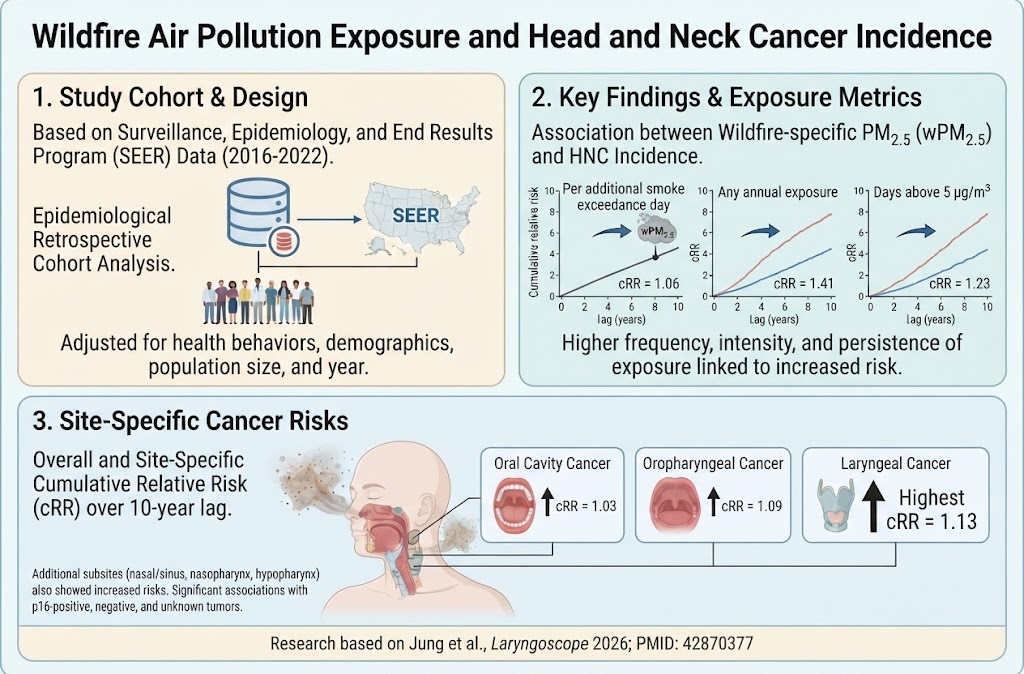
The researchers conducted a retrospective cohort analysis using data from the Surveillance, Epidemiology, and End Results Program (SEER) from 2016 to 2022. They examined county-level wildfire PM2.5 exposure captured as the number of days exceeding smoke thresholds and average concentration above 5 µg/m³ annually.
A distributed lag non-linear model was employed to evaluate the cumulative effects of wildfire PM2.5 over a decade, adjusting for key confounders: tobacco and alcohol use, diet, exercise, sexual activity, age, sex, race/ethnicity, population size, and year of diagnosis. County was treated as a random effect to account for geographic variation.
The HNC subsites analyzed were nasal/sinus/ear, nasopharynx, oral cavity, oropharynx (p16-positive, p16-negative, and unknown), hypopharynx, and larynx.
Key Findings
The analysis revealed a statistically significant association between wildfire-specific PM2.5 exposure and increased cumulative incidence of head and neck cancers over the 0-10 year lag period. Notably:
- Each additional wildfire smoke exceedance day was linked to a 6% increase in cumulative relative risk (cRR 1.06; 95% CI: 1.04-1.09).
- Any annual exposure to wildfire PM2.5 increased risk by 41% (cRR 1.41; 95% CI: 1.24-1.60).
- Each percentage point increase in days exceeding 5 µg/m³ corresponded to a 23% increase in risk (cRR 1.23; 95% CI: 1.13-1.33).
Breaking down by subsite, the oral cavity showed a modest but consistent increase in risk (cRR 1.03, 95% CI: 1.00-1.06), whereas oropharyngeal cancer risk increased more sharply (cRR 1.09, 95% CI: 1.06-1.13). The larynx demonstrated the largest increase, with a 13% rise in cumulative risk per additional wildfire smoke exceedance day over ten years (cRR 1.13; 95% CI: 1.07-1.19).
The stratification by p16 status revealed significant associations across p16-positive, p16-negative, and p16-unknown oropharyngeal cancers, suggesting wildfire smoke exposure influences carcinogenesis regardless of HPV involvement.
Interpretation of Results
This study provides strong epidemiological evidence that prolonged and intense exposure to wildfire-specific fine particulate matter contributes to increasing the incidence of head and neck cancers. The observed latency period (up to 10 years) aligns with carcinogenesis timelines, reinforcing the plausibility of wildfire smoke as a long-term environmental carcinogen.
Fine particulate matter can induce oxidative stress, DNA damage, and inflammatory responses in the mucosa of the upper aerodigestive tract. Chronic exposure may promote genetic mutations and impair immune surveillance, facilitating tumor initiation and progression.
Given the stronger effects in the larynx and oropharynx—areas directly exposed to inhaled air—this relationship is biologically credible. The results emphasize the role of environmental pollutants alongside established behavioral risk factors.
Clinical and Public Health Implications
Awareness of wildfire smoke as a modifiable risk factor for head and neck cancers is crucial as wildfire frequency and intensity increase worldwide due to climate change. Healthcare providers should consider environmental history as part of risk assessment and counsel patients on strategies to reduce smoke exposure during wildfire events.
Population-level measures include improving early warning systems, promoting protective behaviors such as mask wearing and air filtration, and supporting policies that mitigate wildfire risks and air pollution.
Further research is warranted to clarify mechanisms, explore interactions with other carcinogens, and evaluate intervention effectiveness for high-risk populations living in wildfire-prone regions.
Conclusion
This comprehensive epidemiological study demonstrates that wildfire-specific PM2.5 air pollution exposure significantly elevates the risk of head and neck cancers, with the most pronounced effects on the larynx and oropharyngeal sites. The findings shed light on an emerging environmental health threat, underscoring the need for integrated approaches in cancer prevention and environmental health policy.
Recognizing and addressing wildfire smoke exposure expands our understanding of cancer etiology beyond traditional factors and calls for heightened vigilance among clinicians, researchers, and public health officials to protect affected communities.
References
Jung YS, Yu SE, Nadeau KC, Cramer J, Xu MJ, Mitchell MB, Chiang S, Ruan M, Lee SE. Wildfire Air Pollution Exposure and Head and Neck Cancer Incidence. The Laryngoscope. 2026 Oct 13. PMID: 42870377. Available at: https://pubmed.ncbi.nlm.nih.gov/42870377/