Highlight
- Specific VEGFA (rs3025039) and EGF (rs4444903) polymorphisms influence cholangiocarcinoma (CCA) susceptibility and postoperative survival distinctively.
- VEGFA rs3025039 T allele associates with better survival in intrahepatic CCA, whereas EGF rs4444903 G allele correlates with improved outcomes in perihilar CCA.
- High intratumoral VEGFA or EGF mRNA expression portends poor survival, with VEGFA-high tumors exhibiting proliferative and suppressed immune signatures.
- Population data link VEGFA T allele with increased intrahepatic CCA risk; EGF G allele corresponds to elevated circulating EGF levels, suggesting systemic regulatory effects.
Study Background
Cholangiocarcinoma (CCA) is a heterogeneous malignancy arising from biliary epithelium, characterized by poor prognosis and limited therapeutic options. The aggressiveness of CCA is partly driven by dysregulated angiogenesis and growth factor signaling pathways, notably those mediated by vascular endothelial growth factor A (VEGFA) and epidermal growth factor (EGF). VEGFA promotes angiogenesis essential for tumor growth and metastasis, while EGF stimulates tumor cell proliferation and survival through the EGFR signaling axis. Despite recognition of their biological significance in CCA pathogenesis, the clinical impact of genetic variations (single nucleotide polymorphisms, SNPs) in these key genes on disease susceptibility and postoperative outcomes has not been fully elucidated. Addressing this gap could identify novel biomarkers to tailor patient prognosis and inform therapeutic strategies.Study Design
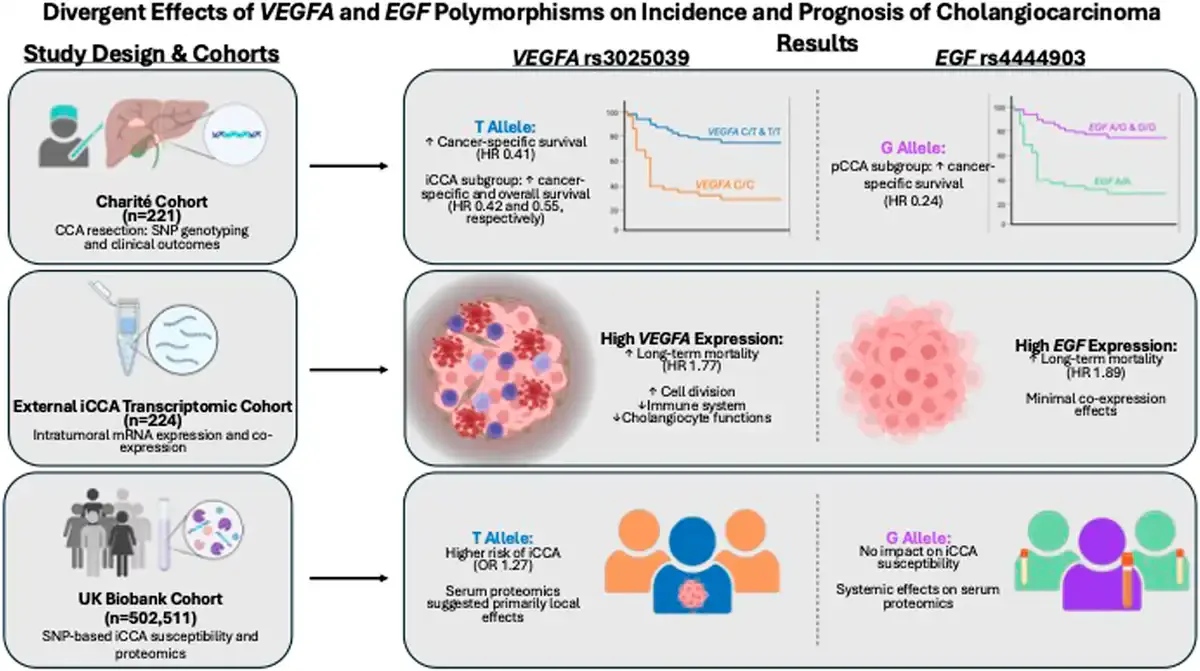
This comprehensive investigation enrolled 221 patients who underwent curative-intent resection for CCA at Charité-Berlin. Genotyping targeted six angiogenesis-related SNPs, focusing on VEGFA rs3025039 and EGF rs4444903 due to their biological plausibility and prior cancer associations. Survival outcomes were assessed via Cox proportional hazards models, stratifying by tumor subtypes (intrahepatic and perihilar CCA). Transcriptomic analyses were performed on an independent cohort to evaluate intratumoral mRNA expression of VEGFA and EGF, alongside co-expression pathways. Furthermore, the UK Biobank population dataset (over 500,000 participants) was leveraged to explore the alleles’ association with CCA susceptibility and systemic proteomic profiles, including circulating growth factors.Key Findings
The study revealed allele-specific associations with postoperative outcomes in CCA subtypes. Carriers of the VEGFA rs3025039 T allele demonstrated significantly improved cancer-specific survival, predominantly observed in intrahepatic CCA, suggesting a protective genetic effect against aggressive tumor behavior. Conversely, the EGF rs4444903 G allele was linked to enhanced survival in perihilar CCA, indicating differential genetic influences related to tumor location. In transcriptomic validation, high intratumoral VEGFA mRNA expression correlated with worse survival, aligning with its role in tumor angiogenesis and progression. These VEGFA-high tumors showed transcriptional profiles marked by increased cellular proliferation and suppression of immune-related gene signatures, reflecting a hostile tumor microenvironment. Elevated EGF expression within tumors also associated with poorer survival initially; however, this association was attenuated after adjusting for confounding clinical variables, implying a more complex or less direct role. Population-level data from the UK Biobank supported these findings, with the VEGFA T allele carriers experiencing increased susceptibility to intrahepatic CCA, potentially reflecting its role in tumor initiation or early progression. Meanwhile, the EGF G allele correlated with higher circulating EGF protein levels, providing mechanistic insight into how systemic growth factor milieu may influence tumor biology. These differential effects underscore that VEGFA and EGF polymorphisms are not uniformly pro- or anti-tumorigenic but modulate distinct biological pathways and clinical phenotypes within CCA.Expert Commentary
This study offers valuable insights into the complex genetics underpinning CCA, emphasizing the divergent roles of angiogenesis and growth factor signaling polymorphisms. The association of VEGFA rs3025039 T allele with improved survival despite increased disease susceptibility suggests a nuanced interplay between tumor initiation and progression governed by genetic variation. Tumor subtype specificity further highlights the heterogeneity of CCA and the necessity for personalized biomarker-driven approaches. While robust, the study’s limitations include a moderate cohort size for genetic association analyses and reliance on retrospective survival data, which may introduce biases. Additionally, functional assays to elucidate the mechanistic consequences of these SNPs on gene/protein expression and pathway activity would strengthen causality. Nonetheless, the integration of transcriptomic and proteomic data with large population cohorts enhances translational relevance.Conclusion
The differential impact of VEGFA and EGF polymorphisms in cholangiocarcinoma underscores their potential utility as prognostic biomarkers tailored by tumor subtype. VEGFA rs3025039 T allele emerges as a marker of improved postoperative survival in intrahepatic CCA, coupled with distinct transcriptomic tumor signatures. EGF rs4444903 G allele similarly predicts favorable outcomes in perihilar CCA and correlates with systemic growth factor levels. These findings advance understanding of genetic factors shaping CCA biology and open avenues for risk stratification and targeted therapeutic interventions. Future research should focus on validating these polymorphisms in larger, prospective cohorts and exploring their predictive capacity for response to anti-angiogenic and EGFR-targeting therapies. Ultimately, integrating germline genetic variants with tumor molecular profiles may improve precision medicine in this challenging malignancy.Funding and Clinical Trials
The study was conducted under institutional support from Charité-Berlin, with data analyses including UK Biobank resources. Specific clinical trial registrations were not reported.References
1. Pein J, Nicklisch S, Horn P, et al. Differential Effects of VEGFA and EGF Polymorphisms on Susceptibility and Postoperative Outcome in Cholangiocarcinoma. Ann Surg. 2026;284(5):935-942. PMID: 42522067. 2. Rizvi S, Khan SA, Hallemeier CL, Kelley RK, Gores GJ. Cholangiocarcinoma – evolving concepts and therapeutic strategies. Nat Rev Clin Oncol. 2018;15(2):95-111. 3. Shukla SK, Ponnusamy MP, Haridas D, et al. Aberrant MUC4 expression in cholangiocarcinoma and pancreatic ductal adenocarcinoma. Cancer Res. 2007;67(7):3144-3152. 4. Carmeliet P, Jain RK. Molecular mechanisms and clinical applications of angiogenesis. Nature. 2011;473(7347):298-307.Specialty calculators
For clinical reference; use professional judgment.