Highlight
- Preoperative ultrasound tends to overestimate tumor size in papillary thyroid carcinoma (PTC), with increasing overestimation for larger tumors.
- Ultrasound shows limited positive predictive value in detecting multifocality and extrathyroidal extension but high negative predictive values, indicating better ruling-out capability.
- These limitations suggest that reliance on ultrasound alone for surgical decisions, especially the extent of thyroidectomy, may risk overtreatment.
Study Background
Papillary thyroid carcinoma (PTC) is the most common thyroid malignancy, often characterized by generally excellent prognosis but with variable pathological features such as tumor size, multifocality, and extrathyroidal extension (ETE) that influence clinical management. Accurate preoperative assessment of these tumor characteristics is pivotal to guide surgical planning, particularly decisions regarding lobectomy versus total thyroidectomy and the extent of lymph node dissection. Ultrasound (US) is the first-line imaging modality due to its accessibility, cost-effectiveness, and ability to visualize thyroid nodules and cervical lymph nodes in real time. However, uncertainties remain about the precision of ultrasound in estimating tumor dimensions and detecting multifocal disease or ETE. Overestimation or underestimation can have significant clinical implications, including unnecessary extensive surgery or inadequate treatment. Hence, evaluating the fidelity of preoperative ultrasound assessment is crucial to optimize patient outcomes.Study Design
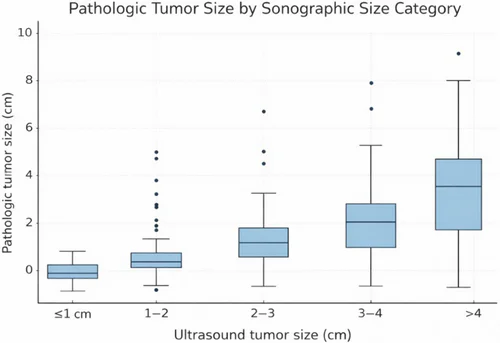
This retrospective cohort study reviewed medical records of 931 patients treated at a tertiary referral center who underwent curative surgery for PTC from 2006 to 2022. The primary objective was to compare preoperative ultrasound-estimated tumor size against postoperative pathological measurements. Tumor size categories were predefined as ≤1 cm, 1-2 cm, 2-3 cm, 3-4 cm, and >4 cm to examine the accuracy across tumor sizes. Secondary endpoints included diagnostic performance characteristics of ultrasound in detecting multifocal tumors and ETE, using postoperative histopathology as the reference standard. Statistical analyses evaluated mean size differences, percentage bias, and predictive values (positive predictive value [PPV] and negative predictive value [NPV]) for US findings.Key Findings
The study found that ultrasound consistently overestimated tumor size relative to pathologic measurements. Mean sonographic tumor size was 2.10 ± 1.42 cm compared with 1.64 ± 1.28 cm pathologically (p4 cm (p<0.001). Overall mean percent difference was +15.7% (±40.7%), indicating a systematic tendency toward larger sonographic size assessments. Regarding multifocality, ultrasound demonstrated a low PPV of 40% but a relatively high NPV of 85%. This suggests ultrasound may miss some multifocal tumors (false negatives) but a negative US finding reasonably excludes multifocality. For extrathyroidal extension, the diagnostic accuracy was even more limited, with a PPV of only 30% but a high NPV of 95%. Thus, while positive ultrasound signs of ETE were often false positives, the absence of sonographic ETE was generally reliable. These data highlight that preoperative ultrasound overestimates tumor size, possibly affecting surgical decisions such as upscaling from lobectomy to total thyroidectomy. Additionally, the limited PPV for multifocality and ETE suggests that ultrasound alone may be insufficient for surgical extent decisions, especially in the absence of other high-risk features such as nodal metastasis.Expert Commentary
Current American Thyroid Association (ATA) guidelines recommend individualized surgical approaches to PTC considering tumor size, nodal status, and other risk features. This study’s findings reinforce the guideline perspective advocating caution in solely relying on ultrasound for critical surgical decisions. The observed overestimation of tumor size on ultrasound may lead to unnecessary total thyroidectomy with increased risk of morbidity, including hypoparathyroidism and recurrent laryngeal nerve injury. Furthermore, the poor PPV for multifocality and ETE detection underscores the need for adjunctive diagnostic tools or intraoperative assessment to refine surgical planning. For instance, fine-needle aspiration cytology, frozen section analysis, or molecular testing might complement ultrasound findings. Moreover, surgeons may consider comprehensive clinical and imaging correlation, including neck CT or MRI in equivocal cases, to better define local extension and multifocality. Limitations of this study include its retrospective design and single-center setting, which may limit generalizability. Operator dependence of ultrasound and variations in imaging protocols over the 16-year span may contribute to measurement variability. Prospective multicenter studies could enhance robustness.Conclusion
This substantial retrospective cohort study demonstrates that preoperative ultrasound in PTC tends to overestimate tumor size and has limited positive predictive value for detecting multifocality and extrathyroidal extension, though its high negative predictive value is reassuring in ruling out these features. Clinicians should exercise caution in basing the extent of thyroidectomy purely on ultrasound findings in the absence of other high-risk factors, to avoid overtreatment and related complications. Multimodal evaluation and judicious surgical planning remain essential in optimal management of papillary thyroid carcinoma.Funding and Clinical Trials
No specific funding sources or clinical trial registrations were reported for this study.References
1. Haugen BR, Alexander EK, Bible KC, et al. 2015 American Thyroid Association Management Guidelines for Adult Patients with Thyroid Nodules and Differentiated Thyroid Cancer. Thyroid. 2016;26(1):1-133. 2. Trimboli P, Nasrollah N, Guidobaldi L, et al. Ultrasound accuracy in predicting extrathyroidal extension in patients with papillary thyroid carcinoma. Endocrine. 2020;68(1):125-131. 3. Ito Y, Miyauchi A. Papillary thyroid carcinoma: surgical management. Expert Rev Anticancer Ther. 2014;14(7):759-767. 4. Nam KH, Park HC, Park JH, et al. A prospective study of risk factors for postoperative hypoparathyroidism after thyroidectomy. Surgery. 2016;159(2):493-501. 5. Kim EY, Han BK, Lee JW, Cha JH, Lee YH. Multifocal papillary thyroid carcinoma: sonographic features and clinical significance. AJR Am J Roentgenol. 2015;204(6):1362-1367.Specialty calculators
For clinical reference; use professional judgment.