Highlight
This large randomized, double-blind, placebo-controlled trial demonstrates that perioperative vaginal oestrogen therapy significantly improves patient-reported symptom improvement and pelvic floor-related quality of life at 12 months after primary native-tissue prolapse surgery in postmenopausal women. Notably, the intervention did not affect anatomical or surgical success rates, or sexual function. The vaginal oestriol cream was well accepted and considered easy to use, supporting its role as an adjunctive treatment option discussed during shared decision-making.
Study Background
Pelvic organ prolapse (POP) is a prevalent condition affecting up to 50% of postmenopausal women to varying degrees, resulting in pelvic pressure, discomfort, urinary and bowel symptoms, and diminished quality of life. The incidence rises with advancing age and menopause-related hypoestrogenism is believed to worsen the integrity of vaginal and pelvic connective tissues, contributing to POP’s pathophysiology. Surgical repair remains a definitive treatment, predominantly involving native-tissue repair techniques. However, recurrence rates and persistent symptoms remain high, emphasizing the need for adjuvant therapies that optimize outcomes.
Vaginal oestrogen therapy is widely used for genitourinary syndrome of menopause (GSM), with proven benefits in improving mucosal trophicity, vascularization, and local tissue strength. Its use perioperatively might theoretically enhance healing and symptom relief after prolapse surgery. Prior evidence has been limited, heterogeneous, or observational, prompting the need for rigorously designed randomized controlled trials (RCTs) to define its role.
Study Design
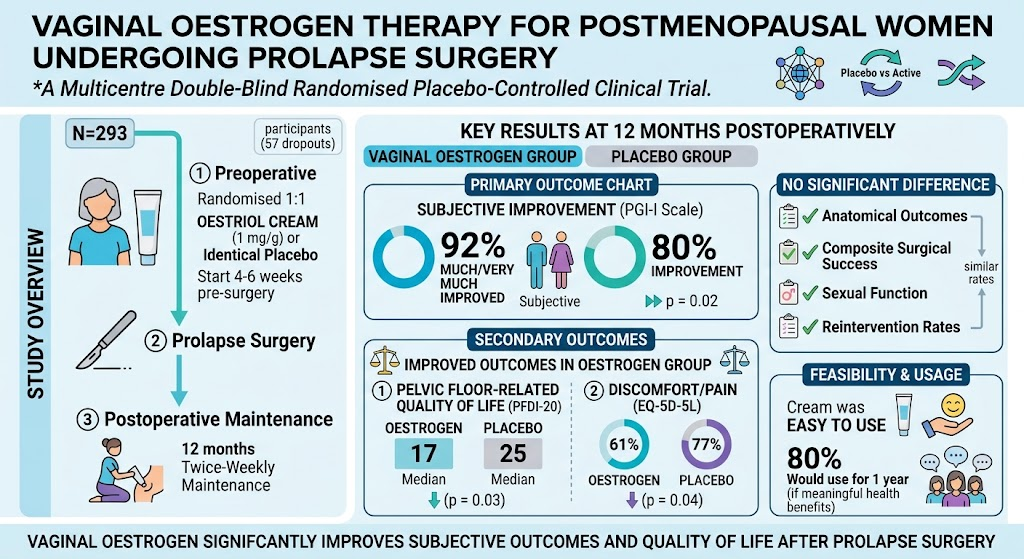
This was a well-conducted, double-blind, randomized, placebo-controlled clinical trial conducted across 22 hospitals in the Netherlands. The study population comprised postmenopausal women with pelvic organ prolapse quantified as POP-Q stage ≥ 2, all scheduled for primary native-tissue prolapse repair. Randomization was 1:1 to receive vaginal oestriol cream (1 mg/g) or a visually identical placebo cream. Treatment was initiated 4-6 weeks before surgery and continued for 12 months postoperatively at a twice-weekly maintenance dose.
The primary endpoint was subjective improvement in prolapse symptoms at 12 months, defined as “much” or “very much” improvement on the Patient Global Impression of Improvement (PGI-I) scale. Secondary endpoints included pelvic floor-related quality of life (Pelvic Floor Distress Inventory-20 [PFDI-20]), generic health-related quality of life (EQ-5D-5L), anatomical outcomes, composite surgical success (anatomical and symptomatic), sexual function, and rates of surgical reintervention. Safety and user acceptability were also assessed.
Key Findings
A total of 293 women were enrolled; 57 dropped out before completion, leaving a robust sample for outcome analysis. At 12 months, a significantly higher proportion of women in the vaginal oestrogen group reported subjective improvement (92%) compared to placebo (80%) on the PGI-I scale (p = 0.02). This represents a clinically relevant absolute improvement of 12% in symptom relief attributable to vaginal oestrogen therapy.
Quality of life outcomes corroborated the symptomatic findings; median PFDI-20 scores were significantly better in the oestrogen group (17) versus placebo (25) (p = 0.03), indicating reduced pelvic floor symptoms. Moreover, a smaller percentage of women experienced discomfort or pain per the EQ-5D-5L (61% vs. 77%, p = 0.04), conveying improved general well-being.
Interestingly, no differences emerged in anatomical success rates or composite surgical success, nor were there significant differences in sexual function scores or reintervention rates. These results suggest that the benefits of vaginal oestrogen are primarily symptomatic and quality-of-life related, rather than structural.
The intervention was reported as easy to use, with 80% of participants indicating willingness to use the cream for one year if it provided meaningful clinical benefits, highlighting good patient adherence and acceptability.
Expert Commentary
This rigorous RCT addresses an important clinical question in urogynecology: does adjunctive vaginal oestrogen improve outcomes after prolapse surgery? The demonstration of significant benefits on patient-reported symptoms and pelvic floor quality of life without anatomical changes aligns with the known physiological effects of estrogen on mucosal and connective tissues, improving tissue quality, lubrication, and local sensation.
While anatomical results were unchanged, the primary therapeutic goal in pelvic floor disorders often extends beyond anatomical correction alone to include symptom relief and quality of life improvement. Hence, the findings justify integrating vaginal oestrogen as part of perioperative management, especially given its safety profile and patient acceptability.
Limitations include the dropout rate which may introduce bias, although intention-to-treat principles and multicenter design enhance generalizability. Additionally, results pertain to primary native-tissue repairs and may not extend to mesh or recurrent prolapse surgeries. There remains a need for longer-term follow-up to confirm durability.
Current guidelines variably recommend vaginal estrogen therapy primarily for GSM symptoms; these trial results may prompt revisions to consider perioperative vaginal estrogen use in prolapse surgery pathways.
Conclusion
The EVA Study provides compelling evidence that perioperative vaginal oestrogen therapy significantly improves symptom relief and pelvic floor-related quality of life at 12 months in postmenopausal women undergoing primary native-tissue prolapse surgery, without influencing anatomical outcomes or complication rates. This therapy is well tolerated and widely accepted by patients, supporting its role as an adjunct in shared decision-making processes to optimize surgical outcomes.
<pFuture research should focus on longer-term effects, its role in recurrent or mesh-based repairs, and mechanistic studies clarifying estrogen’s impact on tissue remodeling post-surgery.
Funding and Trial Registration
The trial was registered under NL-OMON55535 (https://www.onderzoekmetmensen.nl/en/trial/55535). Funding sources were not specified in the abstract but can be consulted in the original publication.
References
- Vodegel EV, van Rest K, Speksnijder L, et al. Vaginal Oestrogen Therapy for Postmenopausal Women Undergoing Prolapse Surgery: A Multicentre Double-Blind Randomised Placebo-Controlled Clinical Trial. BJOG. 2026 Aug 28. PMID: 42663275.
- Bump RC, et al. Pelvic organ prolapse and pelvic floor dysfunction. Epidemiology and clinical significance. Obstet Gynecol. 1999.
- Northington GM, et al. Effects of vaginal estrogen therapy on the vaginal mucosa and pelvic organs: a review. Menopause. 2005.
- Guideline Development Group. Management of pelvic organ prolapse, NICE guideline CG171. 2019.