Highlights
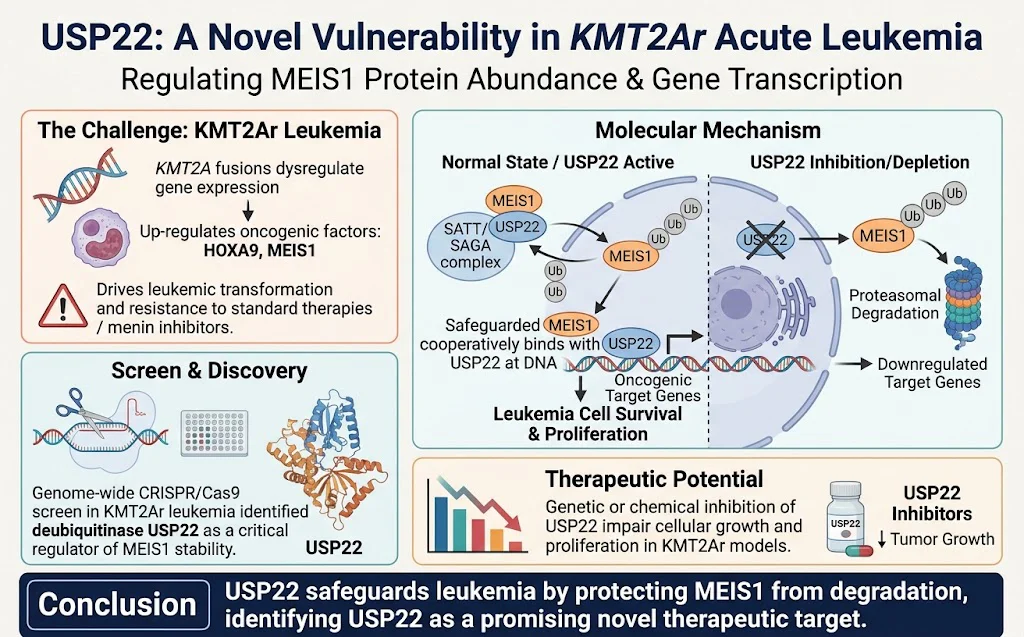
- USP22 is identified as a novel regulator of MEIS1 protein stability in KMT2A-rearranged (KMT2Ar) acute leukemia through genome-wide CRISPR screening.
- USP22 modulates leukemogenic transcription by protecting MEIS1 from proteasomal degradation, thus maintaining oncogenic gene expression.
- Genetic or pharmacologic inhibition of USP22 induces polyubiquitination and degradation of MEIS1, impairing leukemia cell proliferation.
- Targeting USP22 offers a promising therapeutic strategy to overcome chemoresistance and address treatment gaps beyond menin inhibitors in KMT2Ar leukemias.
Background
Acute leukemias harboring rearrangements involving the gene lysine methyltransferase 2A (KMT2A, formerly known as MLL) locus, designated as KMT2Ar leukemias, represent a clinically challenging subgroup with poor prognosis. These leukemias, encompassing both acute lymphoblastic leukemia (ALL) and acute myeloid leukemia (AML) subtypes, are characterized by chromosomal translocations that generate oncogenic KMT2A fusion proteins. These fusion proteins aberrantly regulate transcriptional programs that promote leukemogenesis, primarily through upregulation of homeobox (HOX) clusters and cofactors such as MEIS1, which are critical for leukemic transformation and maintenance. Despite advances, treatment remains challenging due to inherent chemoresistance and rapid relapse. Menin inhibitors, targeting the interaction between menin and KMT2A fusion proteins, have shown therapeutic promise but face emerging resistance mechanisms, underscoring the imperative to identify novel vulnerabilities within the leukemic transcriptional machinery.Key Content
Discovery of USP22 as a MEIS1 Regulator in KMT2Ar Leukemia
The study by Bröchtel et al. (2026) employed an unbiased genome-wide CRISPR/Cas9 knockout approach in a KMT2Ar B-ALL cell line to identify essential regulators of MEIS1, a master leukemogenic transcription factor. USP22, a deubiquitinase component of the Spt-Ada-Gcn5 acetyltransferase (SAGA) complex, emerged as a top candidate that modulates MEIS1 protein abundance. USP22 is well recognized for its roles in chromatin remodeling and transcriptional regulation through histone deubiquitination, but its involvement in acute leukemia and specific transcription factor stabilization had not been fully elucidated.Mechanistic Insights: USP22 Protects MEIS1 from Proteasomal Degradation
Detailed mechanistic studies revealed that USP22 binds cooperatively with MEIS1 at key leukemogenic target gene loci, as shown by chromatin immunoprecipitation assays. This cooperation is functionally significant: USP22 suppresses the polyubiquitination of MEIS1, thereby preventing its proteasomal degradation. Upon genetic depletion or chemical inhibition of USP22, MEIS1 undergoes increased polyubiquitination leading to accelerated proteasomal degradation. This causes a downregulation of MEIS1 target gene expression, disrupting leukemogenic transcriptional programs.Functional Impact on Leukemia Cell Proliferation and Survival
The loss of USP22 in KMT2Ar leukemia models impaired cellular growth and proliferation, indicating that USP22 is essential for leukemia maintenance and progression. The findings were consistent across multiple experimental systems, underscoring the relevance of USP22 as a molecular vulnerability. Importantly, this effect extends beyond mere MEIS1 protein control; USP22, via its role in the SAGA complex, reshapes the chromatin landscape supporting leukemogenic transcription.Therapeutic Implications and Resistance Landscape
Current therapeutic strategies for KMT2Ar leukemias increasingly focus on disrupting oncogenic transcription factor complexes, exemplified by menin-MLL inhibitors. However, resistance to menin inhibitors has been documented, necessitating alternative or combinatorial approaches. Targeting USP22 offers an orthogonal strategy by destabilizing MEIS1 post-translationally rather than blocking upstream interactions. Pharmacological inhibition of USP22 could thus potentiate or synergize with existing therapies, possibly overcoming resistance and improving outcomes. To date, no clinically approved USP22 inhibitors exist; nonetheless, this study highlights the scope for drug discovery efforts to develop targeted inhibitors given the enzyme’s enzymatic role and impact on leukemogenesis.Expert Commentary
The identification of USP22 as a critical modulator of MEIS1 protein stability advances our understanding of transcriptional regulation in KMT2Ar leukemia. USP22’s dual role in chromatin remodeling and direct regulation of MEIS1 stability situates it as a nodal point in leukemic gene regulation. From a mechanistic standpoint, this work elegantly integrates proteostasis and epigenetic control, highlighting how post-translational modifications can critically influence transcription factors central to leukemia. The cooperative chromatin binding of USP22 and MEIS1 delineates a tightly coordinated regulatory network that safeguards aberrant transcriptional programs. Clinically, this study opens avenues for novel therapies targeting deubiquitinases, an emerging class of enzymes with growing interest in oncology. The potential to induce selective leukemia cell death by promoting degradation of MEIS1 addresses a key vulnerability in this aggressive leukemia subtype. Limitations include the preclinical nature of the findings, with further validation needed in patient-derived xenograft models and clinical samples. Additionally, off-target and systemic effects of USP22 inhibition warrant careful evaluation due to its broader roles in normal cell physiology.Conclusion
The study by Bröchtel et al. establishes USP22 as a pivotal regulator of MEIS1 protein stability and leukemogenic transcription in KMT2Ar acute leukemia. The novel insight that USP22 protects MEIS1 from proteasomal degradation unveils a therapeutic target with potential to disrupt oncogenic transcriptional programs essential for leukemia maintenance. Future research is needed to develop selective USP22 inhibitors and to integrate such approaches with existing therapies, including menin inhibitors, to overcome treatment resistance and improve clinical outcomes for patients with KMT2Ar leukemia. This work also exemplifies the power of functional genomic screens in uncovering critical molecular dependencies in aggressive leukemias.References
- Bröchtel S, Schneider C, Müller M, et al. USP22 is a novel vulnerability regulating MEIS1 protein abundance and gene transcription in KMT2Ar acute leukemia. Blood. 2026 Oct 29;148(18):2251-2263. PMID: 42418681.
- Krivtsov AV, Armstrong SA. MLL translocations, histone modifications and leukaemia stem-cell development. Nat Rev Cancer. 2007 Nov;7(11):823-33. PMID: 17971765.
- Bernt KM, Armstrong SA. Targeting epigenetic programs in MLL-rearranged leukemias. Hematology Am Soc Hematol Educ Program. 2011;2011:354-60. PMID: 22160002.
- Shin J, et al. Targeting deubiquitinases in cancer: Emerging opportunities and challenges. Biochem Pharmacol. 2021 Oct;193:114753. PMID: 34184306.
Specialty calculators
For clinical reference; use professional judgment.