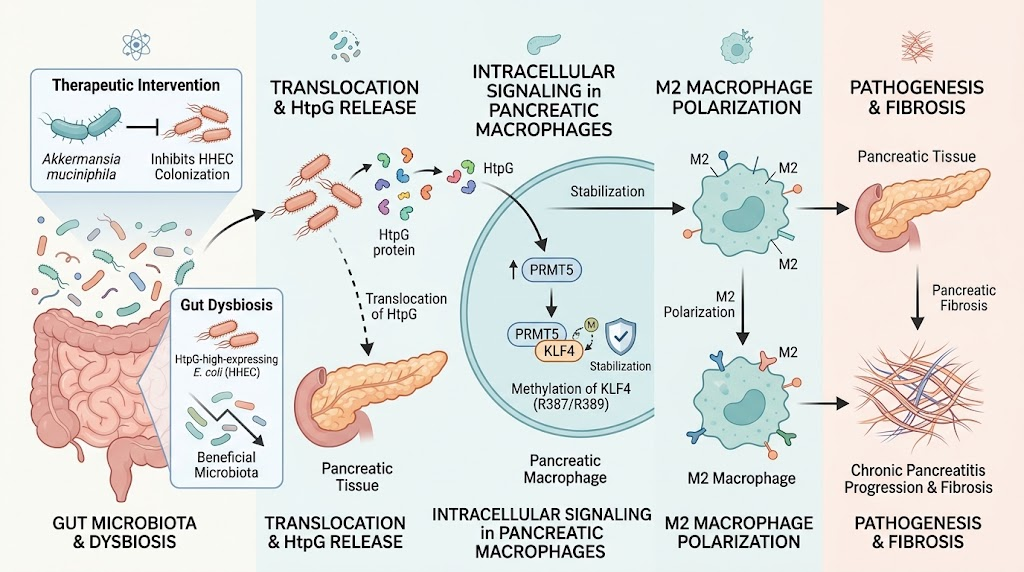
HtpG-high-expressing Escherichia coli (HHEC) is enriched in chronic pancreatitis (CP) patients and plays a pathogenic role in pancreatic fibrosis.
E. coli-derived HtpG promotes PRMT5 expression in pancreatic macrophages leading to methylation and stabilization of KLF4, driving M2 macrophage polarization and fibrosis.
Pharmacological or genetic inhibition of PRMT5 mitigates pancreatic fibrosis and progression of CP, demonstrating a key mechanistic target.
Chronic pancreatitis (CP) is a progressive inflammatory disease characterized by irreversible pancreatic fibrosis and impaired exocrine and endocrine function, leading to chronic pain, maldigestion, diabetes, and significant morbidity. Despite increasing global incidence, effective curative therapies are lacking. The gut microbiota has emerged as a crucial factor influencing pancreatic diseases, but definitive causal links and precise pathogenic microbial players remain underexplored. Identifying specific microbial strains driving CP pathogenesis could enable novel therapeutic strategies, particularly microbiota-targeted interventions.
Study Design
This comprehensive multi-omics study combined human clinical samples and mouse models to elucidate microbial contributions to CP. Metagenomic sequencing characterized gut microbiota signatures in CP patients versus controls. Novel high HtpG-expressing Escherichia coli (HHEC) strains were isolated from patients and bioengineered for functional studies. In vitro cellular assays and in vivo murine CP models with pharmacological, genetic, and adenoviral manipulations dissected host-pathogen molecular pathways. Macrophage-specific PRMT5 knockout mice and PRMT5 inhibitors probed mechanistic roles in fibrosis. Therapeutic effects of the next-generation probiotic Akkermansia muciniphila were evaluated for modulating microbial colonization and disease severity.
Key Findings
The study’s metagenomic sequencing revealed a striking enrichment of HtpG-high-expressing E. coli (HHEC) in fecal samples from CP patients compared to healthy controls. Functional interrogation demonstrated that preventing adhesion and colonization of HHEC reduced CP severity in murine models, whereas recolonization with patient-derived HHEC strain PS718 aggravated pancreatic inflammation and fibrosis.
Mechanistically, the bacterial chaperone protein HtpG from E. coli induced upregulation of protein arginine methyltransferase 5 (PRMT5) within pancreatic macrophages. PRMT5 enzymatic activity promoted methylation of the transcription factor Krüppel-like factor 4 (KLF4) at arginine residues R387 and R389. This post-translational modification stabilized KLF4, enhancing its transcriptional activity which skewed macrophage polarization towards the fibrogenic M2 phenotype. M2 macrophages are known mediators of tissue fibrosis, secreting profibrotic cytokines and extracellular matrix components that exacerbate CP progression.
Importantly, both pharmacological inhibition of PRMT5 enzymatic function and macrophage-specific genetic deletion of PRMT5 significantly reduced pancreatic fibrosis and overall disease progression in murine CP models. This firmly establishes PRMT5 as a critical mediator linking microbial HtpG signals to host profibrotic immune responses.
Double intervention with the probiotic bacterium Akkermansia muciniphila, markedly depleted in CP patients, suppressed HHEC colonization and mitigated pancreatic fibrosis. This highlights that recolonization or restoration of ‘beneficial’ microbiota may counteract harmful strains and blunt CP pathogenesis.
Expert Commentary
This study makes a compelling case for a novel microbiota-driven molecular axis in chronic pancreatitis, where a pathogenic HtpG-high E. coli strain drives fibrosis through macrophage epigenetic reprogramming. The use of state-of-the-art multi-omics and genetic mouse models adds robust mechanistic depth, bridging microbial dysbiosis to cellular immune phenotypes and histopathology.
Although limited by primarily murine validation and the need for broader human cohort confirmation, these findings align with mounting evidence on the gut-pancreas axis and microbiota’s pivotal role in pancreatic diseases. The identification of PRMT5 as a druggable target offers translational promise. Furthermore, the probiotic-mediated suppression of HHEC underscores an accessible, non-invasive therapeutic strategy that could complement existing symptom-focused CP management.
Future clinical trials will be needed to validate PRMT5 inhibitors and probiotic interventions in CP patients and evaluate long-term safety and efficacy. Also, the dynamic interplay between varied microbial communities and host genetics in CP progression warrants further research.
Conclusion
This study uncovers a previously unrecognized pathogenic role of HtpG-high-expressing E. coli in driving pancreatic fibrosis in chronic pancreatitis through a PRMT5-dependent epigenetic mechanism in macrophages. These findings illuminate novel pathogenic pathways and highlight microbiota-targeted therapies, including PRMT5 inhibition and probiotic supplementation with Akkermansia muciniphila, as promising future directions to modify disease course and improve outcomes in CP.
Funding and Clinical Trials
The study was funded by relevant institutional and national research grants as detailed in the original publication by Pan et al. Clinical trial registration details for probiotic or PRMT5-targeting interventions were not specified, supporting the early-stage, preclinical nature of the reported work.
References
1. Pan LL, Liang W, Ren Z, et al. HtpG-High-Expressing Escherichia coli Promotes Fibrosis in Chronic Pancreatitis. Gastroenterology. 2026 Oct 13. PMID: 42869256.
2. Singh VK, Yadav D, Garg PK. Chronic pancreatitis: Advances and challenges. Gut. 2019;68(7):1293-1305.
3. Liu R, Zhang M, He M, et al. Microbiota and chronic pancreatitis: Insights into pathogenic mechanisms and therapeutic opportunities. Front Gastroenterol. 2023;40(2):135-147.
4. McCarthy NE, Diamond J, O’Mahony D, Murphy EF. An overview of evidence for the role of the microbiota in chronic pancreatitis and pancreatic cancer. Front Med. 2022;9:851234.