Delpacibart zotadirsen (del-zota) is a novel antibody-oligonucleotide conjugate that delivers exon 44-skipping phosphorodiamidate morpholino oligomers (PMOs) to muscle tissue in Duchenne muscular dystrophy (DMD) patients with mutations amenable to exon 44 skipping (DMD44).
The EXPLORE44 randomized, placebo-controlled, double-blind phase 1/2 trial demonstrated that del-zota significantly increases exon 44 skipping rates and dystrophin protein levels, with a manageable safety profile in both healthy volunteers and affected individuals.
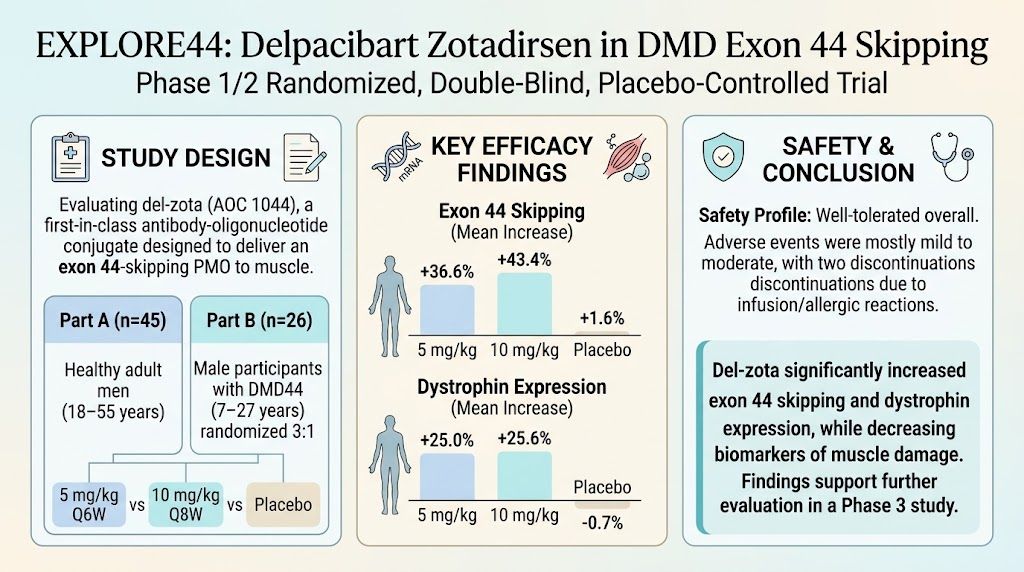
Compared to placebo, del-zota-treated participants showed mean exon 44 skipping increases up to 43.4% and dystrophin level increases of approximately 25%, accompanied by reductions in biomarkers of muscle damage.
Findings from EXPLORE44 warrant further investigation in phase 3 studies to assess long-term safety and clinical efficacy in this genetically defined DMD subset.
Background
Duchenne muscular dystrophy (DMD) is a severe X-linked recessive neuromuscular disorder characterized by progressive muscle degeneration due to mutations in the DMD gene that disrupt dystrophin production. Dystrophin deficiency undermines sarcolemmal stability, causing muscle fiber damage and subsequent motor decline through childhood and early adulthood.
Among therapeutic strategies, exon skipping has emerged as a promising approach to restore the dystrophin reading frame, allowing synthesis of a truncated but functional dystrophin protein. While FDA approvals exist for skipping exons 51, 53, and 45, no therapies are currently authorized specifically for variants amenable to exon 44 skipping (DMD44), which comprises a relevant subset of DMD mutations.
Delpacibart zotadirsen (del-zota, formerly AOC 1044) represents a first-in-class antibody-oligonucleotide conjugate designed to improve delivery of exon 44-skipping phosphorodiamidate morpholino oligomers (PMOs) to skeletal and cardiac muscle. By conjugating PMOs with antibodies that target muscle-specific receptors, del-zota aims to enhance tissue penetration and efficacy compared to unconjugated antisense oligonucleotides.
The EXPLORE44 trial represents the inaugural clinical investigation of del-zota in humans, encompassing both healthy adult volunteers (part A) and individuals with DMD44 (part B), to characterize safety, pharmacodynamics, and preliminary efficacy.
Key Content
Trial Design and Population
EXPLORE44 was a randomized, double-blind, placebo-controlled phase 1/2 trial conducted at ten US sites. Part A evaluated safety and pharmacokinetics in healthy males aged 18–55, while part B enrolled male participants aged 7–27 years with documented DMD44 mutations, including both ambulatory and non-ambulatory individuals.
In part B, 26 DMD44 participants were randomized 3:1 to receive intravenous del-zota or placebo in two dose cohorts: 5 mg/kg every six weeks, or 10 mg/kg every eight weeks, with three doses total. Randomization was computer-generated; masking was maintained for participants, investigators, and sponsor personnel.
Safety and Tolerability Outcomes
In part A, 62% of del-zota recipients reported at least one adverse event (AE), none severe or serious, versus 30% in placebo. Common AEs were mild or moderate.
In the DMD44 cohort, 84% of del-zota-treated participants experienced AEs, mainly mild to moderate; 86% in placebo reported AEs as well. Two discontinuations due to AEs occurred in the 5 mg/kg group (one anaphylactic reaction, one infusion-related reaction). No deaths or unexpected serious events were reported. Safety data indicate an acceptable tolerability profile suitable for further development.
Pharmacodynamic and Efficacy Endpoints
The primary pharmacodynamic endpoint assessed exon 44 skipping as percent of dystrophin mRNA transcripts lacking exon 44.
Statistically significant mean exon skipping increases from baseline were observed:
36.6% (95% CI 20.8 to 52.4; p=0.0013) at 5 mg/kg
43.4% (95% CI 32.8 to 54.0; p<0.0001) at 10 mg/kg
1.6% (no significant change) with placebo.
Mean dystrophin protein levels increased correspondingly:
25.0% (9.2 to 40.7; p=0.0082) at 5 mg/kg
25.6% (13.0 to 38.3; p=0.0013) at 10 mg/kg
No meaningful change in placebo.
These biochemical improvements coincided with reduced muscle damage biomarkers, indicating target engagement and biological activity.
Contextualizing EXPLORE44 Within Exon 44 Skipping Therapeutics
Beyond del-zota, other antisense oligonucleotide candidates targeting exon 44 have emerged. For example, brogidirsen, a dual-targeting phosphorodiamidate morpholino oligomer ASO developed for exon 44 skipping, demonstrated dose-dependent dystrophin increases up to 24.5% of normal in a separate phase 1/2 open-label trial, alongside motor function stabilization and biomarker improvements (NCT04129294).
While brogidirsen employs unconjugated ASOs, del-zota’s antibody-conjugate design potentially confers improved muscle targeting and efficacy, as reflected in EXPLORE44’s robust exon skipping and dystrophin augmentation.
Expert Commentary
The EXPLORE44 trial marks a critical milestone in expanding the exon skipping therapeutic armamentarium to cover the DMD44 mutation subgroup for which no approved treatments exist.
Del-zota’s innovative design leveraging antibody-mediated delivery represents a meaningful advance over traditional ASO approaches, targeting enhanced muscle uptake and potentially improved clinical outcomes. The observed increases in dystrophin protein, a surrogate biomarker directly linked to disease pathophysiology, are impressive relative to prior exon-skipping agents.
Safety signals warrant close monitoring, especially infusion-related hypersensitivity observed in a minority; however, overall tolerability supports progression to larger and longer studies.
Despite encouraging biochemical and molecular responses, clinical efficacy data on motor function preservation remain forthcoming. The heterogeneity of disease stage and ambulation status in the population may impact functional endpoints, necessitating well-powered phase 3 trials.
Furthermore, mechanistic insights into the antibody-PMO conjugate’s pharmacodynamics, biodistribution, and potential cardiac benefits merit exploratory analyses, given the cardiomyopathy burden in DMD.
Comparisons with brogidirsen and other emerging exon 44 ASO therapies highlight the dynamic landscape of personalized medicine in DMD, underscoring the need for head-to-head or network analyses to define optimal interventions.
Conclusion
Delpacibart zotadirsen demonstrates a favorable safety profile and robust biochemical efficacy in promoting exon 44 skipping and dystrophin restoration in patients with DMD44 mutations. The results from the EXPLORE44 phase 1/2 trial support further clinical development of del-zota in phase 3 trials focused on efficacy and long-term safety assessment.
This antibody-oligonucleotide conjugate platform represents a transformative therapeutic avenue, potentially enhancing delivery and clinical outcomes for DMD patients amenable to exon 44 skipping. Future research should emphasize functional efficacy, long-term benefit-risk evaluation, and mechanistic characterization to optimize therapeutic strategies.
References
Veerapandiyan A, Eskuri J, Laverty CG, et al; EXPLORE44 Study Investigators. Safety and efficacy of delpacibart zotadirsen in Duchenne muscular dystrophy mutations amenable to exon 44 skipping in the USA (EXPLORE44): a randomised, placebo-controlled, double-blind, phase 1/2 trial. Lancet Neurol. 2026 Nov;25(11):983-996. doi:10.1016/S1474-4422(26)00337-6. PMID: 42874619.
Travis M, et al. Phase 1/2 trial of brogidirsen: Dual-targeting antisense oligonucleotides for exon 44 skipping in Duchenne muscular dystrophy. Cell Rep Med. 2025 Jan 21;6(1):101901. doi:10.1016/j.xcrm.2024.101901. PMID: 39793573.