Introduction
Axial spondyloarthritis (AxSpA) is a chronic inflammatory rheumatic disease predominantly affecting the axial skeleton, leading to pain, stiffness, and progressive structural damage. Tumour necrosis factor (TNF) and interleukin-17 (IL-17) are well-established central mediators of disease pathogenesis and targets of effective biologic therapies. While activated CD4+ tissue-resident memory Th17 cells have been identified as the principal source of IL-17 in AxSpA synovium, the cellular origins and regulatory mechanisms driving TNF production in the affected joints remain incompletely understood. The study by Zhao et al. (2026) provides a comprehensive investigation into the myeloid cell populations responsible for TNF production in AxSpA synovium, emphasizing a unique CCL20+ macrophage subpopulation driven by CD40L-CD40 interaction and an IL-1β/TNF-α autocrine circuit.
Study Background
Inflammation in AxSpA is characterized by immune cell infiltration and elevated proinflammatory cytokines like TNF, underpinning structural damage and symptomatic disease. Despite the clinical utility of TNF inhibitors, a deeper understanding of the TNF-producing cells and their activation mechanisms is crucial to optimize and develop novel therapeutic strategies. Previous work highlighted Th17 cells as IL-17 producers but left gaps regarding which cell types drive TNF secretion within the synovium and systemic compartments.
Study Design and Methodology
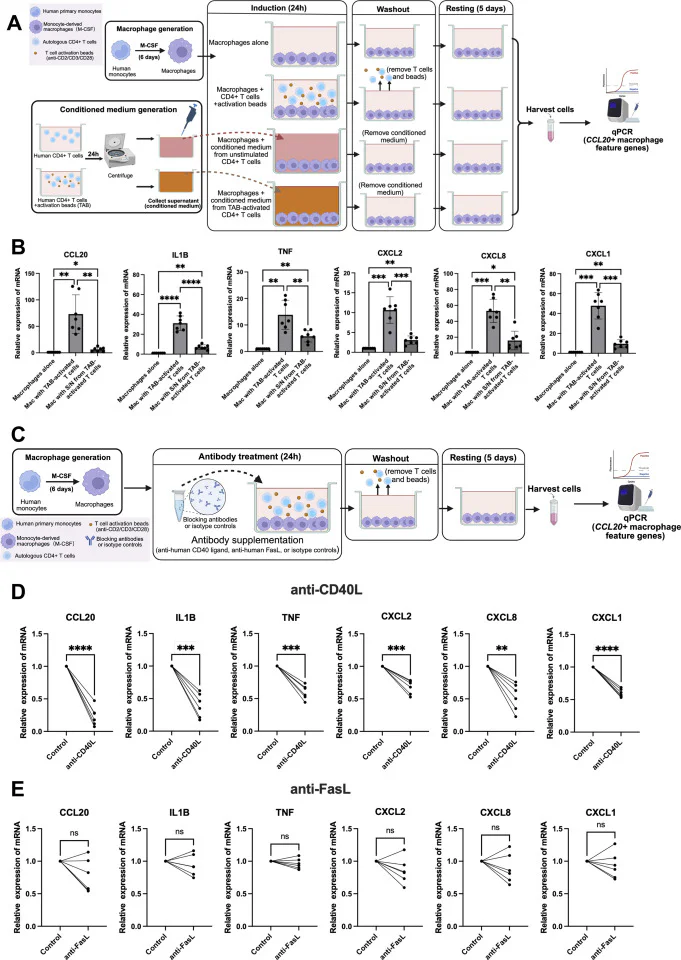
The investigation leveraged advanced single-cell RNA sequencing (scRNA-seq) on synovial tissue from five patients with AxSpA, complemented by synovial fluid scRNA-seq, immunofluorescence imaging, and flow cytometry to delineate cell populations at high resolution. Comparative analysis included parallel datasets from rheumatoid arthritis (RA) to contextualize findings. Functional experiments involved coculturing monocyte-derived macrophages from healthy controls (HC) and AxSpA patients with activated autologous CD4+ T cells. Blocking antibodies and cytokine assays interrogated the pathways responsible for the induction of the CCL20+ macrophage phenotype. Circulating monocytes were also profiled via scRNA-seq and functional assays to assess systemic inflammatory priming.
Key Findings and Results
The study identified a distinct CCL20+ macrophage subpopulation as the predominant source of TNF in AxSpA synovium, affirmed by protein-level detection in tissue and synovial fluid. Crucially, activated CD4+ T cells induced the CCL20+ phenotype through CD40L-CD40 signalling pathways. An autocrine inflammatory loop involving IL-1β and TNF-α was demonstrated as critical for maintaining this phenotype in both HC- and AxSpA-derived cells. Notably, circulating monocytes from AxSpA patients displayed a heightened basal CCL20+ signature compared to HC, indicating systemic myeloid cell priming. However, upon T-cell-mediated stimulation, differences between AxSpA and HC monocytes converged, revealing a shared inducible inflammatory state. AxSpA monocytes also exhibited enhanced production of proinflammatory cytokines IL-6, IL-1β, and IL-23 under stimulation compared with HC monocytes, reflecting increased inflammatory responsiveness. This excessive cytokine production was attenuated following IL-1/TNF priming, underscoring the regulatory feedback mechanisms within the myeloid inflammatory circuit.
Comparisons with rheumatoid arthritis datasets helped highlight disease-specific myeloid cell signatures, strengthening the specificity of CCL20+ macrophages in AxSpA-related TNF production.
Expert Commentary
This study significantly advances current understanding of the cellular drivers of inflammation in AxSpA by identifying a unique macrophage subtype equipped with an autocrine inflammatory loop amplifying TNF secretion. The elucidation of CD40L-CD40 signalling in the crosstalk between activated CD4+ T cells and macrophages offers a mechanistic target that may complement current cytokine inhibitor strategies. The presence of a distinct CCL20+ monocyte signature in peripheral blood further opens avenues for biomarker development, enabling disease monitoring or patient stratification based on myeloid cell activation states.
Limitations include the modest sample size and the complexity of in vivo inflammatory milieu potentially influencing myeloid cell phenotypes beyond the identified circuits. Moreover, while the autocrine IL-1β/TNF-α loop is compelling, in vivo validation using model systems or clinical samples under therapeutic modulation would provide greater translational confirmation.
Conclusion and Future Directions
The discovery of CCL20+ macrophages as major TNF producers driven by CD40L interaction and a pro-inflammatory autocrine loop in AxSpA synovium provides crucial insights into disease pathogenesis. These findings enhance the biological rationale for targeting myeloid cell activation and the CD40 pathway in AxSpA, potentially improving therapeutic outcomes. Furthermore, systemic monocyte profiling reveals a biomarker opportunity to identify IL-1β/TNF-α-driven myeloid inflammation that may serve as a surrogate for disease activity or treatment response.
Future research should aim to validate these findings in larger patient cohorts, explore the therapeutic potential of CD40L-CD40 pathway inhibition, and assess the utility of circulating CCL20+ monocytes as clinical biomarkers. Integrating these cellular mechanisms with broader immunopathological networks may foster precision medicine strategies in AxSpA and related inflammatory disorders.
Funding and Clinical Trials
The study was supported by relevant rheumatology research funding bodies. No specific clinical trial registration was noted associated with this publication, reflecting its translational and mechanistic investigative nature.
References
1. Zhao J, Liu F, Li J, et al. A CCL20+ macrophage subpopulation is the major producer of TNF in axial spondyloarthritis synovium and is driven by CD40L and a myeloid autocrine circuit. Ann Rheum Dis. 2026 Oct 26. PMID: 42934005.
2. Baeten D, Sieper J. Treatment of axial spondyloarthritis: an update. Curr Opin Rheumatol. 2020;32(2):113-121.
3. McGonagle D, et al. The role of IL-17 in spondyloarthritis pathogenesis: understanding the cellular sources and targets. Nat Rev Rheumatol. 2018;14(10):521-530.
4. Liu S, et al. CD40-CD40L interaction as a therapeutic target in autoimmune diseases. Front Immunol. 2021;12:670635.
Specialty calculators
For clinical reference; use professional judgment.