Highlight
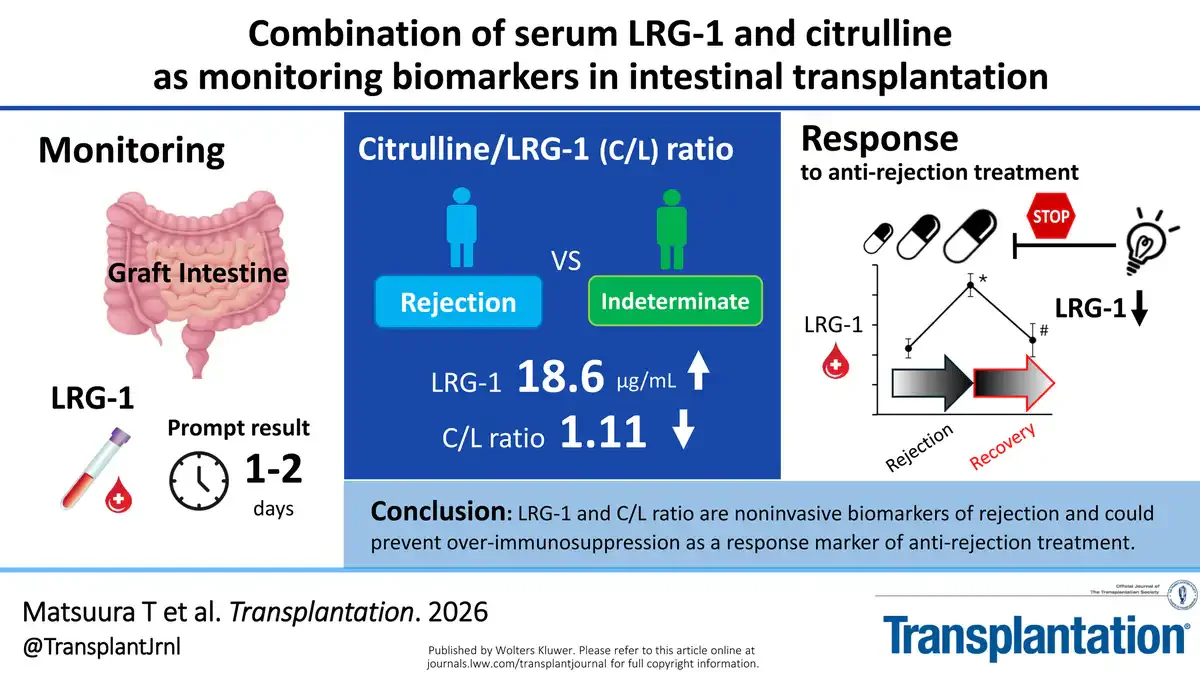
This study identifies serum leucine-rich alpha-2-glycoprotein 1 (LRG-1) combined with citrulline as a promising noninvasive biomarker duo for detecting intestinal graft rejection and monitoring response to antirejection treatment post-intestinal transplantation. The ratio of citrulline to LRG-1 (C/L ratio) shows high diagnostic accuracy correlating with both endoscopic and histopathologic rejection findings, offering a potential to reduce invasive surveillance procedures.
Study Background
Intestinal transplantation (ITx) remains the solid organ transplant with the highest incidence of rejection, necessitating vigilant graft monitoring. Currently, surveillance involves frequent endoscopy and biopsies, which are invasive, burdensome, and carry risk for patients. The absence of reliable, convenient serum biomarkers limits early detection of rejection and timely intervention. Citrulline, a non-protein amino acid synthesized by small intestinal enterocytes, has been recognized as a marker of intestinal mass and function; lower serum levels correlate with mucosal injury. However, citrulline alone lacks sufficient sensitivity and specificity for rejection monitoring.
Leucine-rich alpha-2-glycoprotein 1 (LRG-1) has emerged as a novel serum biomarker reflecting inflammation and disease activity in various gastrointestinal inflammatory disorders. Given these properties, this study aimed to evaluate the utility of serum LRG-1 levels, alone and in combination with citrulline, as biomarkers for predicting intestinal graft rejection after ITx.
Study Design
The prospective observational study included 5 patients undergoing intestinal transplantation. A total of 77 serum samples for LRG-1 and 64 for citrulline were collected at multiple time points post-transplant. Concurrent endoscopic evaluation of the graft was performed, scoring mucosal features by the “VENCH” system (Villi appearance, Erythema, Capillary network, Crypt widening, and Heterogeneity) on the same day as serum sampling. Histopathologic biopsy diagnosis served as the gold standard to classify rejection status.
The study statistically analyzed correlations between serum biomarker levels and the VENCH endoscopic scores as well as histological rejection, assessing diagnostic accuracy metrics such as sensitivity, specificity, and area under the ROC curve (AUC).
Key Findings
Serum LRG-1 levels were significantly elevated in samples with high VENCH scores (≥4), indicative of graft inflammation and mucosal abnormalities (P < 0.0001). Conversely, citrulline levels negatively correlated with LRG-1, reflecting mucosal compromise. The citrulline/LRG-1 (C/L) ratio had an excellent diagnostic performance for detecting endoscopic abnormalities with an AUC of 0.896, sensitivity of 87%, and specificity of 89%.
Importantly, serum LRG-1 concentrations were markedly higher in histologically confirmed rejection samples compared with nonrejection samples (P < 0.0001). The C/L ratio discriminated rejection with even greater accuracy, exhibiting an AUC of 0.992, sensitivity of 100%, and specificity of 94%. These data substantiate that combining these biomarkers improves rejection detection beyond either marker alone.
Though this cohort was small, consistent patterns across multiple samples and time points robustly support the clinical utility of these serum markers.
Expert Commentary
Identifying noninvasive biomarkers for intestinal graft rejection has been a critical unmet need due to the invasiveness and costs associated with endoscopic monitoring. Serum LRG-1 reflects acute-phase and intestinal mucosal inflammation with high sensitivity, while citrulline levels provide functional insight regarding the absorptive capacity and mucosal integrity. Their inverse relationship and combined ratio offer a valuable composite indicator balancing inflammation and tissue function.
This study’s findings align with prior work recognizing citrulline’s role in monitoring intestinal health but importantly enhance it by integrating LRG-1, thereby increasing diagnostic precision. The superior performance of the C/L ratio could facilitate earlier and less invasive detection of rejection episodes, enabling timely therapeutic adjustments and potentially improving graft survival.
Limitations include the small sample size and single-center nature, which may affect generalizability. Larger multicenter validation studies are essential to confirm these promising results, refine cutoffs, and define optimal sampling intervals. Additional research into the kinetics of these biomarkers during treatment response will augment their clinical application.
Conclusion
This study demonstrates that serum LRG-1, especially when combined with citrulline as a ratio, is a highly sensitive and specific noninvasive biomarker for intestinal graft rejection post-transplant. Routine serum monitoring of the C/L ratio could substantially reduce dependence on invasive endoscopy, improving patient safety and comfort while facilitating tighter immunosuppressive management. Adoption of this biomarker approach into clinical practice awaits external validation but holds significant promise to transform post-ITx surveillance.
Funding and ClinicalTrials.gov
The original study did not specify funding sources or clinical trial registration information.
References
- Matsuura T, Toriigahara Y, Maeda S, et al. Combination of Serum Leucine-rich Alpha-2-Glycoprotein 1 and Citrulline as Biomarkers of Graft Monitoring and Response to Antirejection Treatment in Intestinal Transplantation. Transplantation. 2026 Oct 27. PMID: 42934206.
- Cravedi P, Heeger PS. Noninvasive biomarkers of transplant rejection: clinical applicability and future prospects. Nat Rev Nephrol. 2016;12(10):645-658.
- Thiim M, Mortensen J, Qvist N. Plasma citrulline – a biomarker for small intestinal function and absorption in short bowel syndrome and intestinal transplantation. Curr Opin Clin Nutr Metab Care. 2008 May;11(3):275-8.
- Miyoshi H, et al. Leucine-rich alpha 2 glycoprotein (LRG) as a novel serum biomarker of disease activity in IBD. Dig Dis Sci. 2017;62(3):755-762.
Specialty calculators
For clinical reference; use professional judgment.