Highlight
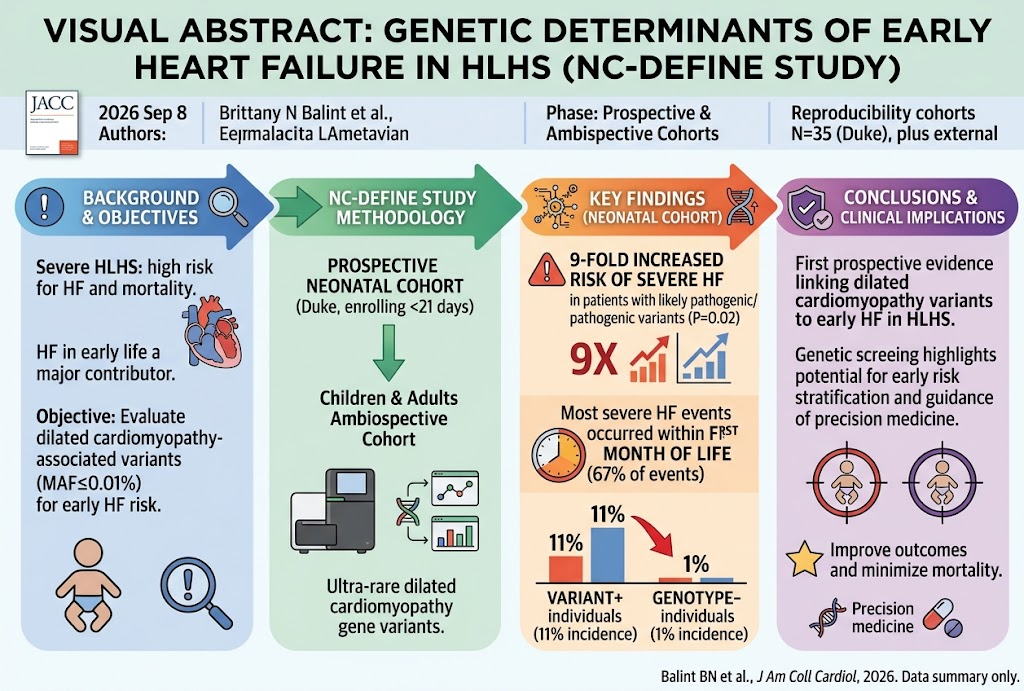
- Ultra-rare variants in dilated cardiomyopathy-associated genes are linked to significantly increased risk of early severe heart failure in neonates with hypoplastic left heart syndrome (HLHS).
- The NC-DEFINE prospective cohort identified a ninefold increase in severe heart failure risk among genotype-positive infants compared to genotype-negative peers.
- External validation in multiple centers confirmed similar associations, reinforcing the genetic contribution to myocardial vulnerability in HLHS.
- These findings support integration of genetic testing for early risk stratification and personalized management strategies in this high-risk congenital heart disease population.
Study Background
Hypoplastic left heart syndrome (HLHS) represents one of the most severe forms of congenital heart disease, characterized by underdevelopment of the left-sided heart structures, which critically impairs systemic circulation. Despite advances in surgical palliation, including staged reconstructive procedures, patients with HLHS remain at high lifetime risk of heart failure (HF), a leading cause of morbidity and mortality, particularly in infancy and early childhood. Early-onset HF significantly worsens prognosis and complicates management, yet reliable predictive tools to identify infants at highest risk are lacking.
While anatomical and hemodynamic factors contribute to outcomes, emerging evidence points to a genetic component influencing myocardial resilience and susceptibility to HF in HLHS. Variants in genes implicated in cardiomyopathies might predispose to impaired myocardial function, but prospective data evaluating this hypothesis have been sparse.
Study Design
The NC-DEFINE study prospectively enrolled neonates diagnosed with HLHS within the first 21 days of life at Duke University Health System. An ambispective cohort enrolled older children and adults with HLHS from Duke and the University of North Carolina to assess age-related associations. External validation cohorts were drawn from Nationwide Children’s Hospital and Vanderbilt University Medical Center, facilitating reproducibility analysis.
All participants underwent comprehensive genome sequencing focusing on ultra-rare variants (minor allele frequency ≤0.01%) in a panel of genes associated with dilated cardiomyopathy. The primary outcome was the development of HF, categorized as severe—requiring ventricular assist device (VAD) implantation, heart transplantation, or resulting in death—or medically managed, defined by reduced systemic ventricular ejection fraction and/or initiation or escalation of HF therapy.
Associations between the presence of likely pathogenic/pathogenic variants and HF risk were quantified using Cox proportional hazards regression models.
Key Findings
In the prospectively enrolled group of 35 neonates with HLHS, 7 (20%) experienced severe HF within the first month of life, and an additional 10 (28.6%) developed medically managed HF. Notably, 18 infants (51.4%) remained free of HF.
The presence of likely pathogenic or pathogenic variants in cardiomyopathy-associated genes was markedly associated with a ninefold increase in risk of severe HF compared to genotype-negative infants (P=0.02). This genetic risk appeared concentrated in the earliest period after birth, with approximately two-thirds of severe HF events occurring within one month.
Validation cohorts from Nationwide Children’s Hospital and Vanderbilt University Medical Center confirmed similar associations, reporting an 11-fold and 3-fold increased risk respectively (all P 0.05), potentially reflecting survivorship bias or age-related changes in genetic influence.
These data collectively indicate that ultra-rare dilated cardiomyopathy gene variants confer substantial vulnerability to early HF in HLHS neonates, with potential implications for early clinical decision-making.
Expert Commentary
The NC-DEFINE study uniquely contributes prospective evidence tying cardiomyopathy-associated pathogenic variants to early-onset heart failure risk in HLHS. This advances understanding beyond structural abnormalities to encompass myocardial genetic vulnerability as a driver of outcomes.
By utilizing rigorous genome sequencing and well-curated phenotyping, the study addresses prior limitations inherent in retrospective or small cohort analyses. Its multi-institutional validation enhances generalizability.
One limitation is the moderate cohort size, which while adequate for robust associations, calls for larger international studies to further delineate variant-specific risks and gene-environment interactions. Additionally, the attenuated associations in older cohorts suggest that genetic predisposition is most critical in neonatal myocardium, warranting age-stratified research.
The findings open compelling avenues for precision medicine, including integrating genetic screening into newborn assessment and tailoring surveillance intensity or therapeutic strategies based on genetic risk profiles. This aligns with growing trends to personalize care in congenital heart disease.
Conclusion
The NC-DEFINE study provides the first prospective demonstration that ultra-rare pathogenic variants in dilated cardiomyopathy-associated genes significantly elevate the risk of early, severe heart failure in neonates with hypoplastic left heart syndrome. This genetic contribution to myocardial susceptibility underscores the potential of genomic screening for early risk stratification in HLHS.
Integrating genetic insights into clinical pathways could enable identification of infants at highest risk, fostering tailored surveillance and intervention to mitigate early HF and improve outcomes. Future research should expand cohorts, investigate mechanistic pathways, and test targeted therapies to translate these findings into clinical practice effectively.
Funding and ClinicalTrials.gov
The study was conducted under the NC-DEFINE consortium with funding sources not detailed in the abstract. The full publication or registry entries should be consulted for comprehensive disclosure.
References
Balint BN, Sunthankar SD, Monaco G, et al. Genetic Determinants of Early Heart Failure in Hypoplastic Left Heart Syndrome: A Prospective NC-DEFINE Study. J Am Coll Cardiol. 2026 Sep 8;88(10):1141-1153. PMID: 42714046.
McCrindle BW, et al. Hypoplastic Left Heart Syndrome: Current Outcomes and Challenges. Circulation. 2013;128(3):282-293.
Ware JS, Li J, Mazaika E, et al. Genetic Investigation in Pediatric Cardiomyopathies. Nat Rev Cardiol. 2018;15(12):792-805.