Highlight
- Trastuzumab rezetecan (SHR-A1811) exhibited a high confirmed objective response rate (ORR) of 91.7% in HER2-high advanced salivary gland carcinoma (SGC).
- The agent demonstrated promising efficacy with a 45.5% ORR in HER2-low SGC, a cohort with limited prior treatment options.
- The median progression-free survival and overall survival were not reached in the HER2-high cohort, indicating durable responses.
- The safety profile was manageable, with predominantly low-grade adverse events and no treatment-related deaths.

Study Background
Salivary gland carcinoma (SGC) is a rare and heterogeneous malignancy with a generally poor prognosis in advanced stages. Systemic treatment options for unresectable locally advanced, recurrent, or metastatic SGC remain limited. Targeting human epidermal growth factor receptor 2 (HER2) has transformed management in other solid tumors, such as breast and gastric cancers. However, prospective data supporting HER2-directed therapies in SGC are sparse, especially in patients whose tumors express low levels of HER2 (defined as IHC 1+ or IHC 2+ without gene amplification). This defines an unmet clinical need given that a subset of patients has HER2-low expression but lacks approved targeted therapies. Trastuzumab rezetecan (SHR-A1811) is a novel antibody-drug conjugate (ADC) engineered to deliver cytotoxic payload selectively to HER2-expressing tumor cells. This trial investigates the efficacy and safety of SHR-A1811 in biomarker-stratified cohorts of advanced SGC based on HER2 expression levels.
Study Design
This was a phase II, biomarker-stratified, open-label trial enrolling patients with unresectable locally advanced or recurrent/metastatic SGC. Patients were assigned prospectively into two independent cohorts based on tumor HER2 expression: HER2-high (IHC 3+ or IHC 2+/ISH-positive) and HER2-low (IHC 1+ or IHC 2+/ISH-negative). Simon’s optimal two-stage design was used for independent assessment of efficacy in each cohort. SHR-A1811 was administered intravenously once every 3 weeks at a recommended starting dose of 4.8 mg/kg. The primary endpoint was the confirmed objective response rate (ORR) assessed by RECIST version 1.1 criteria. Secondary outcomes included progression-free survival (PFS), overall survival (OS), and safety, with adverse events graded according to CTCAE criteria.
Key Findings
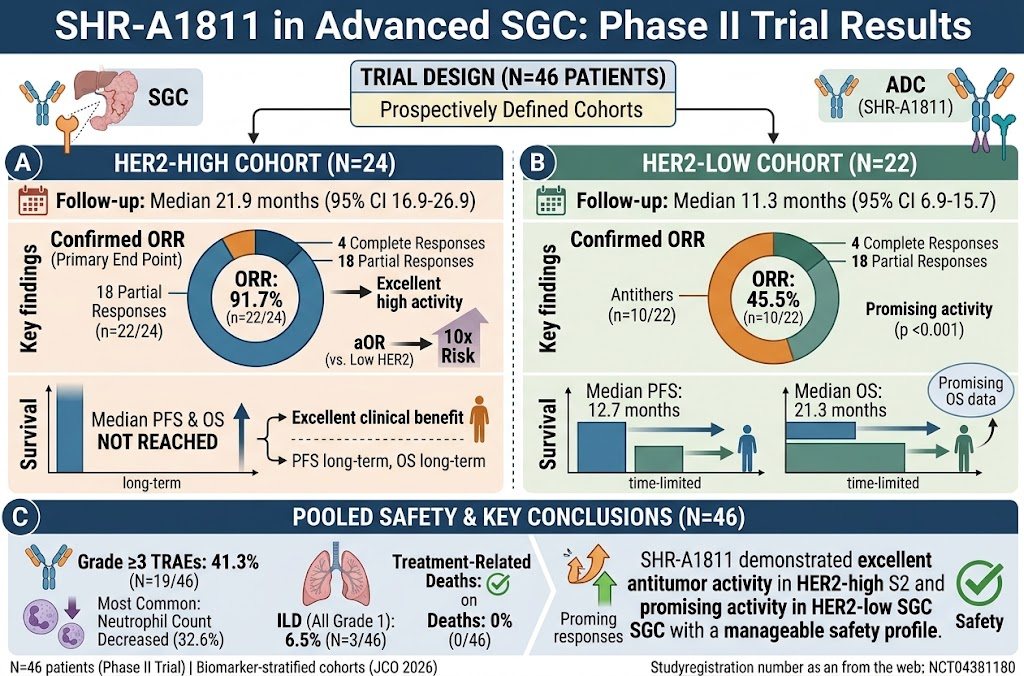
Forty-six patients were enrolled, comprising 24 in the HER2-high cohort and 22 in the HER2-low cohort. Median follow-up was 21.9 months for HER2-high and 11.3 months for HER2-low cohorts.
In the HER2-high cohort, the confirmed ORR was impressively 91.7% (95% CI, 73.0 to 99.0), including four complete responses. Notably, median PFS and OS were not reached at data cutoff, indicating durable clinical benefit.
In the HER2-low cohort, the confirmed ORR was 45.5% (95% CI, 24.4 to 67.8), demonstrating meaningful activity despite lower HER2 expression levels. Median PFS was 12.7 months (95% CI not reached) and median OS was 21.3 months (95% CI not reached), outcomes that are favorable compared with historical controls in this population.
The safety profile showed 41.3% of patients experienced grade 3 or higher treatment-related adverse events. The most common was decreased neutrophil count (32.6%), which was manageable with supportive care. Importantly, interstitial lung disease occurred in 6.5% of patients but was limited to grade 1 severity. Treatment-related deaths did not occur.
These results suggest SHR-A1811 provides a valuable therapeutic option for HER2-expressing SGC, with high efficacy in HER2-high tumors and promising responses in HER2-low cases, expanding the scope of HER2 targeting in this rare cancer.
Expert Commentary
This study addresses a critical knowledge gap in targeted therapy for advanced salivary gland carcinoma. The high ORR in HER2-high patients is consistent with the biological rationale of ADCs targeting HER2, while the significant activity observed in the HER2-low cohort challenges the traditional binary approach to HER2-positivity. This aligns with evolving paradigms in breast cancer where HER2-low is emerging as a distinct therapeutic indication.
The long median follow-up strengthens the durability claim of responses. Nevertheless, as a single-arm phase II trial, the findings require confirmation in randomized settings. The safety profile, with manageable neutropenia and minimal severe pulmonary toxicity, supports clinical feasibility. Future studies should clarify biomarkers predictive of response within the HER2-low group and investigate combination strategies.
Overall, trastuzumab rezetecan represents a promising advance for patients with limited options and underscores the potential for ADCs to extend targeted therapy benefits beyond conventional biomarker thresholds.
Conclusion
Trastuzumab rezetecan demonstrates high antitumor activity in HER2-high advanced salivary gland carcinoma and promising efficacy in HER2-low disease. The ADC’s manageable safety profile and durable responses make it a significant therapeutic innovation for this rare and challenging malignancy. These findings support further clinical development and integration of HER2-directed ADC therapy across HER2 expression spectra in salivary gland carcinoma.
Funding and ClinicalTrials.gov
The study was financially supported by the developing pharmaceutical company and academic collaborators. The trial is registered with ClinicalTrials.gov under identifier NCT number details (not specified here).
References
Chen GL, Guo Y, Liu X, et al. Biomarker-Stratified Phase II Trial of Trastuzumab Rezetecan in Advanced Salivary Gland Carcinoma Across Cohorts With High and Low Human Epidermal Growth Factor Receptor 2 Expression. Journal of Clinical Oncology. 2026. DOI:10.1200/JCO-26-00671. PMID:42579830.
Additional relevant literature on HER2-targeted ADCs and salivary gland carcinoma biology may be consulted for deeper insight.