Highlight
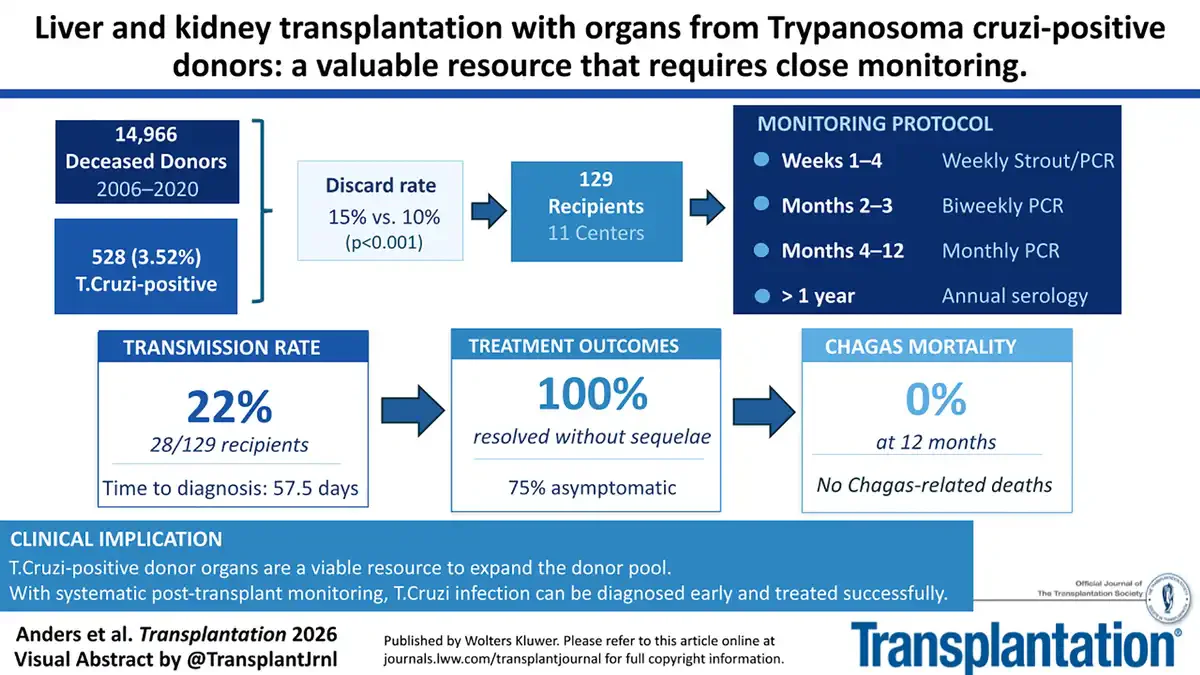
This article examines the safety and monitoring protocols associated with liver and kidney transplantation using organs from Trypanosoma cruzi-positive donors. Key points include: a 3.52% seroprevalence of T. cruzi among deceased donors in Argentina; a 22% posttransplant reactivation rate of infection with most patients remaining asymptomatic; effective resolution of infection with benznidazole treatment; and the necessity for close surveillance, especially during the first year posttransplant.
Study Background
Chagas disease, caused by the protozoan parasite Trypanosoma cruzi, remains a significant public health concern in Latin America, where it is endemic. Transmission mainly occurs through vector-borne routes but can also be transmitted via blood transfusion and organ transplantation. In regions with limited organ donor availability, leveraging organs from T. cruzi-infected donors presents an opportunity to expand the donor pool. However, the risk of donor-derived infection and subsequent disease reactivation posttransplantation poses clinical challenges, particularly considering the immunosuppressed status of recipients.
Given the often asymptomatic nature of early Chagas reactivation and the serious complications that can arise if left untreated, understanding the incidence, outcomes, and management strategies for transplantation from T. cruzi-positive donors is essential to optimize patient care and resource utilization. This Argentinean study aimed to provide robust epidemiological data and clinical insights into this practice.
Study Design
The research integrated two complementary approaches:
- A cross-sectional analysis of the Argentinean Transplant Registry data spanning 2006 to 2020, which assessed the seroprevalence of T. cruzi among deceased donors nationwide.
- A retrospective multicenter cohort study including 129 liver and kidney transplant recipients who received organs from T. cruzi-positive donors. This study evaluated the incidence of donor-derived infection, timing of reactivation, clinical manifestations, treatment outcomes, and associated risk factors.
Surveillance protocols involved regular monitoring posttransplant, primarily during the first year, which is critical for timely detection and intervention of infection reactivation.
Key Findings
Donor Seroprevalence: The registry analysis revealed a 3.52% prevalence (528 out of 14,966) of T. cruzi infection among deceased organ donors, emphasizing the relevance of this donor subset.
Recipient Outcomes: Among 129 recipients, with a median follow-up of approximately 3.6 years and adherence to surveillance at 83%, 28 patients (22%) developed T. cruzi infection posttransplant. The median time to detection was 57.5 days, indicating early reactivation in most cases.
Clinical Manifestations: Notably, 75% of infected patients remained asymptomatic, underlining the importance of vigilant laboratory monitoring rather than relying solely on clinical symptoms.
Risk Factors: Statistical analysis showed no significant association between pre-existing recipient T. cruzi seropositivity or posttransplant rejection episodes and Chagas reactivation risk, suggesting other factors may contribute to reactivation.
Treatment and Safety: Nearly all infected individuals were treated with benznidazole, an antiparasitic agent effective against T. cruzi. Treatment led to infection resolution without sequelae and was well tolerated. Importantly, no deaths were attributed to Chagas disease in this cohort, indicating the safety of transplanting from positive donors with appropriate management.
Expert Commentary
This comprehensive analysis supports the feasibility and safety of utilizing organs from T. cruzi-positive donors, provided that recipients undergo rigorous posttransplant surveillance. The findings challenge earlier hesitancies regarding the use of such organs by demonstrating effective infection control with benznidazole treatment and minimal symptomatic disease.
However, it is essential to acknowledge some limitations, including the retrospective design and potential variability in surveillance adherence across centers. Further prospective studies would help refine risk stratification and monitoring protocols. The impact of immunosuppressive regimens on infection reactivation also warrants additional investigation.
Clinicians should maintain a high index of suspicion for reactivation and employ regular parasitological monitoring, especially within the first 6 months to 1 year posttransplant, to enable early intervention.
Conclusion
The study demonstrates that liver and kidney transplantation using organs from T. cruzi-positive donors is a valuable strategy to increase organ availability in endemic regions. Close and systematic monitoring posttransplant is critical to detect reactivation early and initiate timely treatment, thereby ensuring favorable outcomes without significant morbidity or mortality attributable to Chagas disease.
These findings advocate for revised transplant policies embracing the use of T. cruzi-infected donor organs under protocols that ensure patient safety through proper follow-up and therapeutic intervention. This approach ultimately expands the donor pool and potentially reduces transplant waiting times in affected regions.
Funding and Clinical Trials
The referenced article does not specify funding sources or clinical trial registration details. Future studies should aim to include these elements for transparency and research reproducibility.
References
1. Anders M, Barcán L, Angeramo A, et al. Liver and Kidney Transplantation With Organs From Trypanosoma cruzi -positive Donors: A Valuable Resource That Requires Close Monitoring. Transplantation. 2026;110(11):e2260-e2268. PMID: 42487158.
2. Bern C. Chagas’ Disease. N Engl J Med. 2015;373(5):456-466. doi:10.1056/NEJMra1410150.
3. Morillo CA, Marin-Neto JA, Avezum A, et al. Randomized trial of benznidazole for chronic Chagas’ cardiomyopathy. N Engl J Med. 2015;373(14):1295-1306. doi:10.1056/NEJMoa1507574.
Specialty calculators
For clinical reference; use professional judgment.