Highlight
This study demonstrates that rapid whole-genome sequencing (WGS) achieved a high diagnostic yield of 45.1% in pediatric neurology inpatients, with substantial management changes in two-thirds of diagnosed cases. It highlights differences in diagnostic rates between neonatal and nonneonatal patients and identifies clinical features such as family history and multisystem involvement that predict diagnostic success. Furthermore, reanalysis of negative cases contributes additional diagnoses, validating longitudinal genomic evaluation.
Study Background and Disease Burden
Genetic disorders constitute a significant and often underrecognized contributor to pediatric neurological presentations in inpatient settings. Rapid identification of underlying genetic etiologies can enable targeted management, prognostication, and familial counseling. While rapid whole-genome sequencing has progressively integrated into neonatal and pediatric intensive care units (ICUs) with promising diagnostic yields and clinical impacts, its utility across broader pediatric neurology inpatient populations—including general pediatric wards—remains less well studied. The heterogeneous and often complex neurological phenotypes seen in these patients necessitate timely and precise molecular diagnostics to optimize care delivery and improve outcomes.
Study Design
Conducted as a retrospective cohort study from June 1, 2022, to January 17, 2026, this research was based at a tertiary medical center and included pediatric inpatients presenting with unexplained neurological symptoms. The cohort consisted of neonates (≤28 days old) and nonneonates admitted to neonatal ICU, pediatric ICU, or general pediatric wards. Patients with known non-genetic causes were excluded to focus on undiagnosed genetic conditions.
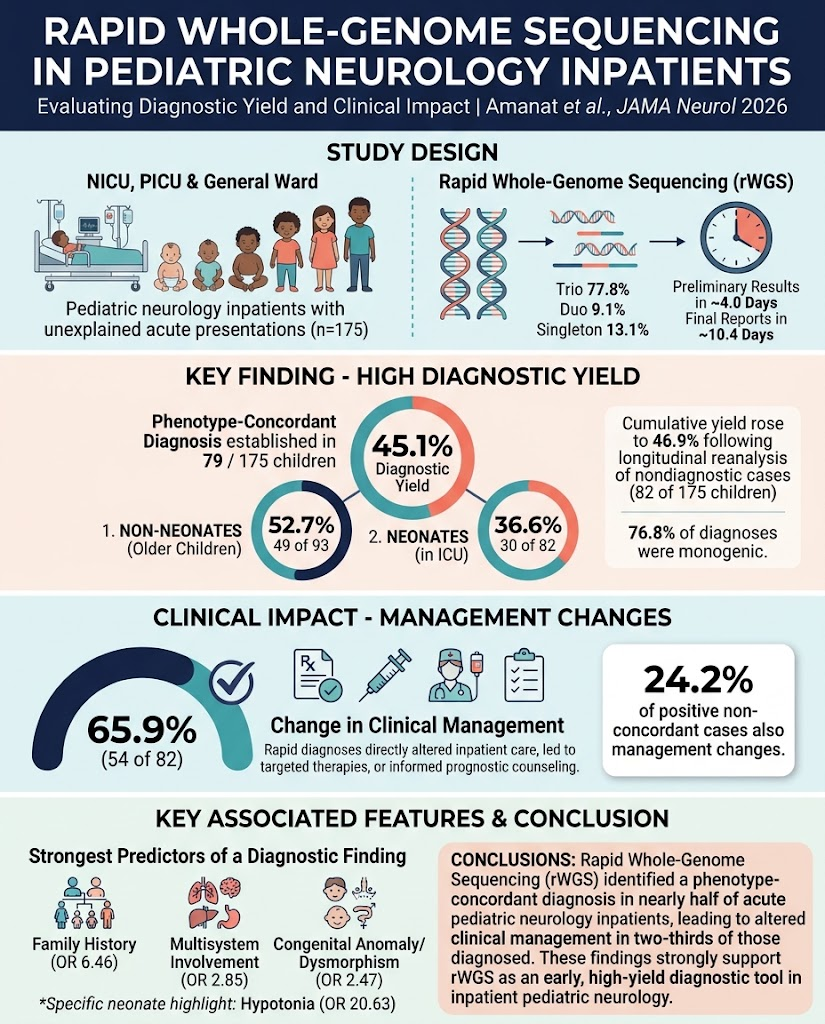
Rapid WGS was performed utilizing trio (both parents and child, 77.8%), duo (one parent and child, 9.1%), or singleton (child only, 13.1%) sequencing strategies. The primary endpoint was the initial diagnostic yield of phenotype-concordant genetic findings at the point of care. Secondary outcomes included additional diagnoses obtained from reanalysis prompted by new clinical features or family requests, overall cumulative diagnostic yield, and changes in clinical management attributable to genetic findings. Logistic regression assessed clinical factors associated with positive diagnoses.
Key Findings
A total of 175 children (median age of 4 months, interquartile range 1 day to 4 years; 53.1% male) were analyzed—82 neonates and 93 nonneonates. Rapid WGS yielded an initial phenotype-concordant diagnosis in 79 children (45.1%), with a significantly higher yield in nonneonates (52.7%) than neonates (36.6%). Preliminary results were available rapidly, mean 4.0 days, supporting timely clinical decision-making.
Notably, 33 children (18.9%) harbored positive genetic findings considered nonconcordant with the presenting phenotype; these often revealed additional risk or secondary genetic information. Fourteen initially negative cases underwent reanalysis, which identified three new diagnoses, raising the cumulative diagnostic yield to 46.9%.
Monogenic disorders predominated (76.8% of all diagnoses), emphasizing the relevance of single-gene mutations in pediatric neurological conditions. Clinical management changed in 65.9% of the phenotype-concordant diagnosed cases (54/82), with the majority occurring promptly after initial results. Changes included tailored therapy, surveillance adjustments, and genetic counseling interventions. Even among nonconcordant findings, 24.2% led to management alterations.
Multivariate analysis highlighted several clinical predictors of successful diagnosis: a positive family history conferred a more than six-fold increased odds (adjusted OR 6.46; 95% CI 3.23–12.93), multisystem involvement nearly tripled odds (aOR 2.85), and congenital anomalies or dysmorphisms doubled the odds (aOR 2.47). Hypotonia was strongly associated with positive findings in neonates (OR 20.63), whereas ICU admission status was a significant predictor in nonneonates (OR 10.25).
Expert Commentary
This landmark study extends the evidence base for rapid WGS beyond neonatal and pediatric ICU populations to include a broader pediatric neurology inpatient cohort. The high diagnostic yield and substantial impact on clinical management underscore rapid WGS as a transformative tool facilitating precision medicine in neurology.
The study’s identification of clinical predictors can help refine patient selection strategies, ensuring resource-efficient deployment of WGS. Moreover, the value of periodic reanalysis addresses the evolving understanding of genetic variants and phenotypes, significantly enhancing longitudinal diagnostic capability.
Nevertheless, limitations include its retrospective design and single-center scope, which may affect generalizability. The turnaround time, while rapid, could be further improved with streamlined workflows. Future prospective studies and cost-effectiveness analyses could strengthen the adoption framework.
Conclusion
Rapid whole-genome sequencing delivers nearly half of genetic diagnoses in pediatric neurology inpatients and drives changes in clinical care in a majority of diagnosed cases. This supports its role as an early diagnostic approach across diverse inpatient settings beyond ICUs. Clinical features such as family history, multisystem involvement, and congenital anomalies importantly forecast diagnostic success and should guide application. Reanalysis of initially nondiagnostic cases broadens yield, highlighting the dynamic nature of genomic medicine. Integration of rapid WGS into pediatric neurology practice promises improved diagnostic precision, personalized treatment, and informed family counseling.
Funding and ClinicalTrials.gov
The study did not report specific funding sources or ClinicalTrials.gov registration details.
References
1. Amanat M, Ali A, Tan Q, et al. Rapid Whole-Genome Sequencing in Pediatric Neurology Inpatients. JAMA Neurol. 2026; DOI: 10.1001/jamaneurol.2026.42832236. PMID: 42832236.
2. Stranneheim H, Wedell A. Exome and genome sequencing: a revolution for the discovery and diagnosis of monogenic disorders. J Intern Med. 2016;279(1):3-15.
3. Petrikin JE, Klaiman C, Feuchtbaum L, et al. The NSIGHT1 randomized controlled trial: rapid exome sequencing in 41 critically ill infants. Genet Med. 2018;20(12):1594-1603.
4. Reuter MS, Jobling R, Chao R, et al. The Diagnostic Utility of Genome Sequencing in a Pediatric Neurology Population. Genet Med. 2019;21(7):1577-1585.