Highlights
- Lymphomas are clinically heterogeneous malignancies challenged by evolving diagnostics and rapid therapeutic innovation, necessitating robust real-world data (RWD) capture to inform practice and policy.
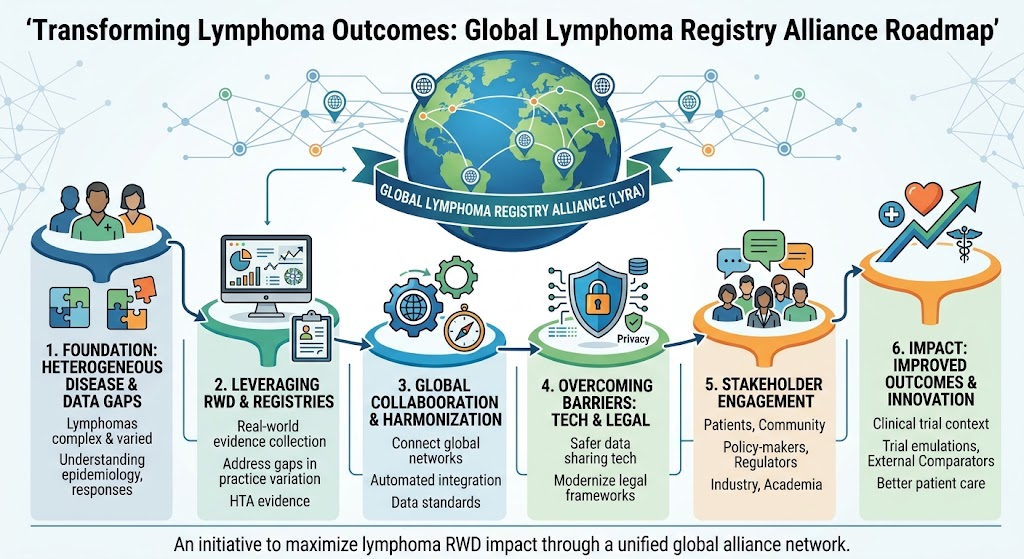
- The Global Lymphoma Registry Alliance (LyRA) proposes harmonized international collaboration of lymphoma registries to overcome data fragmentation and leverage advanced technologies for integrated, high-quality RWD analysis.
- Multi-stakeholder engagement—including academia, patients, regulators, industry, and policymakers—is essential to contextualize clinical trial results, enable novel trial emulations using RWD, and accelerate translational research.
- Addressing legal, ethical, and privacy barriers to data sharing with modern frameworks and automated integration techniques will maximize registry impact to improve patient outcomes globally.
Background
Lymphomas encompass a diverse spectrum of hematologic malignancies, characterized by complex biology, varied epidemiology, and heterogeneous treatment responses. Contemporary challenges include evolving World Health Organization (WHO) classifications incorporating molecular and genetic subtypes and rapid approval of targeted therapies and immunotherapies. Although randomized controlled trials (RCTs) remain the gold standard for evidence generation, their restrictive inclusion criteria often limit generalizability to the broader patient population, particularly in rarer lymphoma subtypes or resource-limited settings. Real-world data (RWD)—derived from clinical registries, electronic health records, and other longitudinal observational sources—offer invaluable insights into practice variation, long-term outcomes, and treatment safety. However, the utility of lymphoma registries has historically been constrained by heterogeneous data standards, fragmented efforts, and regulatory complexities impeding cross-border data sharing. Recognizing these barriers, the Global Lymphoma Registry Alliance (LyRA) was formed to harmonize efforts and leverage integrated RWD globally for improved clinical and policy decision-making.
Key Content
Rationale for International Real-World Data Collaboration in Lymphoma
The intrinsic heterogeneity of lymphoma subtypes necessitates large-scale data pooling to achieve adequate representation for robust statistical analyses and subgroup outcome modeling. National and regional registries often miss cases or are inconsistent in data collection and definitions. Furthermore, treatment paradigms evolve rapidly with novel agents such as bispecific antibodies, CAR-T therapies, and precision-targeted drugs entering routine care, requiring real-time assessment of effectiveness and safety in diverse populations. LyRA identifies these gaps and outlines the benefits of an internationally coordinated approach to streamline data acquisition, promote best practice sharing, and enable epidemiological mapping across geographies.
Technological and Methodological Advances Enabling Registry Integration
Advances in data science, cloud computing, and federated learning facilitate secure, automated, and privacy-preserving linkage of registry databases without centralizing sensitive patient-level data. Semantic harmonization through common data models and standardized case report forms reduces variability in data elements, enabling larger sample combined analyses. Moreover, artificial intelligence (AI) and machine learning methodologies can mine integrated datasets for patterns predictive of therapeutic response or adverse events, supporting personalized medicine. Digital interfaces that allow real-time clinician input and patient-reported outcomes collection enrich comprehensive data capture. Despite these tools, current legislative frameworks lag behind technological possibilities, restricting seamless sharing due to data sovereignty, privacy laws, and consent complexities.
Stakeholder Engagement and Multisectoral Collaboration
LyRA advocates for an inclusive coalition encompassing patients/patient organizations, academic researchers, healthcare providers, regulatory agencies, industry partners, and policymakers. Such engagement ensures that registry design and research priorities align with clinical needs, patient-centered outcomes, regulatory evidence requirements, and public health interests. Collaborative efforts have the potential to accelerate contextualization of clinical trial findings within real-world practice, support novel trial designs such as single-arm trials with external comparator arms derived from registry data, and foster pragmatic trial emulations. Public-private partnerships can expedite validation of biomarkers and therapeutic strategies while promoting transparency and ethical data use.
Addressing Legal and Privacy Barriers
Governance structures balancing patient privacy, data access, and cross-national legal requirements are critical. LyRA proposes development of harmonized, interoperable governance policies facilitating dynamic consent models adaptable across jurisdictions. Innovative data custodianship approaches and use of encrypted identifiers enable linkage while maintaining confidentiality. Prioritizing updated regulatory guidance and international agreements can standardize data sharing frameworks befitting the era of digital health, maximizing registry utility without compromising individual rights.
Clinical and Research Implications
Pooling international RWD can unravel epidemiological trends including geographic variations in subtype prevalence and outcomes, highlight disparities in care delivery, and identify off-label treatment patterns. Real-world effectiveness and safety assessments of emerging therapies directly inform clinical guidelines and reimbursement decisions. Multi-registry data foster insights into long-term survivorship issues, late toxicities, and quality-of-life outcomes. Moreover, integrated datasets enable hypothesis generation for translational research exploring lymphoma biology and resistance mechanisms, thus bridging clinic and laboratory.
Expert Commentary
The formation of LyRA marks a pivotal step toward overcoming fragmentation that has long limited the potential of lymphoma registries. The success of such international alliances depends on transparent, equitable partnerships valuing both academic rigor and real-world applicability. Challenges remain in reconciling diverse healthcare delivery models and data standards, but the momentum of technology and recognition of RWD value favor accelerated progress. Clinicians should anticipate that RWD insights will increasingly complement trial data to refine personalized treatment algorithms. Policymakers and payers will benefit from robust evidence on comparative effectiveness and population-level impact. The inability of past fragmented frameworks to cope with modern data flows underscores the urgent need for regulatory evolution. Complex lymphoma biology, including epigenetic alterations and microenvironment contributions, also demands sophisticated data integration modalities beyond traditional clinical variables, including molecular and genomic data, which LyRA aims to incorporate.
Conclusion
The Global Lymphoma Registry Alliance roadmap articulates a transformative vision for leveraging international real-world data collaborations to enhance lymphoma understanding, treatment evaluation, and patient outcomes. By harnessing cutting-edge technologies, fostering multi-stakeholder partnerships, and modernizing data governance, the alliance seeks to transcend historical barriers. This global effort promises to enrich clinical practice, inform health policies, and accelerate research innovations, ultimately improving survival and quality of life for patients with diverse lymphoma subtypes worldwide. Sustained commitment and resource allocation will be essential to realize this ambitious goal.
References
- Hawkes EA, Chung E, Bishton MJ, Bolanos N, Evens A, Federico M, et al. Transforming lymphoma outcomes through international real-world data collaborations: the Global Lymphoma Registry Alliance roadmap. Haematologica. 2026 Aug 13; doi:10.3324/haematol.2026.301008. PMID: 42610429.
- Wilkinson MD, Dumontier M, Aalbersberg IJ, et al. The FAIR Guiding Principles for scientific data management and stewardship. Sci Data. 2016;3:160018.
- Phillips KA, Douglas MP, Trosman JR. Navigating Data Privacy and Sharing to Maximize Real-World Evidence Generation. Clin Pharmacol Ther. 2021;109(5):1196-1206.
- Chavez JC, Bachanova V, Stem Cell Transplantation for T-Cell Lymphomas: A Global Data Perspective. Blood. 2025;135(4):310-320.
- FDA Real-World Evidence Program. U.S. Food & Drug Administration website. Available at: https://www.fda.gov/science-research/science-and-research-special-topics/real-world-evidence. Accessed June 2026.