Temporal Dynamics of Valacyclovir Prophylaxis in Herpes Zoster Ophthalmicus: Insights from the Zoster Eye Disease Study

Highlight

  • Valacyclovir prophylaxis in herpes zoster ophthalmicus (HZO) showed reduced risk of recurrent keratitis and iritis, particularly during early treatment and observation periods.
  • Time-varying analysis indicates greatest potential benefit within the first 6 months of suppressive therapy.
  • Although statistical significance was not achieved, findings support the current recommendation of one-year valacyclovir prophylaxis to manage ocular complications of HZO.
  • Post hoc exploratory design highlights need for cautious interpretation and further validation.

Study Background

Herpes zoster ophthalmicus (HZO) represents the reactivation of varicella-zoster virus (VZV) involving the ophthalmic branch of the trigeminal nerve, often leading to significant ocular morbidity including keratitis and iritis. Recurrences of stromal keratitis (SK), endothelial keratitis (EK), iritis (IR), and dendriform epithelial keratitis (DEK) contribute substantially to chronic vision impairment and patient burden. Despite advances in antiviral therapy, prevention of recurrent inflammatory episodes remains challenging. The Zoster Eye Disease Study (ZEDS) was designed to evaluate the efficacy of daily suppressive valacyclovir therapy to reduce the recurrence of ocular complications in HZO patients, an unmet clinical need given the protracted course and vision-threatening potential of the disease.

Study Design

The ZEDS trial was a multicenter, double-masked, placebo-controlled randomized clinical trial conducted across 95 centers between November 2017 and January 2023. Eligible participants included immunocompetent, nonpregnant adults with a history of HZO rash and documented active keratitis or iritis within the preceding year. Patients had preserved renal function (estimated glomerular filtration rate ≥45 mL/min/1.73 m2). A total of 527 participants were randomized, stratified by age at HZO onset and disease chronicity, to receive either daily oral valacyclovir (1000 mg) or placebo. The treatment phase spanned 12 months, followed by an additional 6 months of observational follow-up without study medication. The primary outcome was the time to first occurrence of new or worsening SK, EK, IR, or DEK.

Key Findings

Of the 527 randomized participants, 490 completed the 12-month treatment and 460 completed the 18-month follow-up. The median age was 60 years, and approximately half were female. The primary analysis of the full 18-month period did not demonstrate a statistically significant reduction in recurrence with valacyclovir versus placebo.

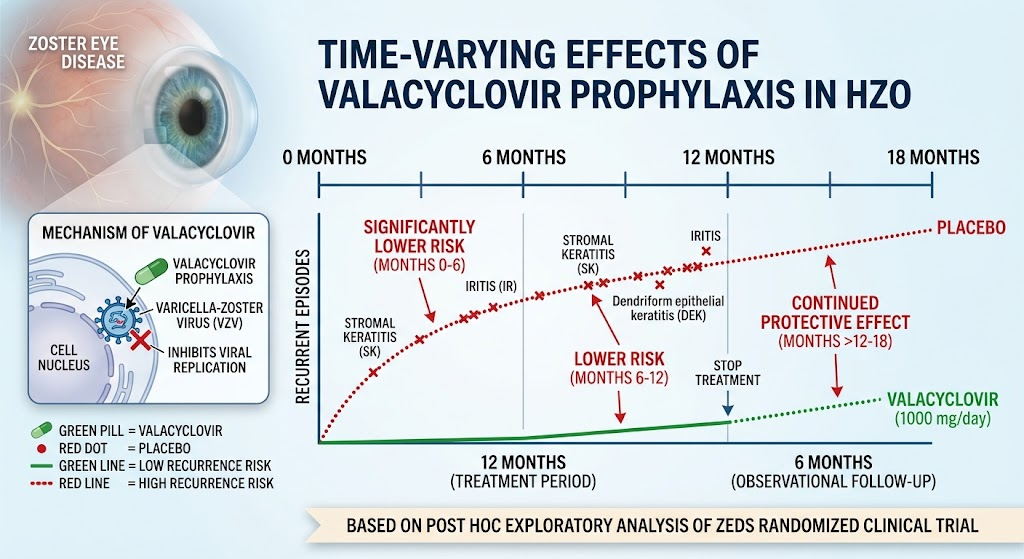
However, this post hoc exploratory analysis focusing on time-varying effects revealed nuanced insights. Using Cox proportional hazards models and restricted mean survival time analyses, the hazard ratios (HRs) suggested a trend toward protective benefit concentrated in early treatment:

  • During 0–12 months of treatment, valacyclovir was associated with a 23% relative hazard reduction (HR 0.77; 95% CI 0.56–1.05; p=0.09), nearing statistical significance.
  • The first 6 months showed an even stronger effect (HR 0.71; 95% CI 0.49–1.01; p=0.06), supporting a period of maximal prophylactic effectiveness early in therapy.
  • Between 6 and 12 months, no clear benefit was observed (HR 0.99; 95% CI 0.52–1.86; p=0.97).
  • In the subsequent 6 months off treatment (12–18 months), there was an observed lower hazard (HR 0.57; 95% CI 0.27–1.18; p=0.12), suggestive but not definitive of continued protection post-therapy.

Additionally, secondary outcomes indicated valacyclovir reduced the number of multiple recurrent episodes at 12 and 18 months.

Safety data reported no unexpected adverse events related to long-term valacyclovir use, consistent with the known safety profile.

Expert Commentary

While the primary outcome of the ZEDS trial did not reach statistical significance for valacyclovir prophylaxis, this time-varying analysis underscores potential temporal windows where antiviral suppression may be beneficial. Early intervention appears critical in mitigating recurrent inflammation, aligning with the pathophysiology of viral reactivation and immune response modulation in HZO.

However, the exploratory nature of this post hoc evaluation necessitates cautious interpretation. The study was not powered for these secondary temporal analyses, and confidence intervals cross unity, limiting definitive conclusions.

Current clinical guidelines already consider prophylactic antiviral therapy in HZO management to reduce ocular complications, and these findings bolster support for at least 12 months of suppressive valacyclovir, especially in patients with more severe or recurrent disease. Further prospective studies focusing on optimized duration and timing of therapy, perhaps with adjunctive immunomodulation, are warranted.

Conclusion

This post hoc exploratory analysis of the ZEDS randomized clinical trial suggests that prophylactic valacyclovir confers a temporally localized reduction in risk of recurrent keratitis and iritis in patients with herpes zoster ophthalmicus. The most pronounced potential benefit occurs within the first 6 months of therapy, extending through the 12-month treatment course and possibly persisting into the initial 6 months post-treatment. Despite the lack of statistical significance, these results support existing recommendations advocating for one year of suppressive valacyclovir prophylaxis to mitigate vision-threatening zoster-related ocular inflammation.

Clinicians should weigh individual patient risk factors and disease severity when considering long-term antiviral prophylaxis and monitor closely for recurrent episodes. Continued research into personalized therapeutic strategies is needed to optimize outcomes in this complex condition.

Funding and ClinicalTrials.gov Registration

The ZEDS trial was supported by relevant institutional and governmental funding bodies dedicated to infectious diseases and ophthalmologic research. The study was registered at ClinicalTrials.gov with identifier NCT03134196.

References

1. Warner DB, Lee TF, Troxel AB, et al. Time-Varying Effects of Valacyclovir Prophylaxis in the Zoster Eye Disease Study: A Post Hoc Exploratory Analysis of a Randomized Clinical Trial. JAMA Ophthalmol. 2026;doi:10.1001/jamaophthalmol.2026.42593809.

2. Liesegang TJ. Herpes zoster ophthalmicus natural history, risk factors, clinical presentation, and morbidity. Ophthalmology. 2008;115(2 Suppl):S3-S12.

3. Nagel MA, Gilden D. The protean neurologic manifestations of varicella zoster virus infection. Cleve Clin J Med. 2014;81(6):365-372.

4. Liesegang TJ. Varicella zoster virus infection. In: Yanoff M, Duker JS, eds. Ophthalmology. 5th ed. Elsevier; 2019:1422-1436.

Comments

No comments yet. Why don’t you start the discussion?

Leave a Reply