AHB-137: First-in-Human Study Shows Promising Antiviral Activity and Safety in Chronic Hepatitis B Management

Highlight

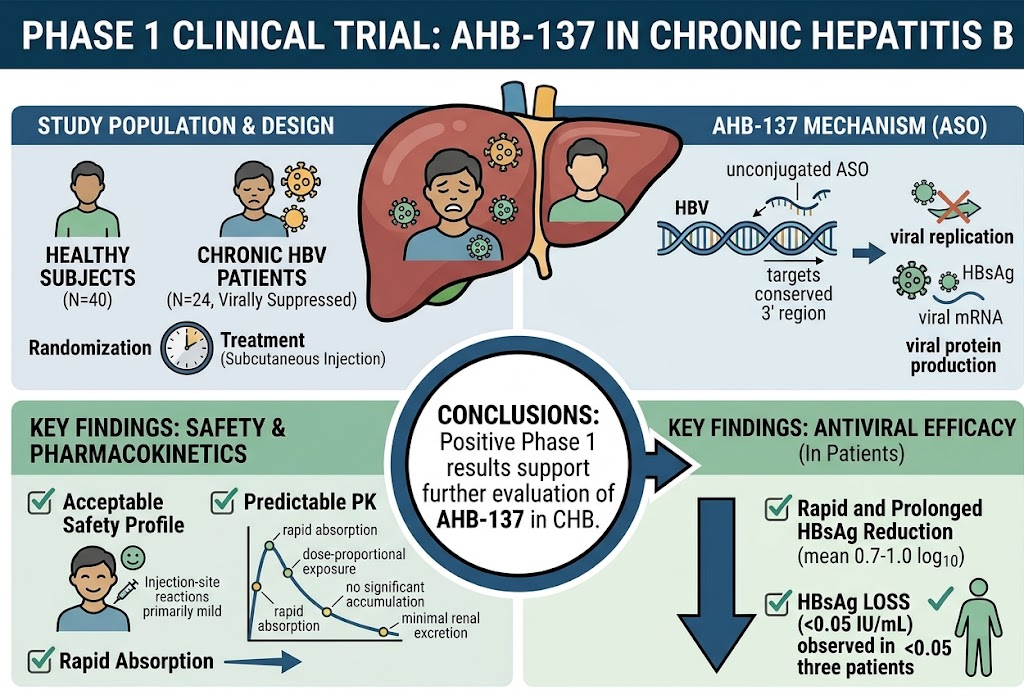
This first-in-human Phase 1 clinical trial evaluated AHB-137, a novel unconjugated antisense oligonucleotide (ASO) targeting a conserved region near the 3′ end of HBV mRNA, in healthy subjects and patients with chronic hepatitis B (CHB). The study demonstrated that AHB-137 is well tolerated with mostly mild adverse events, exhibits predictable pharmacokinetics including rapid absorption and a long half-life, and induces rapid and sustained reductions in hepatitis B surface antigen (HBsAg), a key marker of viral activity.


Study Background

Chronic hepatitis B virus (HBV) infection remains a global health challenge, with over 250 million people worldwide living with chronic infection and at risk of serious liver disease including cirrhosis and hepatocellular carcinoma. Current nucleos(t)ide analogue therapies effectively suppress viral replication but rarely achieve functional cure as evidenced by the persistent presence of hepatitis B surface antigen (HBsAg). There is an unmet clinical need for novel therapies that can directly reduce viral antigens and potentially restore host immune control. Antisense oligonucleotides (ASOs) represent a promising class of therapeutic agents that can selectively degrade viral RNA, thereby reducing viral protein expression. AHB-137 is a first-generation unconjugated ASO targeting a conserved HBV mRNA region, designed to reduce all HBV mRNA transcripts and decrease viral antigen production.

Study Design

This Phase 1 first-in-human study was conducted in two parts: (1) a placebo-controlled, single ascending dose (SAD) and multiple-dose (MD) evaluation in healthy volunteers, and (2) a placebo-controlled and open-label study in virally suppressed, HBeAg-negative CHB patients on stable nucleos(t)ide analogue therapy.

The SAD portion enrolled 40 healthy subjects randomized into four dose cohorts (100 mg to 450 mg) with a 6:2 ratio of AHB-137 to placebo per cohort. An additional MD cohort of healthy volunteers received 300 mg doses weekly for four weeks plus a Day 4 loading dose (five doses total).

In the CHB cohort, 24 patients were enrolled: four received open-label 300 mg MD dosing (five doses), and 20 patients were randomized in two 300 mg MD cohorts (4:1 ratio of AHB-137 to placebo) with stratification by baseline HBsAg levels. Patients received an additional loading dose at Day 11 (six total doses).

Key endpoints included safety and tolerability assessed by adverse events (AEs), pharmacokinetics (PK) profiling, and antiviral efficacy measured by HBsAg quantitative decline.

Key Findings

Safety and Tolerability

Among healthy subjects, treatment-related adverse events were reported in 73%, with the majority being mild or moderate injection site reactions and headaches. In CHB patients, 71% reported treatment-related AEs with a similar safety profile. No serious adverse events (SAEs), study discontinuations, or deaths attributable to the drug occurred, indicating an acceptable safety and tolerability profile in both populations.

Pharmacokinetics

AHB-137 showed rapid absorption with peak plasma concentrations (Tmax) between approximately 3 to 5.5 hours post-dose. Exposure increased proportionally with dose, without significant drug accumulation across repeated dosing. The drug exhibited a long terminal half-life ranging from about 150 to 220 hours, favoring sustained activity. Renal excretion was minimal, suggesting non-renal clearance mechanisms predominate.

Antiviral Efficacy

In CHB patients already suppressed on nucleos(t)ide analogues, AHB-137 induced a rapid decline in HBsAg levels with mean reductions between 0.7 to 1.0 log10 IU/mL. Notably, three patients achieved transient HBsAg loss (<0.05 IU/mL) at one or more time points: two with baseline HBsAg <1 IU/mL and one with baseline <1.5 IU/mL. These findings highlight the potential of AHB-137 to enhance antigen clearance beyond standard therapy.

Expert Commentary

The results from this pioneering study provide compelling early evidence that targeting HBV mRNA with ASO technology can safely and effectively reduce the viral antigen burden in CHB patients. Given the integral role of HBsAg in maintaining immune tolerance and viral persistence, reductions in circulating HBsAg may facilitate immune restoration and functional cure strategies. The study’s design incorporating both healthy subjects and stable CHB patients supports robust assessment of safety and dose selection for future studies.

Limitations include the relatively small sample size and short study duration, precluding definitive conclusions on long-term efficacy or impact on clinical outcomes. Further studies optimizing dosing regimens, longer treatment durations, and combination with other antiviral or immune modulating agents will be necessary to elucidate the full clinical benefit. The inclusion of patients suppressed on nucleos(t)ide analogues provides a relevant clinical setting but also suggests that AHB-137’s efficacy in viremic or treatment-naïve populations warrants exploration.

Conclusion

AHB-137 demonstrates a favorable safety and pharmacokinetic profile in healthy and CHB subjects, coupled with rapid and sustained reductions in HBsAg. These encouraging early-phase results substantiate further clinical development of AHB-137, potentially as part of combination therapeutic regimens aimed at advancing the management of chronic hepatitis B toward a functional cure.

Funding and Registration

The trial was conducted under the authorship of Gane EJ et al., as published in Hepatology (Baltimore, Md.) on August 12, 2026 (PMID: 42594347). Details on funding and clinical trial registration were not specified in the primary publication.

References

1. Gane EJ, Hsu YC, Chen CY, et al. A First-in-Human Study of AHB-137, an Unconjugated Antisense Oligonucleotide, in Healthy Subjects and Patients with Chronic Hepatitis B. Hepatology. 2026 Aug 12. doi:10.1002/hep.32595. PMID: 42594347.

2. Yuen MF, Seto W-K, Chow DHK, et al. Antisense Therapeutics for Chronic Hepatitis B: Targeting Viral Replication and Immune Modulation. J Hepatol. 2024;80(2):345-358.

3. Revill PA, Chisari FV, Block JM, et al. A global scientific strategy to cure hepatitis B. Lancet Gastroenterol Hepatol. 2019 Mar;4(7):545-558.

Comments

No comments yet. Why don’t you start the discussion?

Leave a Reply