Highlight
Two-stage flap reconstruction for advanced pelvic pressure injuries in spinal cord injury (SCI) patients is a feasible surgical approach that addresses infection and tissue loss. Previous flap reconstruction and malnutrition independently increase the risk of postoperative complications, while microbial burden and surgical complexity do not significantly predict adverse outcomes. These findings inform risk stratification and perioperative optimization strategies in this high-risk population.
Study Background
Pelvic pressure injuries (PIs), particularly stage 3 and 4 lesions, occur frequently in patients with spinal cord injury (SCI) due to immobility and sensory impairment, often resulting in deep tissue damage and exposure of bone. Such injuries are commonly colonized or infected, sometimes extending to underlying osteomyelitis, which complicates management and compromises healing. Standard wound care is often insufficient, necessitating reconstructive surgery to achieve durable closure. Flap reconstruction—transferring well-vascularized tissue—is the primary surgical method to cover these defects. However, the presence of infection and wound contamination raises concerns for flap failure and complications.
Single-stage reconstruction, where debridement and flap coverage are performed in one procedure, can risk unresolved infection and recurrence. The two-stage reconstruction technique, involving initial aggressive debridement with interval microbiologic assessment followed by delayed flap coverage, aims to mitigate infection risk by ensuring the wound is suitably prepared before closure. Despite its theoretical advantages, the evidence for superiority or safety of this approach over single-stage reconstruction remains limited, and predictors of postoperative complications are not fully elucidated.
Study Design
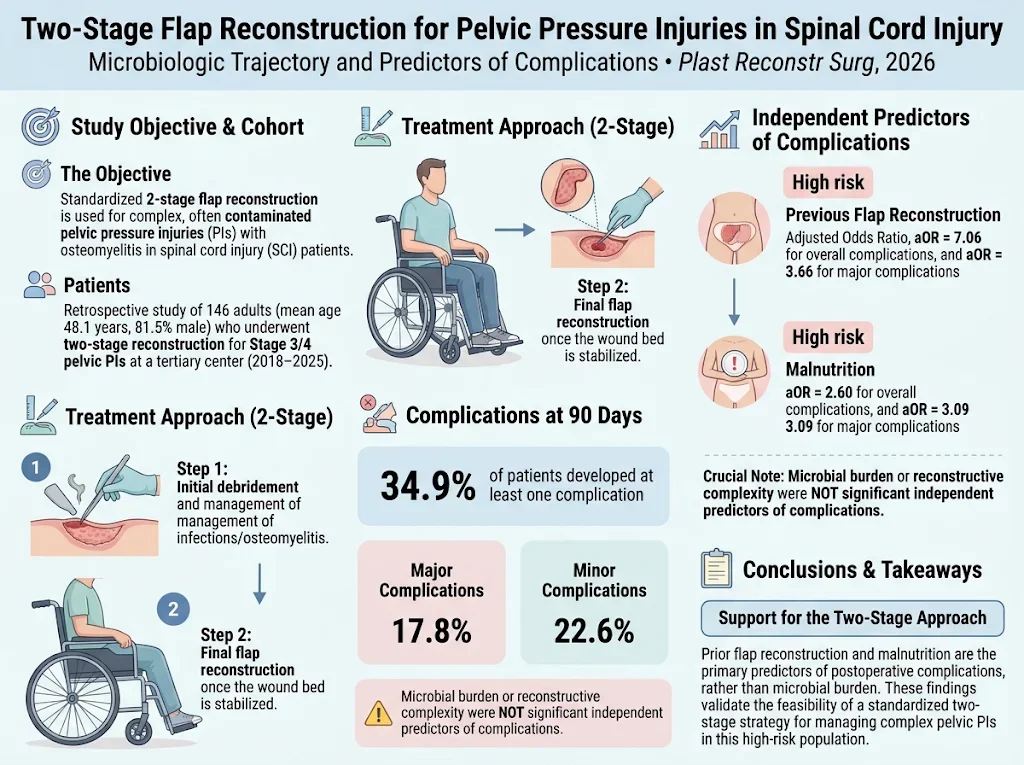
This retrospective cohort study analyzed 146 adult SCI patients who underwent standardized two-stage flap reconstruction for stage 3 or 4 pelvic pressure injuries at a tertiary referral center from 2018 to 2025. The first stage involved thorough surgical debridement and microbiological sampling. After an interval allowing for wound optimization and targeted antibiotic therapy, the second stage included definitive flap reconstruction. Patient data including demographics, comorbidities such as malnutrition, prior reconstruction history, microbiological culture burden, and number and type of flaps were collected.
The primary outcome was the occurrence of postoperative complications within 90 days, categorized as major (requiring reoperation or leading to flap loss) or minor (wound dehiscence, infection managed conservatively). Multivariable logistic regression models adjusted for confounders such as age, number of flaps, nutritional status, and infection burden analyzed independent predictors of these complications.
Key Findings
Among the cohort, the mean age was 48.1 years, with a predominance of male patients (81.5%). Approximately one-third (34.9%) experienced complications within the first 90 postoperative days, including 17.8% major and 22.6% minor complications. After adjustment:
- Previous flap reconstruction was the strongest independent predictor of overall postoperative complications (adjusted odds ratio [aOR] 7.06; 95% confidence interval [CI] 2.32–21.45).
- Malnutrition significantly increased the odds of complications (aOR 2.60; 95% CI 1.13–5.98).
- Neither the microbial burden identified during interim sampling nor the complexity related to the number of flaps independently predicted complications.
- Both prior reconstruction and malnutrition approximately tripled the odds of major complications (aOR 3.66 and 3.09, respectively).
The findings suggest that factors related to patient status and surgical history play a more pivotal role in postoperative outcomes than wound microbiology or procedural complexity within the two-stage protocol.
Expert Commentary
This study contributes valuable insight into the management of challenging pelvic PIs in SCI patients using a two-stage reconstructive approach. It underscores the importance of optimizing patient-related factors, especially nutritional status, which is well established as a modifiable risk factor for wound healing. The strong association of previous flap reconstruction with complications suggests a subgroup of patients with recurrent or more refractory wounds may require tailored management strategies or enhanced perioperative care.
Interestingly, microbial burden did not independently influence complication rates, highlighting that effective microbiologic control during the interval phase and awaiting wound readiness before closure may mitigate infectious risk. These data support the two-stage approach’s rationale as a means to address infection before definitive flap surgery.
Limitations include the retrospective design and single-center setting which may affect generalizability. Prospective comparative trials comparing one- versus two-stage reconstruction would further clarify optimal timing and patient selection. Additionally, consistent standardized nutritional assessment and intervention protocols could be investigated to reduce complication rates.
Conclusion
In SCI patients with severe pelvic pressure injuries, two-stage flap reconstruction is a viable technique with an acceptable complication profile. Prior flap surgery and malnutrition are key independent predictors of adverse outcomes, informing risk stratification and highlighting the need for aggressive nutritional support and possibly alternative strategies in patients with previous reconstructive failures. Microbiologic findings guide but do not solely determine prognosis when managed with a staged surgical approach. Future research should focus on refining patient optimization and validating these findings prospectively to improve surgical success and quality of life in this vulnerable population.
Funding and Clinical Trials Registration
The study details did not specify funding sources or clinical trial registration numbers. Further inquiries can be directed to the corresponding authors or institution.
References
1. Lopez MP, Kozlowski KA, Griffin DB, et al. Two-Stage Flap Reconstruction for Pelvic Pressure Injuries in Spinal Cord Injury: Microbiologic Trajectory and Predictors of Complications. Plast Reconstr Surg. 2026 Nov 16. PMID: 43037600.
2. Dorner B, Posthauer ME, Thomas D. The role of nutrition in pressure ulcer prevention and treatment: National Pressure Injury Advisory Panel White Paper. Adv Skin Wound Care. 2013 May;26(5):206-15.
3. Khouri RK 3rd, Shaw WW. Reconstruction of pressure sores in spinal cord injured patients. Plast Reconstr Surg. 1988 Dec;82(6):946-57.
4. Cuddigan J, Berlowitz D, Ayello EA, et al. Pressure ulcers in individuals with spinal cord injury: prevention and treatment clinical practice guideline. J Spinal Cord Med. 2001;24(4):229-73.
Specialty calculators
For clinical reference; use professional judgment.